
Mexican gray wolf
Canis lupus baileyi · Arizona, New Mexico & northern Mexico
319 in the US, 45 in Mexico
The most endangered gray wolf in North America: rebuilt from seven survivors, and now waiting to learn whether it keeps its legal protection.
Source: 2026 estimate · US & Mexico recovery programmes
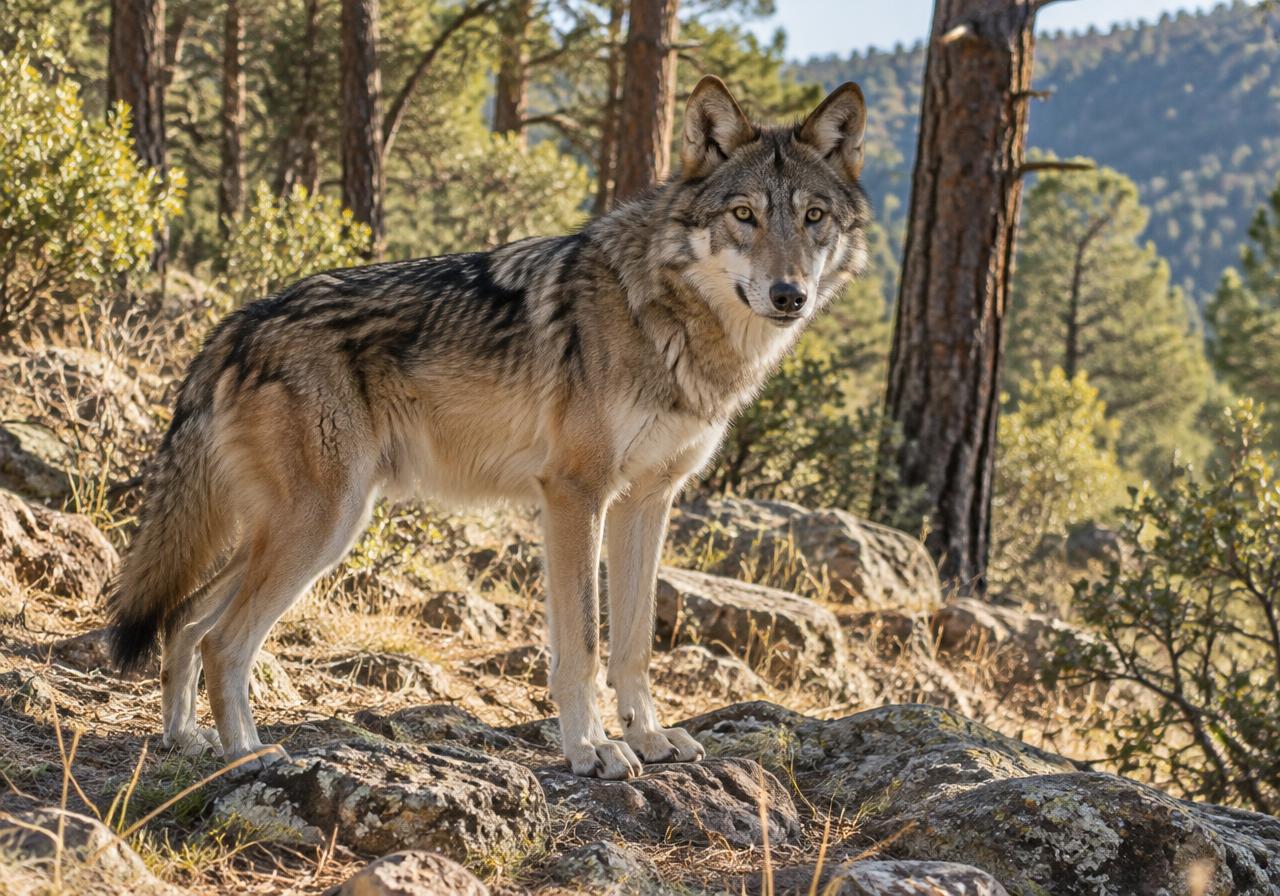 Illustrative depiction
Overview
The lobo that came back from seven
The Mexican gray wolf, or lobo, is the smallest subspecies of gray wolf and the most endangered in North America. Its ancestors crossed from Eurasia into North America between about 70,000 and 23,000 years ago. Its sister group, the Beringian wolf, went extinct; the lobo survived.
Lobos once roamed the Madrean pine-oak woodlands of southeastern Arizona, New Mexico, western Texas and Mexico's Sierra Madre Occidental, hunting white-tailed deer. In pre-Columbian Mexico the wolf was revered as a symbol of war and of the sun, and it held significance for the Apache. By the mid-1900s, trapping, poisoning and hunting, largely by ranchers, had all but wiped it out, and pups were taken from dens.
Listed under the Endangered Species Act in 1976, the lobo was saved when the US and Mexico captured the last five wild wolves between 1977 and 1980. Two more were added in 1995, so every Mexican wolf alive today descends from just seven animals. Releases began in Arizona's Blue Range Wolf Recovery Area in 1998, a wild-born generation followed by 2002, and Mexico began its own releases in 2011. Today an estimated 319 lobos live in the US and 45 in Mexico, with about 380 more in captivity.
Low genetic diversity is a serious threat, but unlike the critically endangered red wolf, the lobo does not breed with coyotes in the wild. On 4 September 2026 an executive order started a 90-day review to remove Endangered Species Act protection for gray wolves; it ends in early December 2026. For now the lobo remains protected, and Earthjustice is fighting in the courts to keep it that way.
Why it is nearly gone
Protection under review, genes stretched thin
Less than 30 years after reintroduction began, the lobo has made real gains, but its future depends on keeping its legal protection.
Loss of legal protection
A federal review started on 4 September 2026 could strip gray wolves of Endangered Species Act protection, opening the door to more killing.
Very low genetic diversity
Every Mexican wolf descends from just seven founders, raising the risk of inbreeding, smaller litters and weaker pups.
Illegal killing and trapping
Shooting, trapping and poisoning, often linked to livestock conflict, remain a leading cause of death for wild lobos.
Lost and fragmented range
Lobos are now absent from most of their original range, confined to a few recovery areas cut through by roads and ranchland.
Conservation history
From extinction in the wild to a federal review
| Year | Event |
|---|---|
| Mid-1900s | Trapping, poisoning and hunting, largely to protect livestock, wipe lobos out of the wild; pups are also taken from dens. |
| 1976 | Listed as endangered under the US Endangered Species Act. |
| 1977–1980 | The US and Mexico capture the last five wild Mexican wolves to start captive breeding. |
| 1982 | First Mexican wolf recovery plan completed. |
| 1995 | Two more founders are added; every living Mexican wolf descends from these seven animals. |
| 1998 | Eleven captive-born wolves are released in the Blue Range Wolf Recovery Area, Arizona. |
| 2002 | The first wild-born generation appears. |
| 2011 | Mexico begins reintroductions in the Sierra Madre Occidental. |
| Sept 2026 | An executive order starts a 90-day review to remove gray wolf ESA protection, ending in early December 2026; Earthjustice is challenging it in court. |
| 2026 | An estimated 319 wolves in the US and 45 in Mexico, with about 380 more in captive facilities. |
Take action
Who's fighting for the lobo
These groups are defending the lobo in court, breeding wolves for release and fostering captive-born pups into wild dens.
Center for Biological Diversity
Legal advocacy group fighting in the courts to protect lobos and the Endangered Species Act.
Earthjustice
Fighting in court to defend gray wolves and their Endangered Species Act protection.
Humane World for Animals
Brought the lawsuit against the previous attempt to remove Endangered Species Act protection for gray wolves.
Defenders of Wildlife
Campaigning and on-the-ground work to help Mexican gray wolves and ranchers coexist.
Wolf Conservation Center
New York centre caring for and breeding Mexican gray wolves for release.
Endangered Wolf Center
Missouri centre running a pup-fostering programme that places captive-born pups into wild dens.
Everyday actions
What you can do from home
- 01
Speak up before the review ends
Public comments and letters to officials matter while the ESA review is open, until early December 2026.
- 02
Support wolf-friendly ranching
Back ranchers who use range riders, fencing and guard animals to keep livestock and wolves apart.
- 03
Adopt or sponsor a lobo
Symbolic adoptions fund the captive breeding that keeps the lobo's small gene pool alive.
- 04
Share the lobo's story
Many people don't know North America has its own critically rare gray wolf — or that its protection is under review.
Selected references
- The Wildlife Society — Wolves: we've been here before
- Center for Biological Diversity — Mexican gray wolf action timeline
- Association of Zoos and Aquariums — Safe Mexican wolf expands reach through partnerships with community-driven conservation organizations
- Wolf Conservation Center — As agencies pursue Mexican wolf downlisting, coalition urges New Mexico to close protection gaps
- Turnbull, T.T., Cain III, J.W. and Roemer, G.W. (2013). Anthropogenic impacts to the recovery of the Mexican gray wolf with a focus on trapping-related incidents. Wildlife Society Bulletin, 37(2), 311–318.