Red wolf
Canis rufus · North Carolina, USA
plus 4 wild litters
America’s own wolf: hunted out of the wild by 1980, brought back to one corner of North Carolina, and still on the brink.
Source: US Fish & Wildlife Service · IUCN Red List
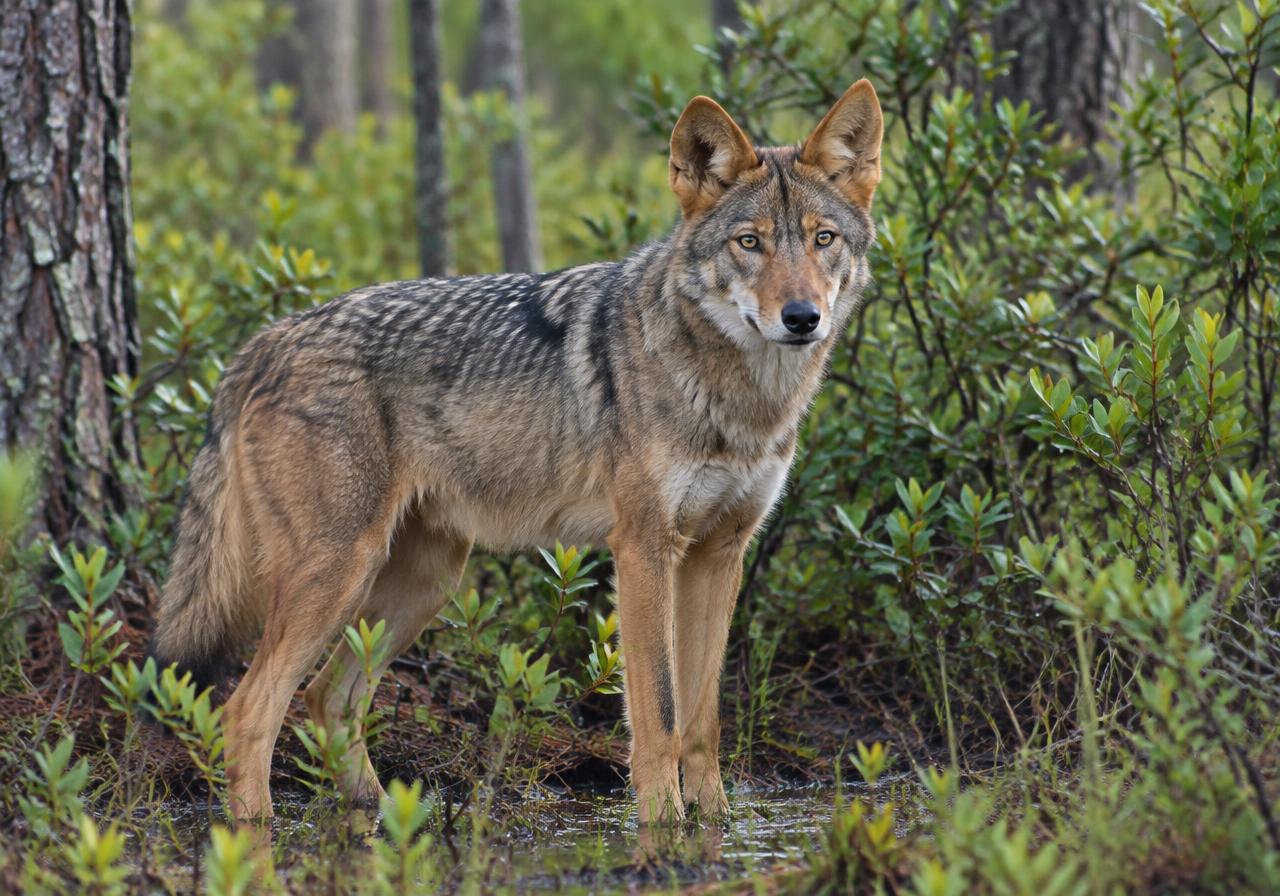 Illustrative depiction
Overview
A devoted family wolf
Red wolves are smaller than grey wolves and larger than coyotes, with long slender legs, a narrow head and a tawny-grey coat touched with cinnamon behind the ears, on the muzzle and on the legs. They mate for life, and older siblings help their parents raise each year's pups.
Pups are born in hidden dens between March and May, leave the den at about six weeks, reach full size at one year and can breed at three. Young wolves then leave home to find an unrelated mate, which normally keeps the population healthy.
Red wolves once lived from Texas to Pennsylvania in river forests, marshes and swamps. Today the only wild population lives in the pine wetlands of eastern North Carolina, hunting deer, raccoons, rabbits and nutria. Scientists still debate how closely red wolves are related to grey wolves and coyotes; the IUCN treats them as a separate species.
Why it is nearly gone
Shot, squeezed and swamped by coyotes
The wild population climbed to over 100 by 2012, then crashed to 14 by 2019.
Illegal shooting
About a quarter of red wolf deaths in North Carolina are illegal shootings, often by hunters mistaking them for coyotes.
Breeding with coyotes
With few red wolves to pair with, lone wolves mate with coyotes, diluting the red wolf's genes.
Broken-up habitat
Small forest patches surrounded by farms and roads stop young wolves from finding unrelated mates.
Vehicle strikes
Roads through the recovery area kill wolves every year.
Conservation history
Wiped out, brought back, nearly lost again
| Year | Event |
|---|---|
| Before 1600s | Widespread across the eastern United States, from Texas to Pennsylvania |
| 1800s–1930s | Bounties and predator-control campaigns wipe out most red wolves; over 800 caught in Texas in 1939 alone |
| 1970s | Fewer than 100 left, on the Texas–Louisiana border |
| 1973 | Listed as endangered under the US Endangered Species Act |
| 1974–80 | The last wild wolves are captured; only 14 prove to be pure red wolves |
| 1977 | First litter born in captivity |
| 1980 | Declared extinct in the wild |
| 1987 | Reintroduced to Alligator River National Wildlife Refuge, North Carolina |
| 1989 | A release in the Great Smoky Mountains fails |
| 2012 | Wild population peaks at over 100 |
| 2014 | Night-time coyote hunting banned across five counties |
| 2019 | Wild population collapses to 14 |
| Today | ~22–23 wild adults, with 4 wild litters of up to 16 pups |
Take action
Who's fighting for the red wolf
Recovery depends on breeding in zoos, placing captive-born pups into wild litters, and holding territory with sterilised coyotes until red wolves can take it back.
Wolf Conservation Center
Captive breeding, public education and campaigning for red wolf recovery
Center for Biological Diversity
Legal action and campaigning to protect red wolves and their habitat
Point Defiance Zoo & Aquarium
Founded the red wolf breeding programme with the last 14 pure wolves
Everyday actions
What you can do from home
- 01
Choose FSC-certified wood and paper
Responsibly managed forests keep the southeastern woodlands red wolves need.
- 02
Back predator-friendly farming
Support farmers who protect livestock with guard animals and fencing instead of killing predators.
- 03
Speak up for the recovery programme
Public comments and letters to officials have kept the red wolf programme alive.
- 04
Share the red wolf's story
Many Americans don't know their country has its own critically endangered wolf.
Selected references