Yangtze giant softshell turtle
Rafetus swinhoei · China & Vietnam
one male at Suzhou Zoo, China; one wild in Vietnam
The rarest turtle on Earth: a sacred river giant that has outlived empires, now down to its last known survivors.
Source: IUCN Red List
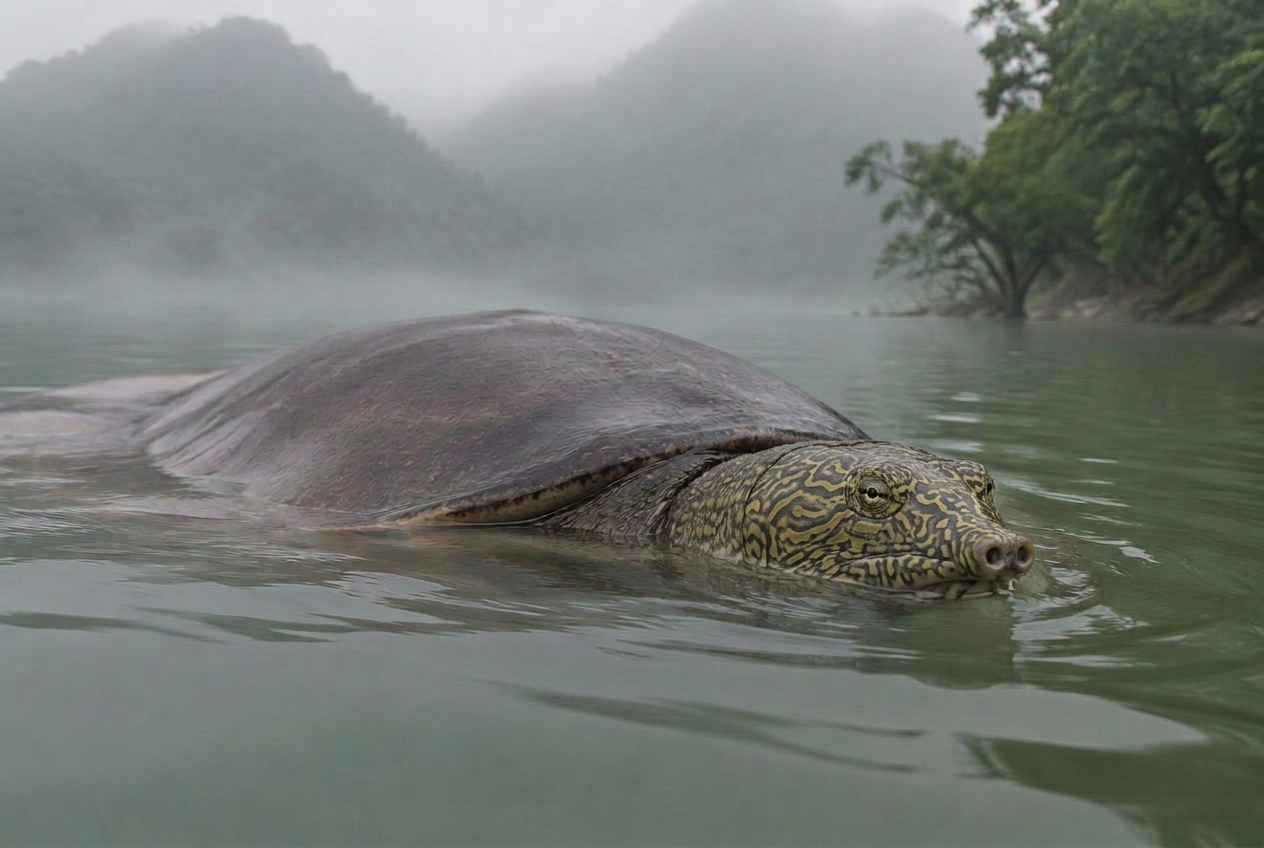 Illustrative depiction
Overview
A river god of East Asia
One of the largest freshwater turtles alive, it has a dark brown, leathery shell, a pig-like snout and eyes set high on its head. A yellow pattern at the corners of its mouth sets it apart from other big softshells. It spends long stretches hidden in deep water, surfacing only briefly to breathe, which makes it very hard to find.
It lived in the Red River basin of China and Vietnam and on the lower Yangtze floodplain. Its genes show its numbers had been shrinking for 10 million years, long before people began hunting it.
In Vietnam it is revered as Kim Qui, the Golden Turtle God. A 15th-century legend tells how Kim Qui gave Emperor Lê Lợi a magic sword to drive out Ming invaders, then took it back in Hanoi's Hoan Kiem Lake. In China it was linked to the water spirits of Lake Taihu and the Yangtze.
Why it is nearly gone
Emptied by trade, dams and nets
In barely a century the turtle went from sacred abundance to just two known survivors.
Hunting and the wildlife trade
Hunted for meat and for traditional medicine made from its shell and bones. Skulls were kept as trophies.
Dams
Twelve major hydroelectric dams on the Red River change its flow and cut off what was left of the turtle's habitat.
Pollution and fishing nets
Industrial runoff fouled the rivers, and turtles drowned in nets and on longlines.
Protection came too late
Without laws in place, hunting went unchecked until the population was past the point of recovery.
Conservation history
From river stronghold to the last few
| Year | Event |
|---|---|
| 1873 | First described by John Edward Gray of the British Museum; already scarce |
| Before 1960s | Found across the Yangtze floodplain and the Red River basin |
| 1960s–80s | Decline from overfishing and the wildlife trade |
| 1980s–90s | Vietnam: wide overharvesting, then a new wave of hunting picks off the last turtles |
| 2005–06 | The individuals at Beijing and Shanghai zoos die |
| 2008–19 | Breeding attempts with the Suzhou Zoo pair produce no viable hatchlings |
| 2018 | Environmental DNA confirms a turtle in Xuan Khanh Lake, Vietnam |
| 2019 | The last known female dies at Suzhou Zoo |
| 2020 | A wild female identified in Dong Mo Lake, Vietnam; a Da River study names 13 possible survival sites |
| 2021 | IUCN reassesses the species as Critically Endangered |
| 2023 | The Dong Mo female is found dead |
| Today | 2 known individuals; functionally extinct |
Take action
Who's searching for survivors
Local hunters believe turtles may still live in Vietnam's Da River. These groups lead the search, the fight against trafficking and the science.
Turtle Survival Alliance
Exploratory visual, drone and camera trap surveys, eDNA analysis, and community outreach and engagement for Rafetus swinhoei
Asian Turtle Program
Environmental DNA sampling, community outreach and search expeditions across Vietnam's lakes and rivers
Everyday actions
What you can do from home
- 01
Avoid wildlife-based remedies
Don't buy medicines or supplements made with turtle shell or cartilage. Demand drives the trade.
- 02
Cut plastic and chemical runoff
Heavy metals and microplastics build up in river mud where turtles live.
- 03
Choose responsibly caught fish
Nets and longlines drown large freshwater turtles.
- 04
Report illegal online sales
Flag listings for wild-caught turtles or turtle products to the platform and wildlife authorities.
Selected references
- IUCN Red List — Rafetus swinhoei (last assessed March 2018)
- IUCN SSC Tortoise and Freshwater Turtle Specialist Group
- Asian Turtle Program
- Turtle Survival Alliance
- Jian, W., Hai-Tao, S., Cheng, W. and Lian-Xian, H. (2013). Habitat selection and conservation suggestions for the Yangtze giant softshell turtle (Rafetus swinhoei) in the Upper Red River, China. Chelonian Conservation and Biology, 12(1), 177–184.
- Van Pham, T., Le Duc, O., Bordes, C., Leprince, B., Ducotterd, C., Zuklin, T., Quang, V.L., Dinh, D.H. and Luiselli, L. (2022). Female wanted for the world's rarest turtle: prioritizing areas where Rafetus swinhoei may persist in the wild. Oryx, 56(3), 396–403.