Vaquita
Phocoena sinus · Upper Gulf of California, Mexico
current estimate
The “little cow” of the sea, and the most endangered marine mammal on Earth. The last few survive in one small patch of the northern Gulf of California.
Source: Sea Shepherd · IUCN Red List
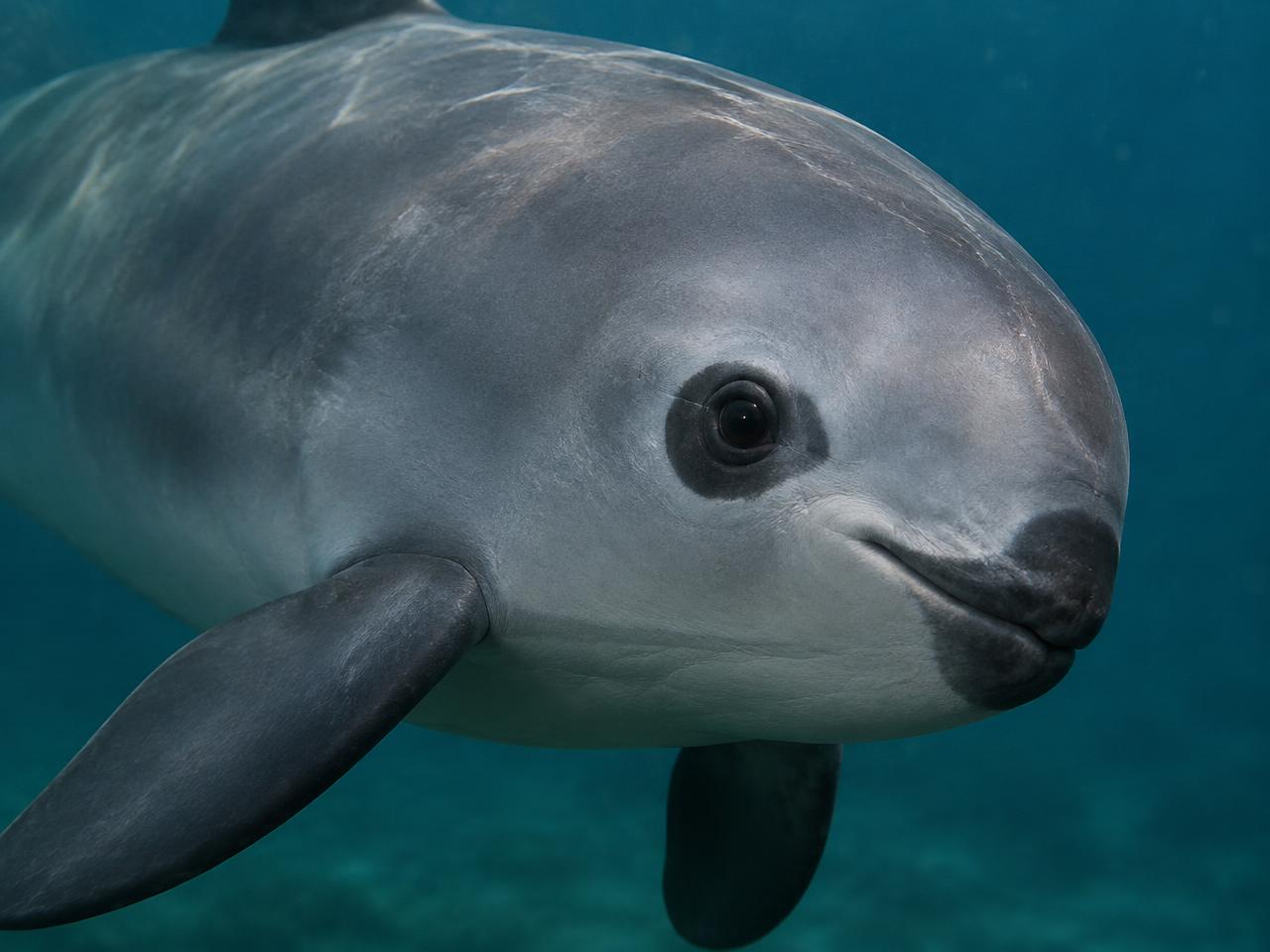 Illustrative depiction
Overview
The smallest cetacean, with the smallest home
The vaquita is the smallest of all whales, dolphins and porpoises, reaching just 150 cm. It has a rounded head with no beak, dark rings around its eyes, a mouth that seems to smile, and a tall triangular fin that is larger in males.
It lives only in the upper Gulf of California, in shallow water under 150 m deep, feeding mostly on fish near the sea floor. It is the only cetacean that lives in water warmer than 30 °C in July. Scientists first described it in 1958, from skulls found on a beach.
Females have a single calf in spring, and not every year. Breeding this slowly means the vaquita cannot recover quickly once its numbers fall.
Why it is critically endangered
Paid for in vaquita lives
Gillnet bycatch
Vaquitas tangle and drown in gillnets set for shrimp, mackerel and sharks. Deaths have been recorded since the 1950s.
The totoaba trade
Illegal large-mesh nets target the totoaba, a fish whose swim bladder sells for tens of thousands of dollars per kilo in China and Hong Kong. The totoaba is itself Critically Endangered.
Weak enforcement
Totoaba fishing has been banned since 1976, but corruption and organised crime have undermined the bans.
A shallow gene pool
Genetic evidence points to a past bottleneck, though the last animals have shown surprising resilience.
Conservation history
From hundreds to around ten
| Year | Event |
|---|---|
| 1958 | First described from skulls found on a beach |
| 1978 | First listed as Vulnerable by the IUCN |
| 1985 | Listed as endangered under the U.S. Endangered Species Act |
| 1993 | Mexico creates the Upper Gulf of California and Colorado River Delta Biosphere Reserve |
| 1996 | Declared Critically Endangered; fewer than 400 estimated (Gerrodette) |
| 2000 | Estimated 224 individuals (D'Agrosa et al. 2000) |
| 2005 | Vaquita refuge zone created (enforced from 2008) |
| 2017 | Permanent gillnet ban in the Upper Gulf; VaquitaCPR rescue mission halted |
| 2018 | At most 19 remain (Jaramillo-Legorreta et al. 2019) |
| 2020 | ~10 estimated, including 3 calves (Sanjurjo-Rivera et al. 2021) |
| Jul 2021 | Mexico reverses the total fishing ban in the refuge zone |
| Mar 2023 | CITES recommends trade sanctions on Mexico |
| Apr 2023 | CITES lifts sanctions after Mexico submits an updated action plan |
Take action
Who's fighting for the vaquita
Vetted organisations removing nets, monitoring the last animals and investigating the traffickers. Give to them directly.
Sea Shepherd Conservation Society
Removes illegal gillnets from the Zero Tolerance Area with the Mexican Navy
National Marine Mammal Foundation
Acoustic monitoring and AI drones to track the last vaquitas
Earth League International
Investigates the totoaba trafficking networks (Operation Fake Gold)
Porpoise Conservation Society
Campaigns and education for porpoises worldwide
Everyday actions
What you can do from home
- 01
Avoid shrimp from the upper Gulf
Check where your shrimp comes from. Gillnet shrimp fishing is a major cause of vaquita deaths.
- 02
Never buy totoaba or fish maw
Refuse swim-bladder products and report wildlife-trade listings you see.
- 03
Choose traceable seafood
Buy from certified, sustainable fisheries. Demand decides which nets go in the water.
- 04
Push for enforcement
Sign petitions and keep pressure on authorities in Mexico and consumer countries.
Selected references
- Jaramillo-Legorreta et al. 2019 — Decline towards extinction of Mexico's vaquita porpoise
- Sanjurjo-Rivera et al. 2021 — 2020 acoustic assessment of the vaquita
- D'Agrosa, Lennert-Cody & Vidal 2000 — vaquita bycatch and incidental mortality
- Hohn et al. 1996 — Life history of the vaquita
- Mexican Government — permanent gillnet ban in the Upper Gulf
- Environmental Investigation Agency — On Borrowed Time (2024)
- Global Initiative — The totoaba trafficking route
- Animal Welfare Institute — Mexico eases enforcement in the Zero Tolerance Area
- Sea Shepherd — Vaquita (current population estimate)
- IUCN Red List — Phocoena sinus (last assessed March 2022)
- IUCN SSC Cetacean Specialist Group — Vaquita