Tarzan's chameleon
Calumma tarzan · Eastern Madagascar
2024 surveys, four sites
A living jewel of the forest, trapped in shrinking islands of foliage in eastern Madagascar.
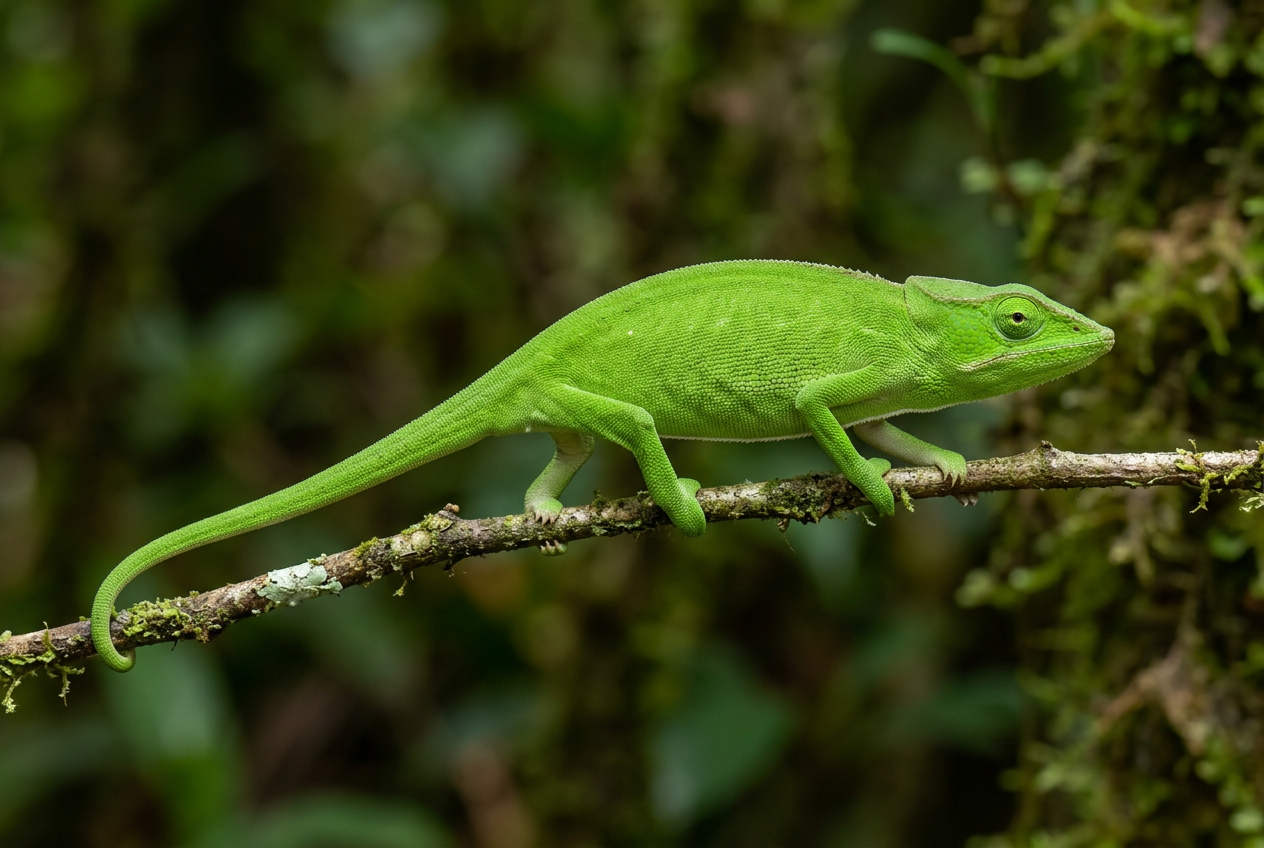 Illustrative depiction
Overview
A tiny hero of the undergrowth
Discovered in 2009, Calumma tarzan is named after Tarzanville (now Ambodimeloka), the village where it was found, a nod to the jungle hero meant to rally people to protect it. It grows to 72 mm from snout to vent, or 150 mm with its tail, and has a distinctive spade-like snout.
Active by day, it perches on the lower branches of humid rainforest. Males are brown to blackish; females range from leaf-green to bright canary yellow. It changes colour with its mood, not for camouflage, and shows dark bands across its body when stressed.
Mostly solitary, chameleons pair up in the mating season. Females lay up to five eggs, which take nearly six months to hatch. Madagascar is home to nearly half the world's chameleon species, and over half of those are on the IUCN Red List.
Why it is nearly gone
A forest reduced to pockets
Its whole known range covers less than 10 km² of mid-altitude rainforest, and none of it is protected.
Slash-and-burn farming
Forest is burned to clear land for crops, destroying the mid-altitude rainforest the chameleon depends on.
Illegal gold mining and logging
Mining and selective logging tear up what forest remains, helped by weak local governance and little enforcement.
Broken-up forest
Clearing splits the chameleons into isolated pockets, so individuals struggle to meet, mate and keep their gene pool healthy. Stranded in small patches, they are easy prey for birds and snakes.
No protected sites
None of the forest areas where it lives has formal protection, leaving every patch open to further damage.
Conservation history
From discovery to flagship species
| Year | Event |
|---|---|
| 2009 | Discovered near the village of Tarzanville (now Ambodimeloka), in forest fragments at 800–900 m in the Alaotra-Mangoro region. |
| 2020 | Sighted in the Atsinanana region. |
| 2024 | Surveys record about 100 individuals across four sites. |
| Today | None of the forest sites where it lives has formal protection. Named a regional flagship species. |
Take action
Who's fighting for Tarzan's chameleon
Madagasikara Voakajy leads on the ground with field surveys, community work and the push for protected reserves, backed by international allies.
Madagasikara Voakajy
Malagasy conservation group leading on the ground: field surveys, work with local communities and the campaign for protected reserves.
Mohamed bin Zayed Species Conservation Fund
International fund giving grants to front-line conservation of threatened species worldwide.
IUCN SSC Chameleon Specialist Group
Global network of chameleon experts assessing threats and setting conservation priorities.
Everyday actions
What you can do from home
- 01
Never buy a wild-caught chameleon
Refuse any chameleon sold without verified captive-bred papers, and report suspicious wildlife-trade listings online or in markets.
- 02
Choose deforestation-free products
Buy certified vanilla, cocoa and cloves from Madagascar that give farmers an alternative to clearing forest.
- 03
Back protected-reserve campaigns
Support groups working to give its forest remnants legal protection before they are cleared.
- 04
Share its story
Share its plight, follow the field surveys and press decision-makers to fund Madagascar's forest protection.
Selected references