Tapanuli orangutan
Pongo tapanuliensis · Batang Toru, Sumatra
estimated
The rarest great ape on Earth, found only in the Batang Toru forests of North Sumatra.
Source: Meijaard et al., 2021 (PLoS One)
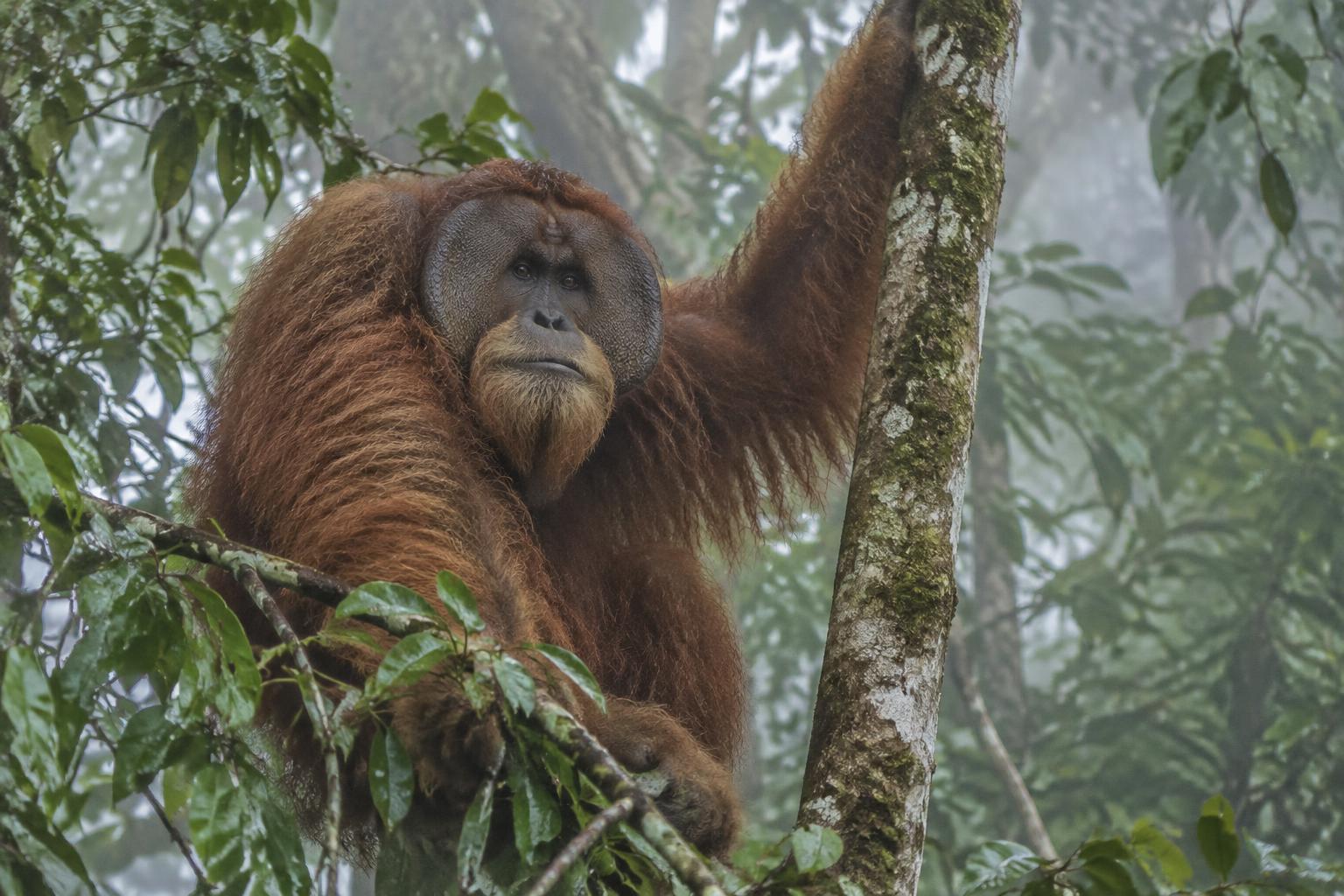 Illustrative depiction
Overview
The newest great ape, and the rarest
The Tapanuli orangutan is one of three orangutan species and the most endangered. It was described as a separate species only in 2017, yet it has the oldest evolutionary history of the three, splitting from its closest relative, the Sumatran orangutan, about 3.4 million years ago.
It lives only in the Batang Toru ecosystem on the island of Sumatra, Indonesia. Fewer than 800 remain, making it the rarest great ape on Earth.
Batang Toru faces growing threats from farming expansion, gold mining, hydropower construction and road building.
Why it is nearly gone
One forest, under pressure
Every Tapanuli orangutan lives in a single forest ecosystem in North Sumatra.
Forest loss
Batang Toru lost 7,659 ha of forest between 2000 and 2023, shrinking the only place this ape lives.
Hydropower and mining
A hydropower dam and gold mining are cutting into the forest and splitting orangutan habitat.
Roads and construction
New roads and development fragment the forest, cutting groups off from each other and bringing more people in.
Farming expansion
Land cleared for crops pushes into the forest edge and can lead to conflict and killings.
Conservation history
A newly named ape, already in decline
| Year | Event |
|---|---|
| 3.4 million years ago | Diverges from its closest relative, the Sumatran orangutan |
| 2017 | Described as a separate species, the third orangutan species; IUCN assesses it as Critically Endangered (October 2017) |
| 2000–2023 | Batang Toru loses 7,659 ha of forest |
| 2021 | Fewer than 800 estimated to remain (Meijaard et al.) |
Take action
Who's fighting for the Tapanuli orangutan
Indonesian and international groups protect the forest, research the orangutans and work with local communities.
Sumatran Orangutan Conservation Programme
Leading orangutan conservation programme in North Sumatra, including Batang Toru.
Yayasan Ekosistem Lestari
Indonesian foundation that co-runs the Sumatran Orangutan Conservation Programme.
Everyday actions
What you can do from home
- 01
Choose sustainable palm oil
Look for RSPO-certified products, or avoid palm oil, to reduce pressure on Sumatra's forests.
- 02
Buy FSC-certified wood and paper
Certified products help keep tropical rainforests standing.
- 03
Never buy wildlife or pet primates
Refuse and report illegal trade in orangutans and other apes.
- 04
Fund forest protection
Donations protect Batang Toru and support local communities and rangers.
Selected references
- IUCN Red List — Pongo tapanuliensis (last assessed October 2017)
- IUCN SSC Primate Specialist Group — Section on Great Apes: Tapanuli orangutans
- Wich, S.A., Fredriksson, G., Usher, G., Kühl, H.S. and Nowak, M.G., 2019. The Tapanuli orangutan: Status, threats, and steps for improved conservation. Conservation Science and Practice.
- Meijaard, E., Ni’matullah, S., Dennis, R., Sherman, J., Onrizal and Wich, S.A., 2021. The historical range and drivers of decline of the Tapanuli orangutan. PLoS One, 16(1), p.e0238087.
- Laurance, W.F., Wich, S.A., Onrizal, O., Fredriksson, G., Usher, G., Santika, T., Byler, D., Mittermeier, R., Kormos, R., Williamson, E. and Meijaard, E., 2020. Tapanuli orangutan endangered by Sumatran hydropower scheme. Nature Ecology and Evolution.
- Love the Last Wildlife Fund — Tapanuli orangutan