Sunda pangolin
Manis javanica · Southeast Asia
no reliable estimate
So elusive and so heavily trafficked across a wide range that no reliable total estimate exists.
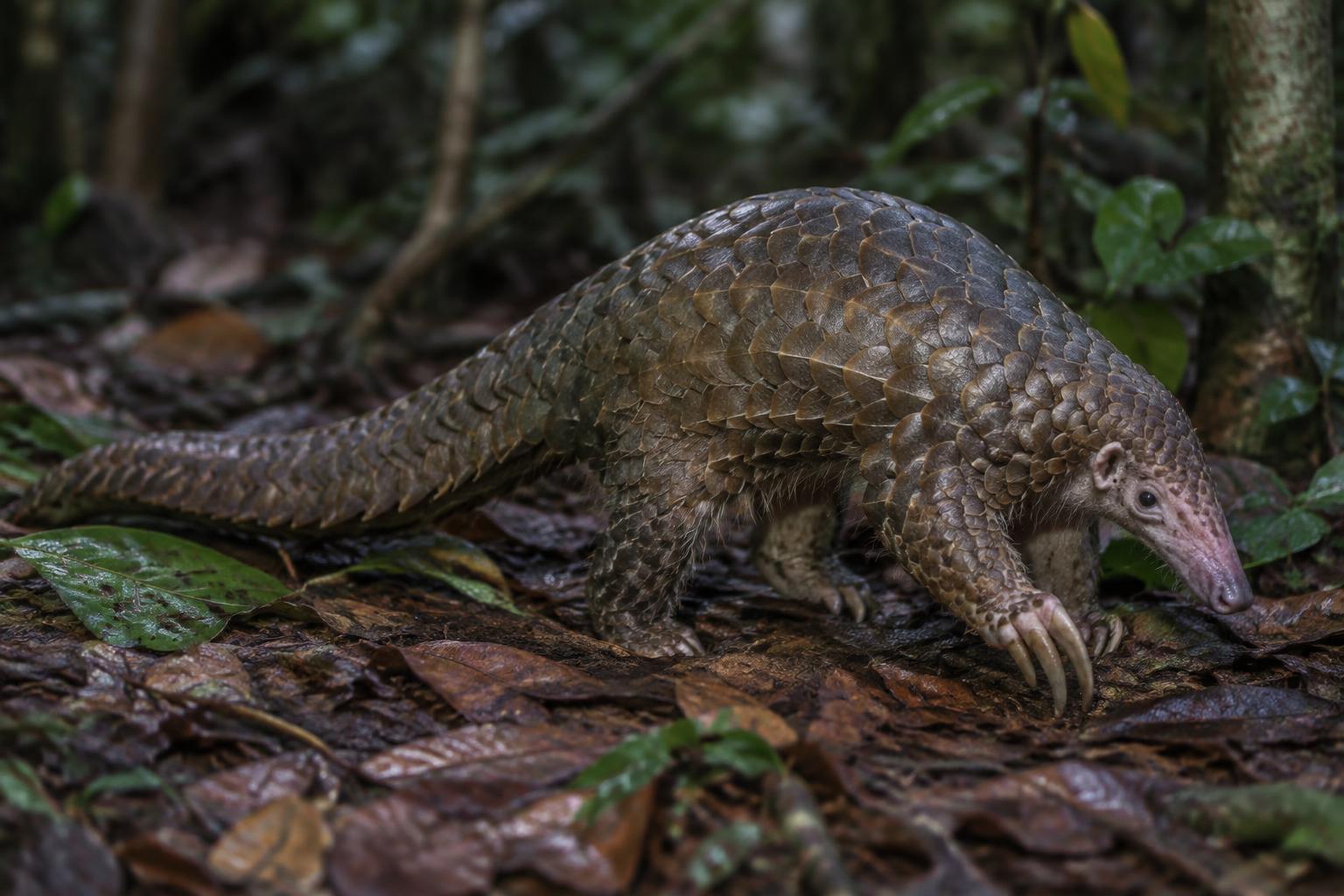 Illustrative depiction
Overview
The armour that could not save them
Also known as the Malayan or Javan pangolin, the Sunda pangolin is the only mammal covered in scales. When frightened it rolls into an armoured ball — a defence against tigers and clouded leopards, but useless against people.
It lives in tropical forests, peat swamps and grasslands across Southeast Asia, mostly below 600 m but up to 1,700 m in Borneo. Nocturnal and shy, it has no teeth and uses powerful claws and a long sticky tongue to eat thousands of ants and termites a night.
Pangolins are the most trafficked mammals in the world. Around 65,000 Sunda pangolins were illegally traded between 2000 and 2019. It is so elusive that no reliable estimate of how many remain exists.
Why it is nearly gone
Hunted for its scales
The scales that protected it from tigers for millions of years are now what traffickers want.
Trafficking for traditional medicine
Its scales are prized in traditional Chinese medicine despite no proven effect. They can fetch up to $3,500 per kg on the black market.
Meat and historic trade
Pangolin meat has been eaten in Asia since the 16th century and is still a delicacy in some areas.
Habitat loss
About 70% of Southeast Asia's forests now lie within 1 km of a forest edge. In Singapore, road collisions add to the losses.
No captive safety net
Captive breeding has repeatedly failed, so protecting pangolins in the wild is the only way forward.
Conservation history
From open trade to a global ban
| Year | Event |
|---|---|
| 1965 | 60 tonnes of pangolin scales exported from Borneo in a single year. |
| 1975 | Pangolins placed on CITES Appendix II. |
| 2000 | Quotas for legally catching Asian pangolins reduced to zero; poaching of African pangolins rose as a result. |
| 2000–2019 | Around 1 million pangolins trafficked globally, including ~65,000 Sunda pangolins. |
| 2013 | Wildlife Reserves Singapore and the IUCN SSC Pangolin Specialist Group host the first pangolin conference. |
| 2014 | Sunda pangolin assessed as Critically Endangered on the IUCN Red List. |
| 2016 | All pangolin species uplisted to CITES Appendix I, making international trade illegal. |
| 2018 | Sunda Pangolin National Conservation Strategy and Action Plan for Singapore published. |
| Today | Sabah in northern Borneo is a recent trade hotspot; demand in Asia remains high. |
Take action
Who's fighting for the Sunda pangolin
Anti-trafficking coalitions, expert networks and rescue teams work across Southeast Asia.
Save Pangolins
Global coalition of NGOs and research groups coordinating anti-trafficking, research and awareness.
IUCN SSC Pangolin Specialist Group
Global expert network providing science, conservation planning and status assessments.
Pangolin Crisis Fund
Grants for high-impact anti-poaching projects; 100% of donations go to programmes.
TRAFFIC
Monitors the global wildlife trade to stop trafficking of pangolin meat and scales.
Pangolin Aware
Malaysian non-profit protecting the Sunda pangolin through local research and education.
Trenggiling Conservation Program
Runs a rescue and rehabilitation centre on Sumatra and investigates trafficking cases.
Wildlife Alliance
Rescues live Sunda pangolins and removes snares in Cambodia's Cardamom Mountains.
Everyday actions
What you can do from home
- 01
Reject pangolin 'medicines' and products
Never buy medicines, wines or crafts containing pangolin scales — the scales are the same protein as fingernails.
- 02
Don't buy pangolin meat or bushmeat
Refuse meat of unknown wild origin and report wildlife-trade listings you see online.
- 03
Demand enforcement of trade bans
All pangolin trade has been illegal since 2016. Ask your representatives to fund customs enforcement.
- 04
Protect connected forests
Support reforestation and protected corridors across Southeast Asia.
- 05
Spread the 'most trafficked' story
Most people have never heard of pangolins. Sharing their story builds pressure to protect them.
Selected references
- TRAFFIC — Illegal trade hammering critically endangered Sunda pangolin stronghold
- Stolen Wildlife — Pangolins
- Reverse The Herd — Sunda pangolin
- IUCN Red List — Sunda pangolin (Critically Endangered since 2014) (last assessed May 2019)
- CITES — Appendix II listing (1975); all pangolin species uplisted to Appendix I (2016).
- Gomez et al. — Sunda pangolin scales in traditional Chinese medicine.
- Sunda Pangolin National Conservation Strategy and Action Plan for Singapore (2018).