Sumatran Rhino
Dicerorhinus sumatrensis · Sumatra and Borneo, Indonesia
current estimate
The smallest and hairiest living rhino, a woolly relic of the ice age whistling into the mist as its kind fades.
Source: International Rhino Foundation · IUCN Red List
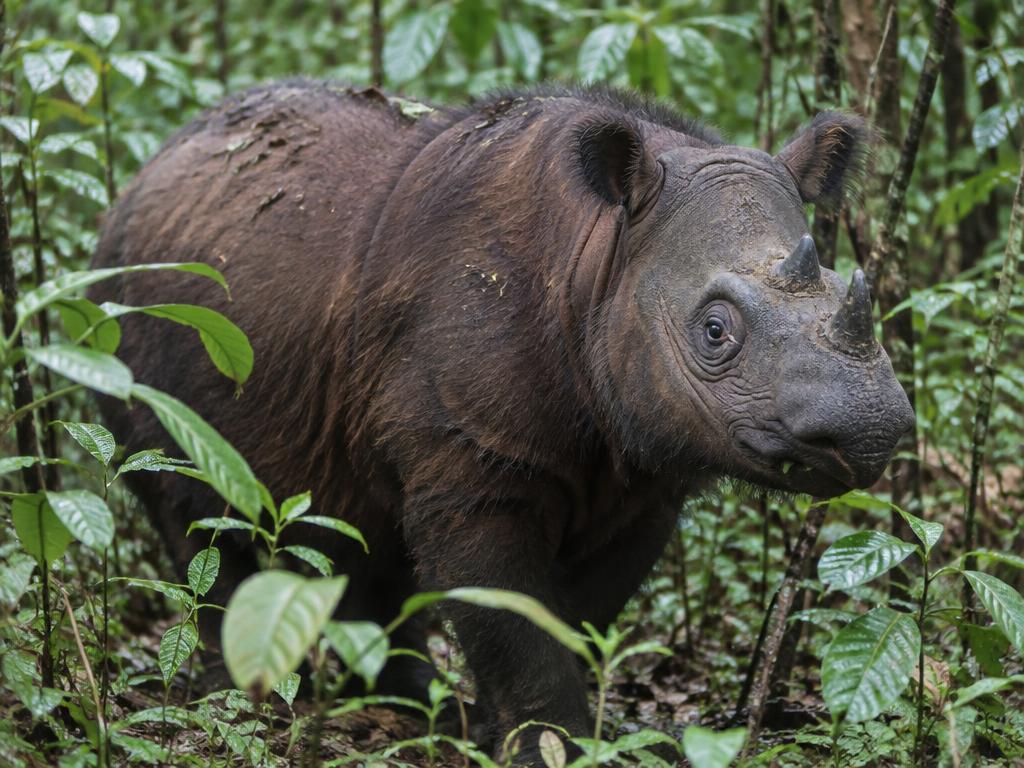 Illustrative depiction
Overview
A hairy, two-horned link to the ice age
The smallest of all living rhinos, the Sumatran rhino wears thick folds of skin and a coat of reddish-brown hair. It shares an ancestry with the long-vanished woolly rhino, and it is the most vocal rhino, calling with whines, groans and whistles.
Once found from the Himalayan foothills through Myanmar, Thailand and Malaysia to Sumatra and Borneo, it has disappeared from over 99% of that range. Only four small wild populations remain, and only the one in the Leuser Ecosystem is thought to be large enough to survive in the long term.
Solitary and most active at dawn and dusk, it browses leaves and saplings, visits salt licks and spends two to three hours each midday wallowing in mud, which keeps its skin healthy.
Why it is critically endangered
Hunted for horn, cut off by logging
Poaching for horn
Rhino horn, made of hardened hair, has been used in traditional Chinese medicine for millennia, and demand surged again from the 1970s.
Habitat loss
Logging, farming and coffee growing have cut into key parks. Gone from over 99% of its former range.
Too few to find each other
The survivors are scattered in tiny, isolated pockets of forest, often too far apart to find mates.
Hard to breed in care
Three separate genetic lineages make breeding complex, and captive births have been very rare.
Conservation history
A story of rapid collapse
| Year | Event |
|---|---|
| 1900 | Around 5,000 rhinos estimated across the range |
| Early 1900s | Still relatively common on Borneo, but alarm bells already ringing |
| 1930s | Fast decline begins across the range |
| 1950s–60s | Hunted to near-extinction in Borneo, 30 or fewer left there |
| 1970s | Rising prosperity in parts of Asia revives demand for rhino horn |
| 1980s | Around 500 rhinos estimated in Kerinci Seblat National Park |
| 1986 | Around 800 rhinos estimated in the wild |
| 1984–2001 | 45 rhinos taken from the wild for captive breeding, with no births |
| 2001 | First captive birth, at Cincinnati Zoo |
| 2007 | The Kerinci Seblat population is wiped out by poaching |
| 2012 | Bukit Barisan Selatan National Park overrun by illegal farming and logging |
| 2019 | Extinct in Malaysia; fewer than 100 left across Borneo and Sumatra |
| Today | Fewer than 50 left in the wild |
Take action
Who's fighting for the Sumatran rhino
These organisations run anti-poaching patrols, fund breeding science and guard the remaining forest corridors of Sumatra and Borneo. Support them directly.
International Rhino Foundation
Veterinary equipment and care at the Sumatran Rhino Sanctuary
Save Sumatran Rhinos
Alliance working to rescue the last rhinos and breed them in managed care
Everyday actions
What you can do from home
- 01
Avoid conflict commodities
Choose certified sustainable palm oil (RSPO), timber and coffee to protect Sumatra's and Borneo's forests.
- 02
Back wildlife-trade enforcement
Support strict CITES enforcement and policies that shut down demand for rhino horn.
- 03
Fund conservation science
Egg retrieval, IVF and sharing genetic material between centres are the species' last technical lifelines.
- 04
Travel responsibly
If you visit Southeast Asia, choose eco-tourism that funds parks, rangers and Rhino Protection Units.
Selected references
- International Rhino Foundation — Sumatran rhino
- Global Conservation — Sumatran rhino
- Save the Rhino — An uncertain future: the Sumatran rhino
- IUCN Red List — Dicerorhinus sumatrensis (last assessed May 2019)
- International Rhino Foundation — Sumatran Rhino Sanctuary
- Re:wild
- Save Sumatran Rhinos
- Leuser International Foundation