Spotted handfish
Brachionichthys hirsutus · Derwent Estuary, Tasmania, Australia
IUCN estimate, 2013
A small spotted fish that walks across the seabed on its fins, now found in just a few bays of one Tasmanian estuary.
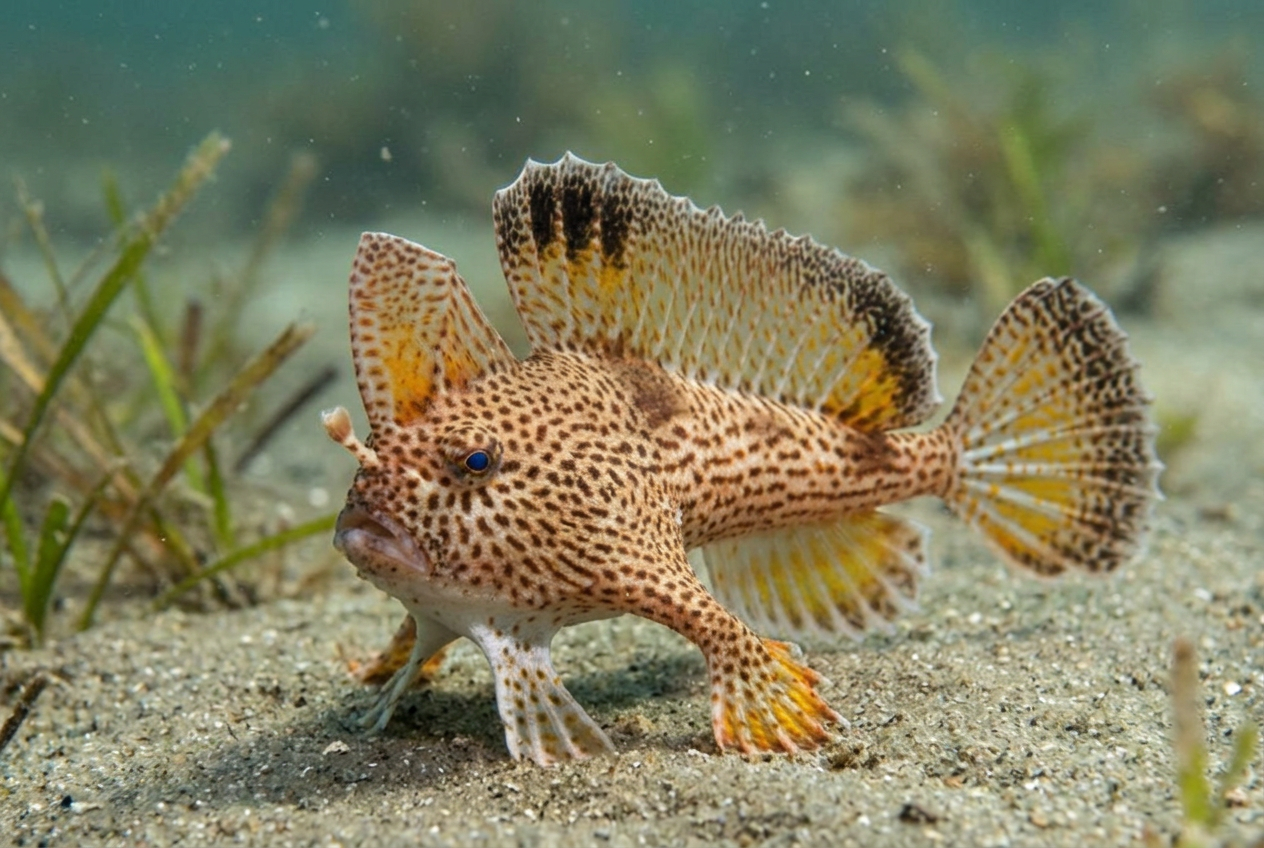 Illustrative depiction
Overview
A fish that walks instead of swims
The spotted handfish is a small anglerfish relative, up to about 12 cm long, with a pale body peppered in dark spots and a tall, frilled dorsal fin. Rather than swimming, it walks slowly over the seabed on its hand-shaped pectoral fins.
It was once common across the Derwent Estuary in south-east Tasmania. After invasive seastars arrived in the 1980s numbers collapsed, and in 1996 it became the first marine fish listed as Critically Endangered. The IUCN's 2013 assessment estimated about 950 adults, still decreasing.
Females lay a few hundred eggs around upright stalks and guard them for weeks. The young hatch fully formed and stay close by, so the fish cannot recolonise lost sites on its own. Artificial spawning habitats and aquarium breeding are now helping it hold on.
Why it is nearly gone
A tiny range with nowhere else to go
Almost every spotted handfish lives in a handful of sites in one estuary beside a city and port.
Invasive seastars
The northern Pacific seastar, carried in ships' ballast water, spread through the Derwent from the 1980s. It eats handfish eggs and the sea squirts they lay them on.
Loss of spawning sites
Handfish wrap their eggs around upright stalks such as sea squirts and seagrass. As these vanished, adults had nowhere safe to breed.
Silt and pollution
Run-off, dredging and industrial pollution cloud the water and smother the sandy seabed the fish need.
No way to spread
Handfish have no floating larval stage; young hatch as tiny adults and stay put. Lost local groups cannot be replaced naturally.
Conservation history
From common to Critically Endangered
| Year | Event |
|---|---|
| 1800s | Described from Tasmania; once common across the Derwent Estuary and nearby bays. |
| 1980s | Numbers fall sharply after the invasive northern Pacific seastar arrives and eats handfish eggs. |
| 1996 | Becomes the first marine fish listed as Critically Endangered on the IUCN Red List. |
| 1999 | National recovery plan adopted; artificial spawning habitats trialled. |
| 2013 | IUCN assessment estimates about 950 adults, still decreasing. |
| 2018–present | Handfish Conservation Project leads captive breeding with Australian aquariums and releases. |
Take action
Who's fighting for the spotted handfish
Scientists, aquariums and estuary managers survey the fish, restore spawning habitat and breed handfish as a backup population.
The Handfish Conservation Project
Scientists and divers running surveys, habitat restoration and captive breeding for Tasmania's handfishes.
Derwent Estuary Program
Partnership improving water quality and habitat in the Derwent Estuary, the handfish's last stronghold.
Sea Life Melbourne
Aquarium caring for and breeding spotted handfish as an insurance population.
Zoo & Aquarium Association Australasia
Coordinates zoo and aquarium breeding programs across Australia and New Zealand.
Everyday actions
What you can do from home
- 01
Clean your boat and gear
Wash hulls, anchors and dive kit between waterways so invasive species are not carried to new places.
- 02
Mind where you anchor
In the Derwent, avoid dropping anchors or moorings on sandy beds where handfish live and spawn.
- 03
Keep drains clean
Anything down a street drain reaches the estuary. Keep soil, paint and chemicals out of stormwater.
- 04
Report sightings
Divers can log handfish sightings with Reef Life Survey or the Handfish Conservation Project. Never touch or move them.
Selected references
- IUCN Red List — Brachionichthys hirsutus (last assessed April 2018)
- Edgar, G.J., Stuart-Smith, R.D., Cooper, A., Jacques, M. and Valentine, J., 2017. New opportunities for conservation of handfishes (Family Brachionichthyidae) and other inconspicuous and threatened marine species through citizen science. Biological Conservation, 208, pp.174–182.
- Stuart-Smith, J., Edgar, G.J., Last, P., Linardich, C., Lynch, T., Barrett, N., Bessell, T., Wong, L. and Stuart-Smith, R.D., 2020. Conservation challenges for the most threatened family of marine bony fishes (handfishes: Brachionichthyidae). Biological Conservation, 252, p.108831.
- Lynch, T.P., Green, M., Wong, L.S.C., Bessell, T.J., Cooper, A., Valentine, J., Barrett, N., Ross, D.J., McEnnulty, F.R. and Foster, S.D., 2022. Assessment of conservation actions for the critically endangered spotted handfish (Brachionichthyidae), following curation of data collected by multiple investigators into a long-term time-series. Journal for Nature Conservation, 69, 126237.
- The Handfish Conservation Project