Spix's macaw
Cyanopsitta spixii · Curaçá, Bahia, Brazil
403 in captivity (2026)
The only small blue macaw on Earth, gone from the wild by 2000 and now being flown home to Brazil's dry Caatinga forest.
Source: ICMBio reintroduction programme, 2026 · IUCN Red List
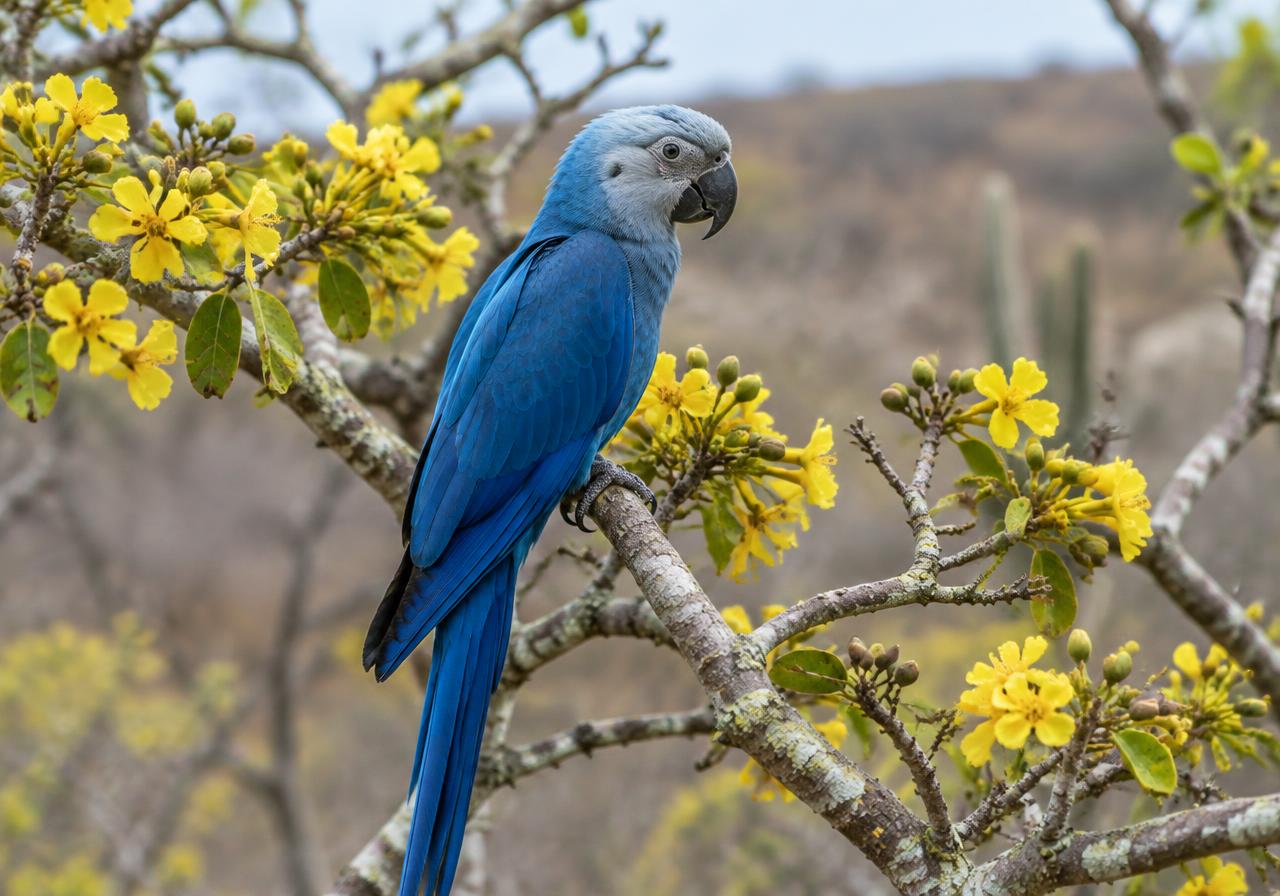 Illustrative depiction
Overview
The only small blue macaw
The Spix's macaw is the only species in its genus, Cyanopsitta, from the Greek for "blue parrot". It has a grey-blue head, bare grey skin around the eyes, a vivid blue back and paler blue underparts. Its family line split from the parakeets before the modern macaws appeared.
It lives only in the riverside woodland of the São Francisco basin, in the hottest, driest part of Brazil's Caatinga. There it roosts, feeds and nests in hollows of the tall Caraibeira tree. Pairs bond for life, feeding each other during courtship.
Trapping and habitat loss pushed it out of the wild by 2000, and the IUCN declared it Extinct in the Wild in 2019. Captive breeding has since rebuilt the population, and birds have been released near Curaçá in Bahia since 2022.
Why it vanished from the wild
Wanted in cages, not in the canopy
Poaching for the pet trade
Trapping for the exotic pet trade emptied the Caatinga from the 1960s on. A single bird could fetch huge sums on the black market.
Loss of Caraibeira woodland
Clearing the tall Caraibeira trees and riverside woodland along the São Francisco took away the hollows the macaw nests and roosts in.
Psittacine circovirus
A non-native parrot virus was found among the reintroduced birds in late 2025, a reminder of how fragile the return to the wild is.
A tiny founding population
Every living Spix's macaw descends from a small number of captive birds, so the whole species depends on careful breeding and biosecurity.
Conservation history
From zero in the wild to flying free
| Year | Event |
|---|---|
| 1638 | First documented by Georg Marcgrave |
| 1819 | Collected by Johann Baptist von Spix in Bahia |
| 1832 | Classified as Cyanopsitta spixii |
| 1960s onwards | Trapping for the pet trade and loss of Caraibeira woodland empty the Caatinga |
| 1986 | Only 3 wild birds left near Curaçá |
| 2000 | Last wild male vanishes; none left in the wild |
| 2019 | IUCN declares the species Extinct in the Wild |
| 2020 | 52 birds flown from Germany to a breeding and release centre in Curaçá, Bahia |
| 2022 | Pilot release of 20 Spix's macaws and 15 blue-winged macaws into the Caatinga |
| Oct 2025 | Psittacine circovirus detected in the reintroduced birds |
| 2026 | 11 living freely near Curaçá; 403 in captivity |
Take action
Who's bringing the macaw home
The organisations leading captive breeding, habitat restoration and reintroduction.
Chico Mendes Institute (ICMBio)
Brazil's federal agency leading the reintroduction programme and managing the Caatinga protected areas
IUCN SSC Wild Parrot Specialist Group
Global scientific guidance on parrot status, trade and recovery planning
World Parrot Trust
International parrot charity supporting field programmes, trade monitoring and education
BlueSky
Caatinga project protecting and restoring the dry forest habitat the Spix's macaw depends on
Everyday actions
What you can do from home
- 01
Buy FSC-certified wood and paper
Make sure what you buy doesn't drive the loss of the dry forests this bird needs.
- 02
Never buy wild-caught parrots
The pet trade emptied the wild. Report suspicious online wildlife sales.
- 03
Back native reforestation
Support community-led replanting of Caraibeira woodland along the São Francisco.
- 04
Share the story
The macaw stands for the nearly one-third of parrot species now threatened. Awareness drives funding.
Selected references
- IUCN Red List — Cyanopsitta spixii (last assessed June 2019)
- Chico Mendes Institute for Biodiversity Conservation (ICMBio)
- World Parrot Trust
- Purchase, C., Lugarini, C., Purchase, C., Ferreira, A., Vercillo, U.E., Stafford, M.L. and White Jr, T.H. (2024). Reintroduction of the extinct-in-the-wild Spix's Macaw (Cyanopsitta spixii) in the Caatinga Forest Domain of Brazil. Diversity, 16(2), 80.