Southern Resident orca
Orcinus orca · Salish Sea, US & Canada
counted
Every whale is known by name, in three pods: J, K and L.
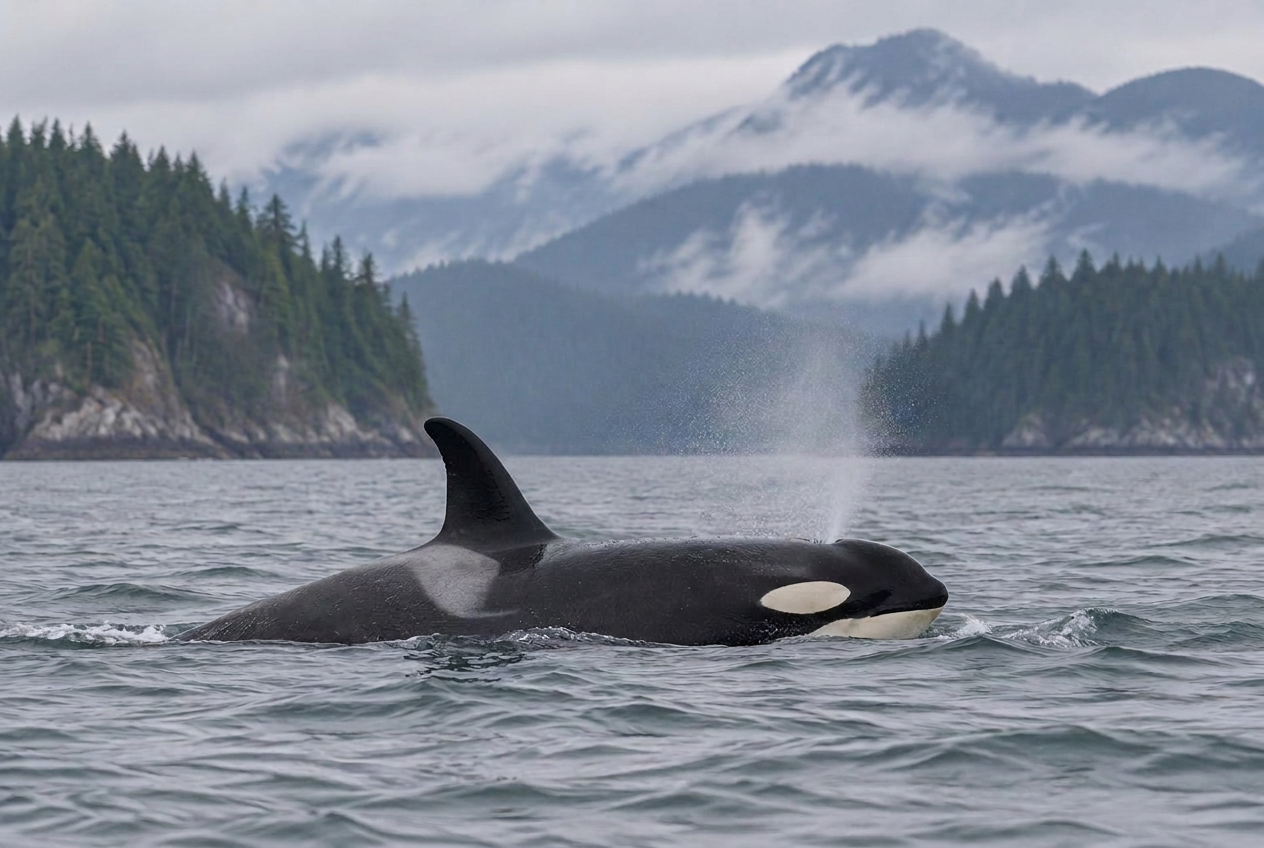 Illustrative depiction
Overview
The orcas that eat only salmon
Southern Resident orcas are a unique population of killer whales that live in the Salish Sea, the inland waters between Washington State and British Columbia. They eat fish, mainly Chinook salmon, and do not hunt seals like other orcas.
They live in three distinct pods, called J, K and L pods, made up of family groups (matrilines) that stay together for life, led by older females.
In July 2025 the Center for Whale Research counted just 74 whales. They are listed as Endangered under the US Endangered Species Act (2005) and protected under Canada's Species at Risk Act.
Why it is nearly gone
Hungry, noisy, polluted waters
All 74 whales share one inland sea beside some of the busiest ports on the Pacific coast.
Not enough salmon
Chinook salmon runs have collapsed from dams, habitat loss and overfishing, leaving the whales short of food.
Vessel noise
Boat traffic masks the clicks the whales use to hunt, making it harder to find scarce fish.
Toxic pollution
PCBs and other chemicals build up in their blubber and are passed from mothers to calves.
Small, inbred population
With so few whales and little mixing with other orcas, inbreeding lowers survival and births.
Conservation history
Fifty years of counting every whale
| Year | Event |
|---|---|
| 1960s–1970s | Dozens of young orcas captured from the population for marine parks. |
| 1976 | Center for Whale Research begins the annual photo-identification census. |
| 1995 | Population peaks at about 98 whales. |
| 2001 | Listed as Endangered under Canada's Species at Risk Act (SARA). |
| 2005 | Listed as Endangered under the US Endangered Species Act. |
| July 2025 | Census counts 74 whales across J, K and L pods. |
Take action
Who's fighting for the Southern Residents
US and Canadian groups count the whales, study them without disturbance and campaign for salmon and quieter waters.
Orca Conservancy
US non-profit advocating for the Southern Residents and their salmon.
Raincoast Conservation Foundation
Canadian scientists working on killer whale habitat and salmon.
Orca Behavior Institute
Non-invasive observational research on the Southern Residents.
Everyday actions
What you can do from home
- 01
Eat sustainable seafood
Avoid at-risk Chinook salmon and choose certified sustainable fish.
- 02
Watch whales responsibly
Choose shore-based or certified operators that keep their distance and slow down.
- 03
Keep chemicals out of drains
What goes down the drain or storm drain ends up in the Salish Sea food chain.
- 04
Support salmon recovery
Back river restoration and dam removal projects that bring the salmon back.
Selected references
- IUCN Red List — Orcinus orca (orca, all populations; last assessed June 2017)
- Center for Whale Research — Orca population
- Ford, M.J., Ward, E.J., Kardos, M., Parsons, K.M., Emmons, C. and Hanson, M.B., 2026. Perspective: The future of the Southern Resident killer whales depends on interactions with other killer whale populations. Ecology and Evolution, 16(3), p.e73205.
- Hanson, M.B., Emmons, C.K., Ford, M.J., Everett, M., Parsons, K., Park, L.K., Hempelmann, J., Van Doornik, D.M., Schorr, G.S., Jacobsen, J.K. and Sears, M.F., 2021. Endangered predators and endangered prey: Seasonal diet of Southern Resident killer whales. PLoS One, 16(3), p.e0247031.
- NOAA Fisheries — Killer whale stock assessment report, 2023 (PDF)