Silky sifaka
Propithecus candidus · Northeastern Madagascar
in the wild
One of the most endangered lemurs in the world, found only in the forests of northeastern Madagascar.
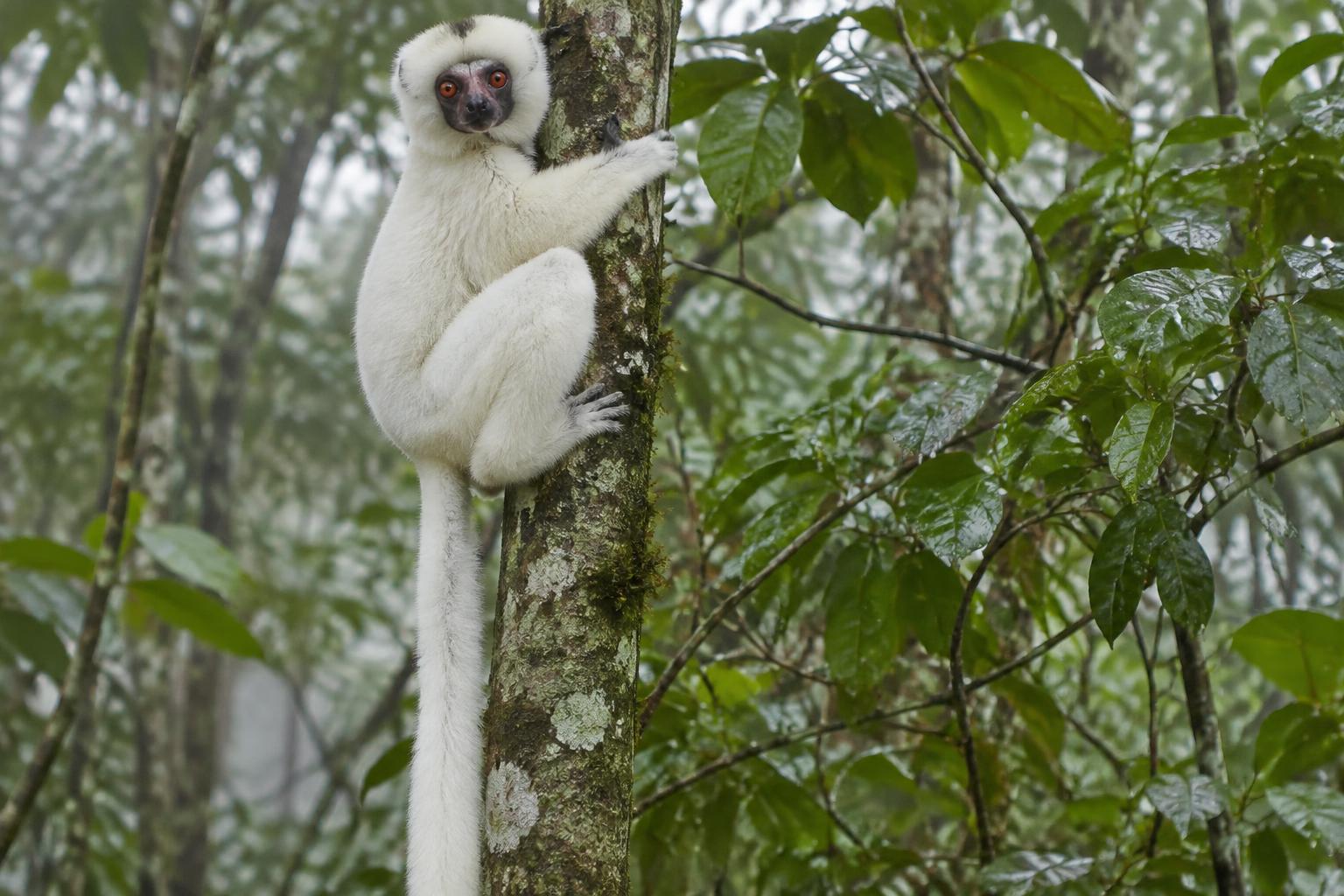 Illustrative depiction
Overview
The angel of the forest
The silky sifaka, known locally as the simpona, is a large lemur cloaked in long, silky white fur, earning it the name “angel of the forest”. It is one of the most endangered lemurs in the world, and lemurs are the most endangered mammals on Earth: 98% of lemur species are threatened.
It lives only in the rainforests of northeastern Madagascar, between 235 m and 1,875 m altitude, and spends almost its entire life in the canopy.
Its breeding is remarkable: females mate on just one day a year, between late December and early January. Adults also practise allocare, looking after other group members' young as well as their own. Fewer than 250 mature individuals are thought to remain, and the population is declining.
Why it is nearly gone
Losing its forest home
Its rainforest is being cleared, logged and hunted.
Slash-and-burn farming
Forest is cleared and burned for rice fields (tavy), shrinking and fragmenting the canopy the sifaka never leaves.
Illegal logging
Selective logging of precious hardwoods such as rosewood opens up and degrades protected forests.
Hunting
Despite local taboos in some areas, silky sifakas are hunted for bushmeat.
A tiny, isolated population
With fewer than 250 mature adults and a single day of mating a year, the species has little room to recover from losses.
Conservation history
A lemur on the brink
| Year | Event |
|---|---|
| 1871 | Described by Alfred Grandidier from northeastern Madagascar. |
| 2004 | Morphological, genetic and craniodental studies (Mayor et al.) confirm the silky sifaka as a distinct species. |
| 2012 | Makira Natural Park formally protected, safeguarding part of its range. |
| 2019 | IUCN Red List assessment: Critically Endangered, fewer than 250 mature individuals, declining. |
Take action
Who's fighting for the silky sifaka
These groups research the sifaka, protect its forests, run breeding programmes and work with local communities. Give to them directly.
New England Primate Conservancy
Funds silky sifaka field research, education and community conservation in the SAVA region.
Duke Lemur Center – SAVA Conservation
Works with communities in northeastern Madagascar on reforestation, education and sustainable livelihoods.
Wildlife Conservation Society – Makira REDD+
Protects Makira Natural Park, home to silky sifakas, through forest carbon funding.
Everyday actions
What you can do from home
- 01
Avoid illegal rosewood & ebony
Never buy furniture or instruments made from Malagasy rosewood or ebony; choose FSC-certified timber.
- 02
Choose responsible vanilla
The SAVA region is the world's vanilla heartland. Buy Fair Trade or traceable vanilla that supports forest-friendly farming.
- 03
Support community reforestation
Tree-planting and livelihoods projects reduce pressure to clear new forest.
- 04
Spread the word
Few people have heard of the silky sifaka. Sharing its story builds support for lemur conservation.
Selected references
- IUCN Red List — Propithecus candidus (last assessed November 2019)
- Patel, E.R., Marshall, J.J. and Parathian, H., 2005. Silky sifaka (Propithecus candidus) conservation education in northeastern Madagascar. Laboratory Primate Newsletter, 44(3), pp.8–11.
- Patel, E.R. and Owren, M.J., 2012. Silky sifaka (Propithecus candidus) “zzuss” vocalizations: Sexual dimorphism, individuality, and function in the alarm call of a monomorphic lemur. The Journal of the Acoustical Society of America, 132(3), pp.1799–1810.
- Mills, C.J., Nekaris, K.A.I., Campera, M. and Patel, E., 2021. Silky sifakas (Propithecus candidus) use sleep sites for thermoregulation, food access and predator avoidance. Folia Primatologica, 92(5–6), pp.315–326.
- Thalmann, U., Müller, A.E., Kerloc’h, P. and Zaramody, A., 2007. Non-maternal infant care in wild silky sifakas (Propithecus candidus). Lemur News, 6, pp.11–16.
- Mayor, M.I., Sommer, J.A., Houck, M.L., Zaonarivelo, J.R., Wright, P.C., Ingram, C., Engel, S.R. and Louis Jr., E.E., 2004. Specific status of Propithecus spp. International Journal of Primatology, 25, pp.875–900.
- Pastorini, J., Forstner, M.R. and Martin, R.D., 2001. Phylogenetic history of sifakas (Propithecus: Lemuriformes) derived from mtDNA sequences. American Journal of Primatology, 53(1), pp.1–17.