Santa Catarina guinea pig
Cavia intermedia · Moleques do Sul, Santa Catarina, Brazil
on under 4 hectares
The mammal with the smallest range on Earth, living on a few rocky islets off southern Brazil.
Source: IUCN Red List
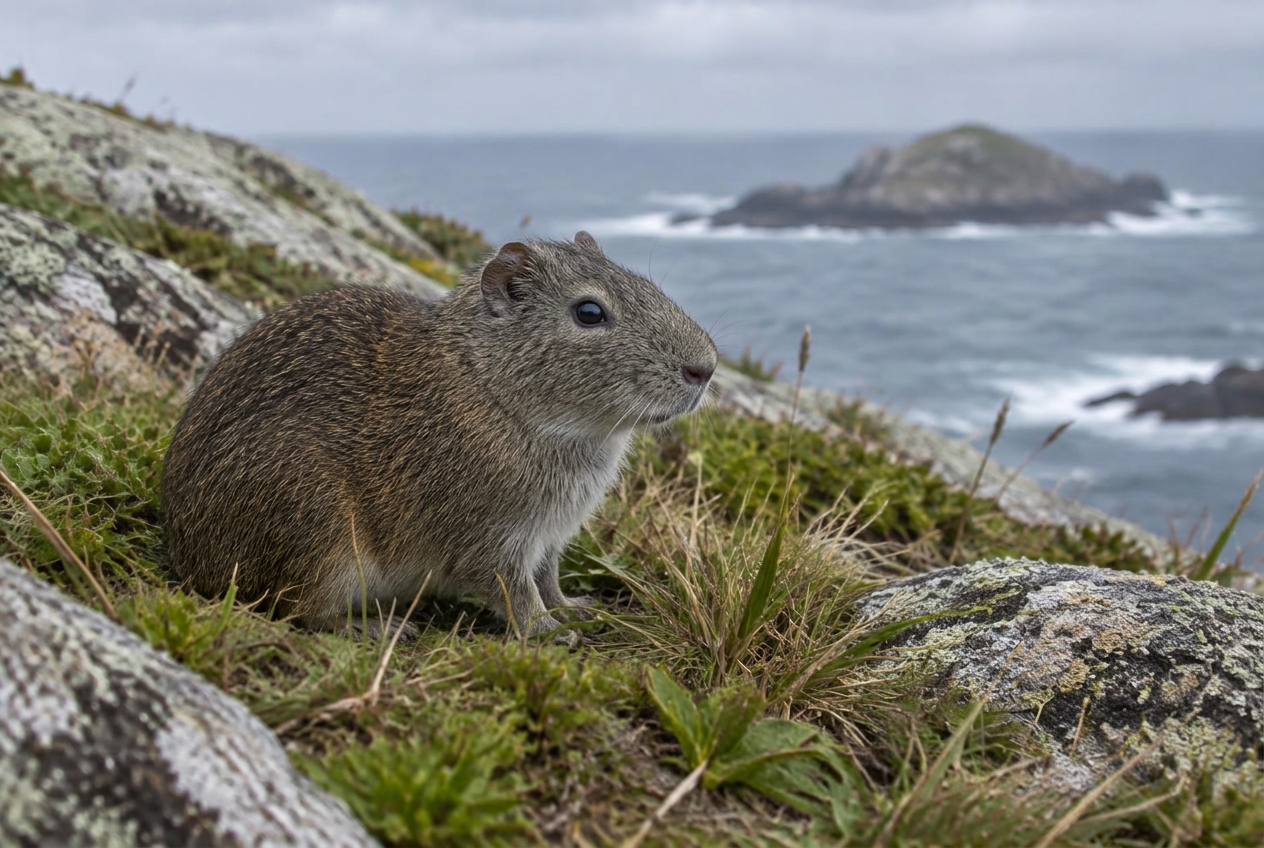 Illustrative depiction
Overview
Life on a postage stamp
Off the coast of southern Brazil, the Moleques do Sul archipelago is a cluster of three rocky islets formed around 8,000 years ago. Here, on barely four hectares, lives the Santa Catarina guinea pig. Its coarse brownish-grey fur blends into the weathered rock and scrub, and short, sturdy legs carry it over the stones and into shallow hollows when raptors such as caracaras and peregrine falcons pass overhead.
There are no trees and little fresh water, so it gets almost all its moisture from the grasses, leaves and roots it eats, and re-eats its droppings to get every nutrient. Most active at dawn and dusk, it lives in close, sociable colonies, talking in whistles and chirps. With no land predators, it is unusually trusting.
It can breed all year, but has just one or two young after a 60–70 day pregnancy. Newborns are furred, open-eyed and can weigh a quarter of their mother's weight. Only 40 to 60 survive today.
Why it is nearly gone
Four hectares, no room for error
The entire species lives on less than four hectares of windswept rock. Any one of these threats could end it.
Storms, fire or disease
One brush fire, severe ocean storm or disease outbreak could wipe out the whole wild population within hours. There is nowhere else for it to go.
Protection on paper only
The islets sit inside Serra do Tabuleiro State Park, but patrols and enforcement on the ground are badly underfunded.
Unchecked landings
Fishermen and visitors can still land, trampling vegetation, damaging habitat and sometimes hunting.
Introduced predators
A single dog, cat or mainland rat brought ashore could devastate animals that evolved with no land predators.
Conservation history
8,000 years alone on an island
| Year | Event |
|---|---|
| ~8,000 years ago | Rising seas cut off the Moleques do Sul islets from the mainland, isolating the guinea pigs that became Cavia intermedia. |
| 1999 | Described as a distinct species. |
| 2000s | Surveys find only about 40–60 individuals on the main islet. |
| Today | The islets sit inside Serra do Tabuleiro State Park, but protection is weakly enforced and boats still land. |
Take action
Who's fighting for the Santa Catarina guinea pig
Government agencies, a Brazilian charity and specialist scientists working to protect the islets and Brazil's Atlantic coast.
SOS Mata Atlântica Foundation
Brazilian charity protecting and restoring the Atlantic Forest and its coastal islands through science, policy and education.
IUCN SSC Small Mammal Specialist Group
Global network of experts tracking high-risk small mammals like Cavia intermedia and setting conservation priorities.
Instituto Chico Mendes de Conservação da Biodiversidade (ICMBio)
Brazil's federal conservation agency, monitoring endangered species and recommending strict protection for threatened wildlife.
Instituto do Meio Ambiente de Santa Catarina (IMA)
The state environment body that manages Serra do Tabuleiro State Park and enforces access limits on Moleques do Sul.
Everyday actions
What you can do from home
- 01
Back island conservation funding
Support funds for island species. They pay for ranger patrols, boat monitoring and signs that stop illegal landings.
- 02
Travel clean
On islands and in reserves anywhere, clean your shoes, kit and clothes, and leave your dog at home, so you don't carry seeds, pests or disease.
- 03
Speak up for small species
Big animals get most conservation money. Share stories about overlooked species like this one.
Selected references