Pygmy three-toed sloth
Bradypus pygmaeus · Isla Escudo de Veraguas, Panama
in the wild
The most endangered of all sloths, found only in the red mangroves of one small island off Panama. Estimates conflict: see the timeline below.
Source: ZSL EDGE of Existence (IUCN Red List last assessed April 2022: population unknown, declining)
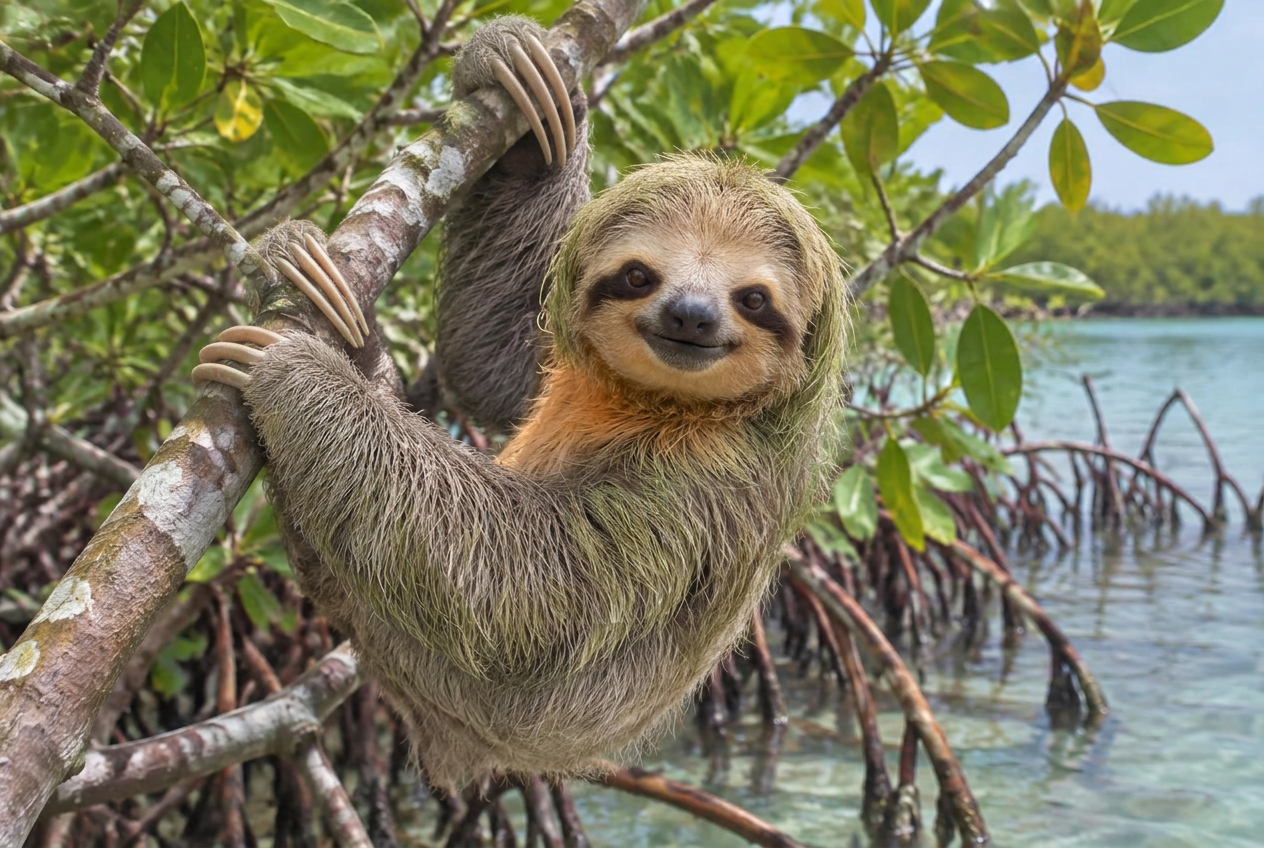 Illustrative depiction
Overview
A dwarf sloth born of 9,000 years of isolation
The pygmy three-toed sloth, also called the dwarf or monk sloth, was described in 2001 by Robert P. Anderson and Charles O. Handley Jr. of the Smithsonian Institution. It is the most endangered of all sloths, and looks like a small brown-throated three-toed sloth.
It lives only on Isla Escudo de Veraguas, an uninhabited island of about 400 ha, 17 km off Panama's Caribbean coast. Cut off from the mainland for some 9,000 years, its sloths shrank through island dwarfism. The island became a Key Biodiversity Area in 2018.
It eats red mangrove leaves and spends up to 20 hours a day in the trees, coming down only to urinate or defecate, as little as once a week. It is a good swimmer. Algae in its fur give it a greenish tinge that helps it hide. Mothers have one baby at a time and carry it everywhere for six months to a year.
Why it is nearly gone
One island, a few mangrove clumps
Its entire world is a single 4.3 km² island, with no captive population as a safety net.
Mangrove cutting
The island's mangroves survive in only about five clumps, and the canopy between them has been cut. Unregulated cutting is a serious threat (Kaviar et al. 2012).
Hunting & disturbance
The island is uninhabited, but seasonal visitors such as fishermen and lobster divers have been known to hunt sloths opportunistically. Tourism could also add pressure.
Pet trade & photo props
The species' rising popularity makes it vulnerable to capture for the pet trade or use as a tourist photo prop. In 2013 an attempt to export 8 sloths to the US was blocked at Panama's ports.
Minimal legal protection
Isla Escudo is an indigenous reserve (Comarca), but the sloth and its habitat have minimal protection under Panamanian law.
Climate change
For a species confined to one small island's mangroves, even modest shifts in temperature, rainfall or sea level could reshape its only habitat.
Conservation history
Conflicting counts, one shrinking home
| Year | Event |
|---|---|
| 2001 | First described by Robert P. Anderson and Charles O. Handley Jr. of the Smithsonian Institution. |
| 2012 | A census estimates around 79 individuals in the coastal mangroves of Isla Escudo. |
| 2012 | Kaviar et al. report unregulated mangrove cutting as a serious threat; mangroves survive in only about five clumps. |
| 2013 | The Pygmy Sloth Project is established under ZSL's EDGE programme, led by EDGE Fellow Direne Smith Cabellos. |
| 2013 | The Animal Welfare Institute petitions to list the species under the US Endangered Species Act. |
| Sep 2013 | Dallas World Aquarium representatives try to capture 8 sloths for export to the US; the export is blocked at Panama ports. |
| 2015 | Bryson Voirin radio-collars 10 sloths and finds they also range inland; the population is estimated at 500–1,500. |
| 2018 | Isla Escudo is assessed as a Key Biodiversity Area of international significance. |
| Apr 2022 | Latest IUCN Red List assessment: Critically Endangered, population declining, no estimate given. |
| Today | No captive safety-net population exists. ZSL estimates fewer than 100 remain. |
Take action
Who's fighting for the pygmy sloth
These groups monitor the sloth, rescue injured animals, protect habitat and campaign against the sloth trade. Give to them directly.
The Pygmy Sloth Project
Established in 2013 under ZSL's EDGE programme and led by EDGE Fellow Direne Smith Cabellos, monitoring the pygmy sloth in its habitat on Isla Escudo.
ZSL EDGE of Existence
Runs the "Saving the pygmy sloth from extinction" programme. Donations support EDGE generally, not the sloth alone.
IUCN SSC Anteater, Sloth and Armadillo Specialist Group
Global expert network for sloths, anteaters and armadillos.
Pan-American Conservation Association (APPC)
Based in Panama, rescues, treats and rehabilitates injured or displaced sloths for return to the wild.
Sloth Conservation Foundation
Political change, anti-trade campaigns and community awareness for Central American sloths, including Slothtober and the campaign to end the commercial sloth trade in the US.
Animal Welfare Institute
Campaigns against the trade and captivity of pygmy sloths; petitioned in 2013 to list the species under the US Endangered Species Act.
Find out about International Sloth Day and the Sloth Conservation Foundation's annual Slothtober campaign ↗
Everyday actions
What you can do from home
- 01
Never buy or handle a pet sloth
Never buy a sloth, and refuse photo opportunities that use captive wild sloths.
- 02
Don't disturb sloths on Isla Escudo
If you visit, keep your distance, never touch or feed a sloth, and choose operators who respect the island's protected status.
- 03
Protect mangrove forests
Support mangrove protection and reforestation to keep the sloth's only habitat intact and connected.
- 04
Reduce your carbon footprint
Lower energy use and back climate action to slow changes that could reshape this tiny habitat.
- 05
Demand real legal protection
Urge representatives to strengthen and enforce protection for the island and its endemic species.
Selected references
- IUCN Red List — Bradypus pygmaeus (last assessed April 2022)
- ZSL EDGE of Existence — Saving the pygmy sloth from extinction
- Animal Welfare Institute — Pygmy three-toed sloth proposed for ESA listing in response to AWI petition
- Hayssen, V., 2008. Bradypus pygmaeus (Pilosa: Bradypodidae). Mammalian Species, (812), pp.1–4.
- Anderson, R.P. and Handley, C.O., 2001. A new species of three-toed sloth (Mammalia: Xenarthra) from Panama, with a review of the genus Bradypus. Proceedings of the Biological Society of Washington, 114(1), pp.1–33.
- Kaviar, B., Shockey, J. and Sundberg, S., 2012. Unregulated cutting of mangroves on Isla Escudo.
- Voirin, B., 2015. Biology and conservation of the pygmy sloth, Bradypus pygmaeus. Journal of Mammalogy, 96(4), pp.703–707.
- Smithsonian Institution — More endangered pygmy sloths in Panama than previously estimated (2015).