Ploughshare tortoise
Astrochelys yniphora · Baly Bay, NW Madagascar
possibly under 100
Madagascar's golden-shelled tortoise, described as functionally extinct in the wild by the Turtle Survival Alliance in 2023.
Source: Turtle Survival Alliance (2023): functionally extinct in the wild
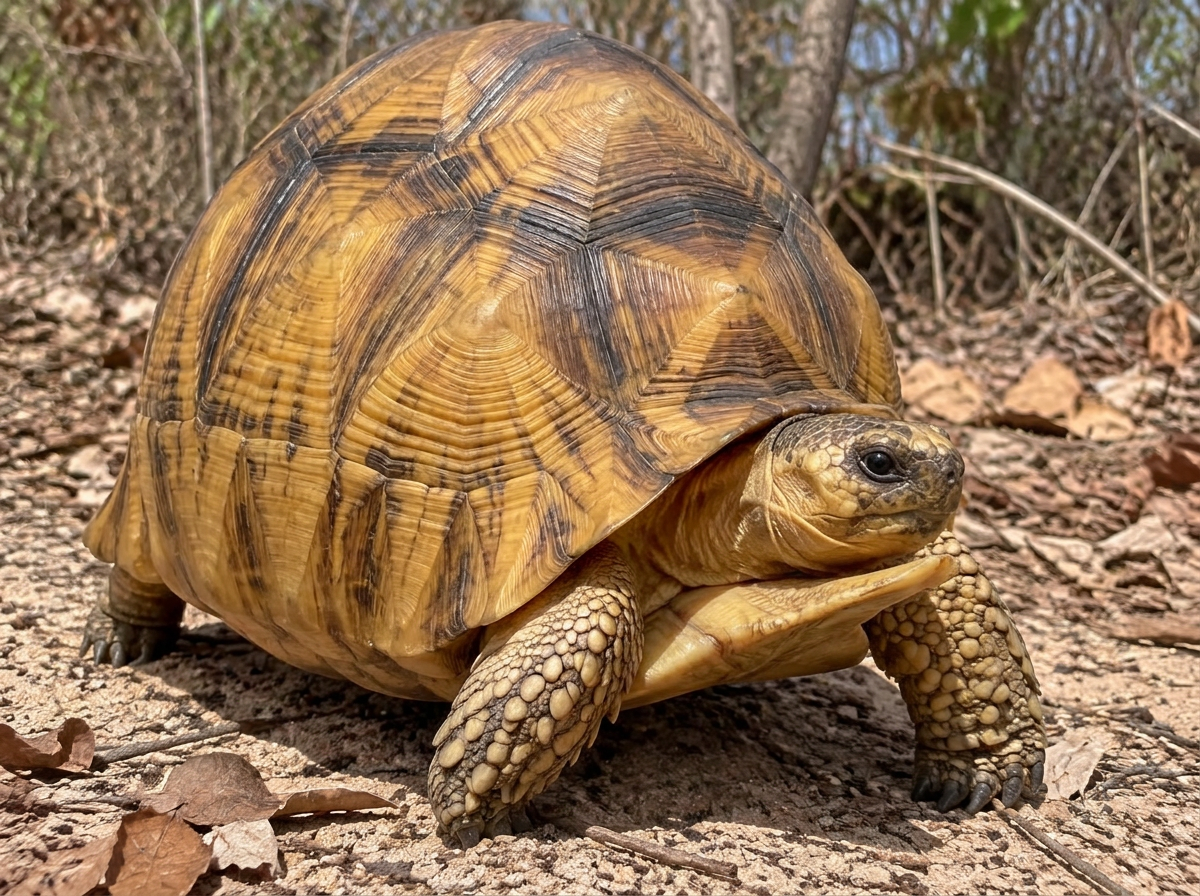 Illustrative depiction
Overview
The world's most threatened tortoise
Also called the angonoka, the ploughshare tortoise is the most endangered of Madagascar's four endemic tortoise species. It gets its name from the gular scute under its chin, which juts forward like the blade of a plough. Its high, golden-brown shell is what makes it so valuable to smugglers.
It now lives only in Baly Bay National Park in north-west Madagascar. In 2000 the wild population was estimated at about 440–600; a 2004 population viability analysis predicted it could be extinct by 2014–2019. The population probably fell by more than half between 2006 and 2015.
Today fewer than 400 are thought to remain in the wild, possibly under 100, and the Turtle Survival Alliance described it as functionally extinct in the wild in 2023. Breeding programmes in Madagascar and abroad, and releases of captive-bred juveniles, are keeping it going.
Why it is nearly gone
Worth more than gold
Poaching for the illegal pet trade is driving it to extinction.
Poaching for the pet trade
Between 2002 and 2018, 334 ploughshare tortoises were recorded poached. Collectors pay high prices on the black market.
A status-symbol shell
Demand for its distinctive golden shell, especially in Asian countries where it is seen as a status symbol, drives smuggling.
Brush fires
Fires set to clear land for grazing burn through the scrub where the tortoises live.
Slow to recover
Tortoises take 20–25 years to mature, so every adult taken from the wild sets the population back by decades.
Conservation history
A countdown to extinction
| Year | Event |
|---|---|
| 2000 | Wild population estimated at around 440–600 (Leuteritz & Pedrono) |
| 2004 | Population viability analysis predicts extinction by 2014–2019 |
| 2008 | Estimate revised to about 400, roughly half adults |
| 2013 | WWF estimates about 400 left; 54 juveniles seized at Bangkok airport |
| 2015 | 100 juveniles released back into the wild |
| 2002–2018 | 334 tortoises recorded poached (Mandimbihasina et al.) |
| 2023 | Turtle Survival Alliance describes it as functionally extinct in the wild |
Take action
Who's fighting for the ploughshare tortoise
These groups breed tortoises, patrol Baly Bay against poachers and work with local communities. Give to them directly.
Durrell Wildlife Conservation Trust
Anti-trafficking, community anti-poaching work and reintroduction in Baly Bay.
Turtle Survival Alliance
Captive assurance colonies, habitat protection and breeding programmes.
IUCN SSC Tortoise and Freshwater Turtle Specialist Group
Sets global conservation priorities for tortoises and freshwater turtles.
Everyday actions
What you can do from home
- 01
Never buy wild-caught reptiles
If you keep reptiles, buy only from verified captive breeders and never buy rare tortoises with unclear origins.
- 02
Report illegal wildlife sales
Report suspicious online listings of rare tortoises to the platform and to wildlife-trade authorities such as TRAFFIC.
- 03
Spread the word
Share the ploughshare's story: lower demand is the only lasting answer to poaching.
- 04
Support anti-poaching patrols
Community rangers in Baly Bay are the tortoise's front line. Donations fund patrols and monitoring.
Selected references
- IUCN Red List — Astrochelys yniphora (last assessed January 2008)
- Mandimbihasina, A.R., Woolaver, L.G., Concannon, L.E., Milner-Gulland, E.J., Lewis, R.E., Terry, A.M., Filazaha, N., Rabetafika, L.L. and Young, R.P. (2020). The illegal pet trade is driving Madagascar's ploughshare tortoise to extinction. Oryx, 54(2), 188–196.
- Walker, R., Lewis, R., Mandimbihasina, A., Goode, E., Gibbons, P., Currylow, A. and Woolaver, L. (2015). The conservation of the world's most threatened tortoise: the ploughshare tortoise (Astrochelys yniphora) of Madagascar. Testudo, 8, 68–75.
- Turtle Survival Alliance — ploughshare tortoise
- Turtle Conservancy — ploughshare tortoise
- Durrell — ploughshare tortoise
- Forgotten Nature — the angonoka tortoise