Philippine eagle
Pithecophaga jefferyi · Philippines
estimated
The monkey-eating eagle, one of the largest and rarest eagles on Earth, found only in the forests of the Philippines.
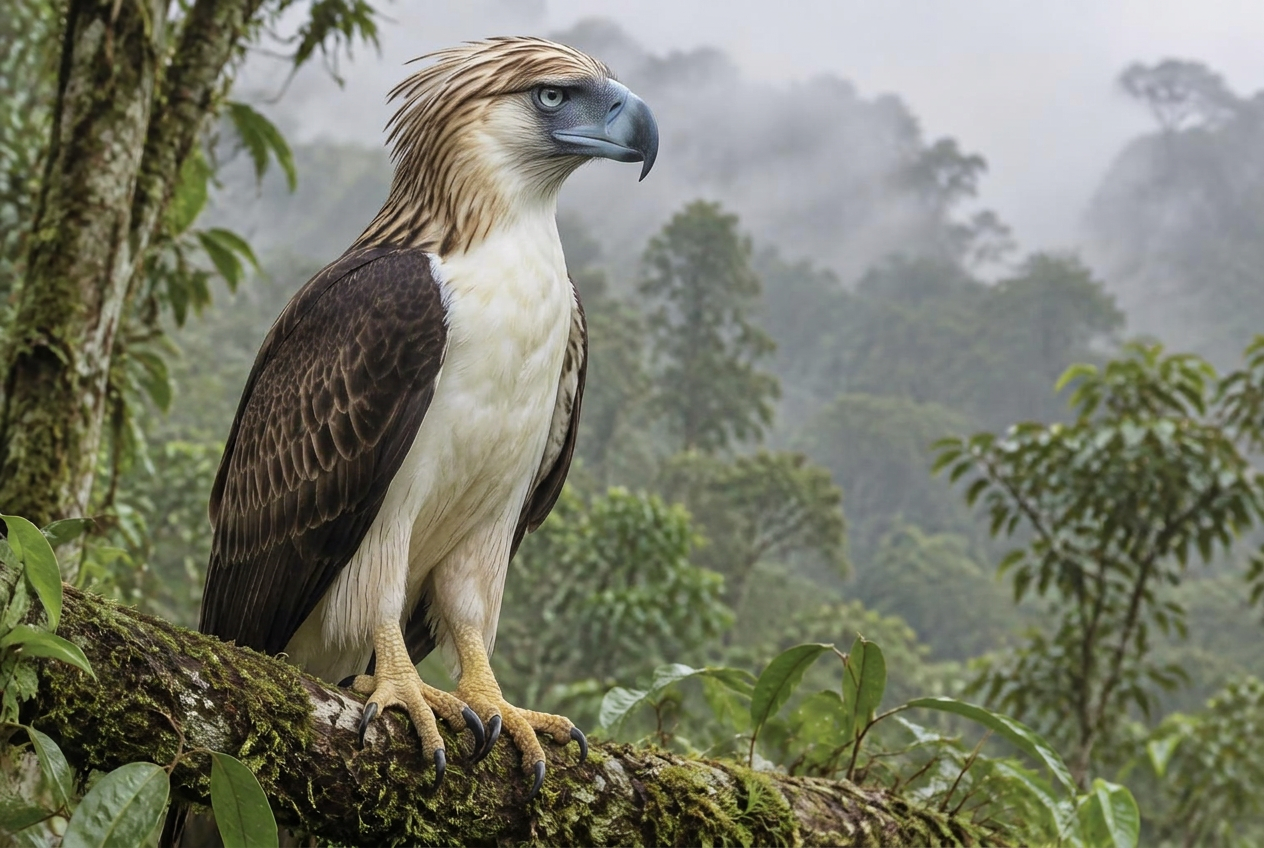 Illustrative depiction
Overview
A giant of the Philippine forest
The Philippine eagle is found only in the Philippines and is the largest eagle in the world by wing area and length. It is the country's national bird.
It is known as the monkey-eating eagle because early local reports said it ate only monkeys. It has since been found to hunt other animals too, including snakes, birds and lizards.
Fewer than 400 breeding pairs remain, and the population is still falling as the forests it depends on are cleared.
Why it is nearly gone
A forest giant losing its forest
Deforestation and habitat loss are the main threats to the Philippine eagle.
Deforestation
Logging and clearing have removed much of the old-growth forest the eagle needs to hunt and nest.
Habitat fragmentation
Each pair needs a large territory of continuous forest; broken-up forest supports far fewer pairs.
Shooting and trapping
Eagles are still killed by hunters or caught in traps set for other animals.
Slow breeding
A pair raises a single chick about every two years, so every lost bird is hard to replace.
Conservation history
A national bird in decline
| Year | Event |
|---|---|
| 1896 | First described to science; named the monkey-eating eagle after early reports that it ate only monkeys. |
| 1987 | Philippine Eagle Foundation founded to breed, rescue and protect the eagle. |
| 1995 | Declared the national bird of the Philippines. |
| 2023 | Global estimate of fewer than 400 breeding pairs (Sutton et al.). |
| 2025 | IUCN reassesses the species as Critically Endangered and declining. |
Take action
Who's fighting for the Philippine eagle
Philippine and international groups breed, rescue and release eagles, research wild pairs and protect their forests with local communities.
Philippine Eagle Foundation
Conservation breeding, rescue, rehabilitation, release, research and community-based forest protection.
Mandai Nature
Singapore-based conservation organisation supporting field tracking, research and population monitoring, and overseas breeding pairs.
Rainforest Trust
Works with local groups to protect ancestral and forest habitats such as the Sierra Madre and Mindanao spirit forests as reserves.
The Peregrine Fund
Long-standing technical and financial support for the Philippine Eagle Foundation's breeding and reintroduction programmes.
Biodiversity Management Bureau (Philippines)
The Philippine government agency leading national eagle protection, community engagement and education.
Everyday actions
What you can do from home
- 01
Adopt an eagle
Symbolic adoptions fund the care of eagles at the Philippine Eagle Foundation.
- 02
Buy FSC-certified wood and paper
Certified products help keep tropical rainforests standing.
- 03
Fund forest protection
Donations help secure the forests where wild pairs still nest.
- 04
Spread the word
Share the eagle's story so more people know it is one of the world's rarest raptors.
Selected references
- IUCN Red List — Pithecophaga jefferyi (last assessed June 2025)
- Sutton, L.J., Ibañez, J.C., Salvador, D.I., Taraya, R.L., Opiso, G.S., Senarillos, T.L.P. and McClure, C.J., 2023. Priority conservation areas and a global population estimate for the critically endangered Philippine Eagle. Animal Conservation, 26(5), pp.684-700.
- Panopio, J.K., Pajaro, M., Grande, J.M., Torre, M.D., Raquino, M. and Watts, P., 2021. Conservation Letter: Deforestation—The Philippine Eagle as a case study in developing local management partnerships with indigenous peoples. Journal of Raptor Research, 55(3), pp.460-467.
- The Peregrine Fund — Philippine eagle