Orange-bellied parrot
Neophema chrysogaster · Tasmania & south-east Australia
up from 14 in 2017
A neon-bright migrating parrot, and arguably the most endangered parrot on Earth.
Source: OBP Recovery Team (Nov 2025) · IUCN Red List
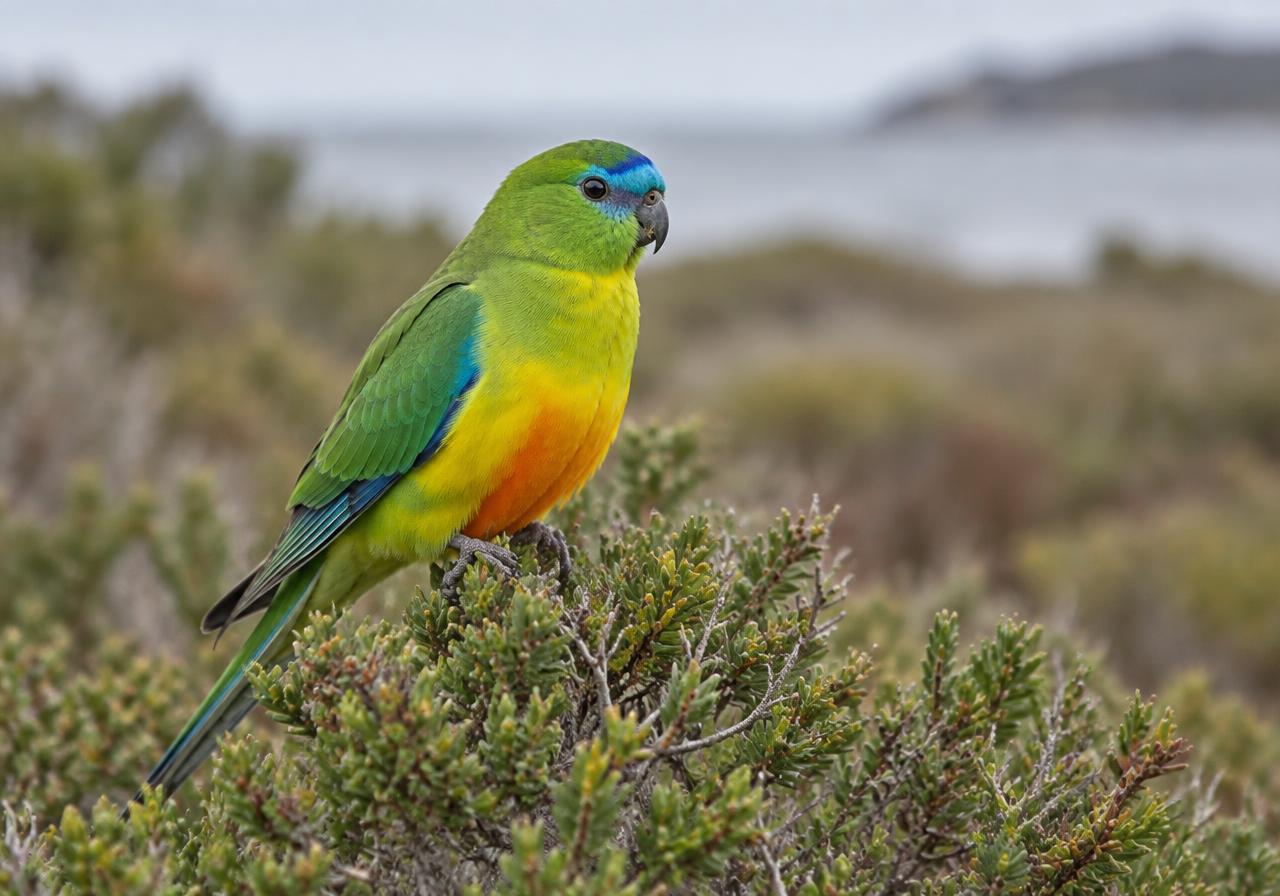 Illustrative depiction
Overview
A neon parrot of the Tasmanian saltmarsh
The orange-bellied parrot is a small, almost neon-bright bird about 20 cm long. Males are bright green above and yellow below, with an orange patch on the belly and a two-toned blue band across the face. Females and young birds are a duller green. Its Latin name means "golden belly".
It is one of only three parrots in the world that migrate. Birds arrive at Melaleuca in southwest Tasmania in October to breed, now mostly in nest boxes, then in March and April fly about 250 km across Bass Strait to spend winter on the coastal saltmarsh of Victoria and South Australia, feeding on glasswort and other seeds.
Pairs usually stay together for life. Females lay 3–6 eggs, and the chicks hatch blind and covered in white down. The species has not been seen breeding anywhere but Melaleuca since 2008.
Why it is nearly gone
One breeding site, one migration
Every wild bird breeds in one place. One storm, one disease outbreak or one failed season could undo the recovery.
Lost wintering habitat
The mainland coastal saltmarsh where the birds spend winter has been cleared and broken up since European settlement.
A dangerous migration
Every bird crosses Bass Strait twice a year, and many never make it back to breed.
Too few females
With far more males than females, few pairs form and few chicks are raised each season.
Disease
Beak and feather disease has killed many birds, and one outbreak could hit the whole flock.
Conservation history
Pulled back from 14 birds
| Year | Event |
|---|---|
| 1790 | First described by ornithologist John Latham |
| 1979 | Monitoring begins at Melaleuca, southwest Tasmania |
| 1982 | Annual population counts begin in Victoria |
| 1984 | Conservation management of the species begins |
| 1986 | Captive population established (Smales et al. 2000) |
| 1999–2009 | 423 captive birds released at Birch's Inlet, but the group dies out |
| 2010–11 | 21 wild birds captured and added to the captive gene pool |
| May 2011 | 10 birds flown from Tasmania to Healesville Sanctuary to avert extinction |
| Since 2013 | Captive birds released at Melaleuca every year (about 22 a year) |
| 2016/17 | Only 3 wild females return from migration |
| Feb 2017 | Wild population falls to 14 birds |
| Nov 2025 | Wild population rebounds to 91 birds |
Take action
Who's fighting for the orange-bellied parrot
Several groups work together through the Recovery Team, breeding, releasing and counting birds across Tasmania and mainland Australia.
Orange-bellied Parrot Recovery Team
Coordinates the national recovery programme, monitoring at Melaleuca and captive releases
Currumbin Wildlife Sanctuary
Queensland wildlife sanctuary funding research and breeding work for the orange-bellied parrot.
Wildcare Tasmania
Tasmanian volunteer charity whose Friends of the OBP group supports the wild population at Melaleuca.
Moonlit Sanctuary
Captive breeding and release partner in Victoria, with an adopt-a-parrot scheme
Zoos SA
Breeds parrots at Adelaide Zoo, one of the three main breeding sites
BirdLife Australia
Leads winter population counts, mainland habitat work and community engagement
Zoos Victoria
Breeds and rears parrots at Healesville Sanctuary, one of the three main breeding sites
Wadawurrung Traditional Owners Aboriginal Corporation
Cares for Country and restores burning practices in the parrot's mainland winter habitat
National Threatened Species Institute
Australian institute supporting recovery programs for threatened species, including the orange-bellied parrot.
Everyday actions
What you can do from home
- 01
Never buy wild-caught parrots
Only buy captive-bred birds from licensed breeders; demand for bright wild parrots fuels trapping.
- 02
Protect coastal saltmarsh
Support wetland protection and oppose clearing of the saltmarsh the parrot needs in winter.
- 03
Back Indigenous land care
Support Traditional Owner-led burning that may boost the parrot's food plants.
- 04
Spread the story
Few people know Australia has a migrating parrot down to under 100 birds. Share it, especially on Threatened Species Day, 7 September.
Selected references
- IUCN Red List — Neophema chrysogaster (last assessed August 2018)
- Orange-bellied Parrot Recovery Team
- Stojanovic et al. (2017) — constraints on recovery of the orange-bellied parrot
- Menkhorst (1990) — orange-bellied parrot recovery outline
- Smales et al. (2000) — establishment of the captive population