Northern white rhino
Ceratotherium simum cottoni · Ol Pejeta, Kenya
Najin and Fatu, both female
A mother and daughter under 24-hour armed guard in Kenya, the last of a rhino lineage that roamed Central Africa.
Source: Ol Pejeta Conservancy · Colossal Foundation
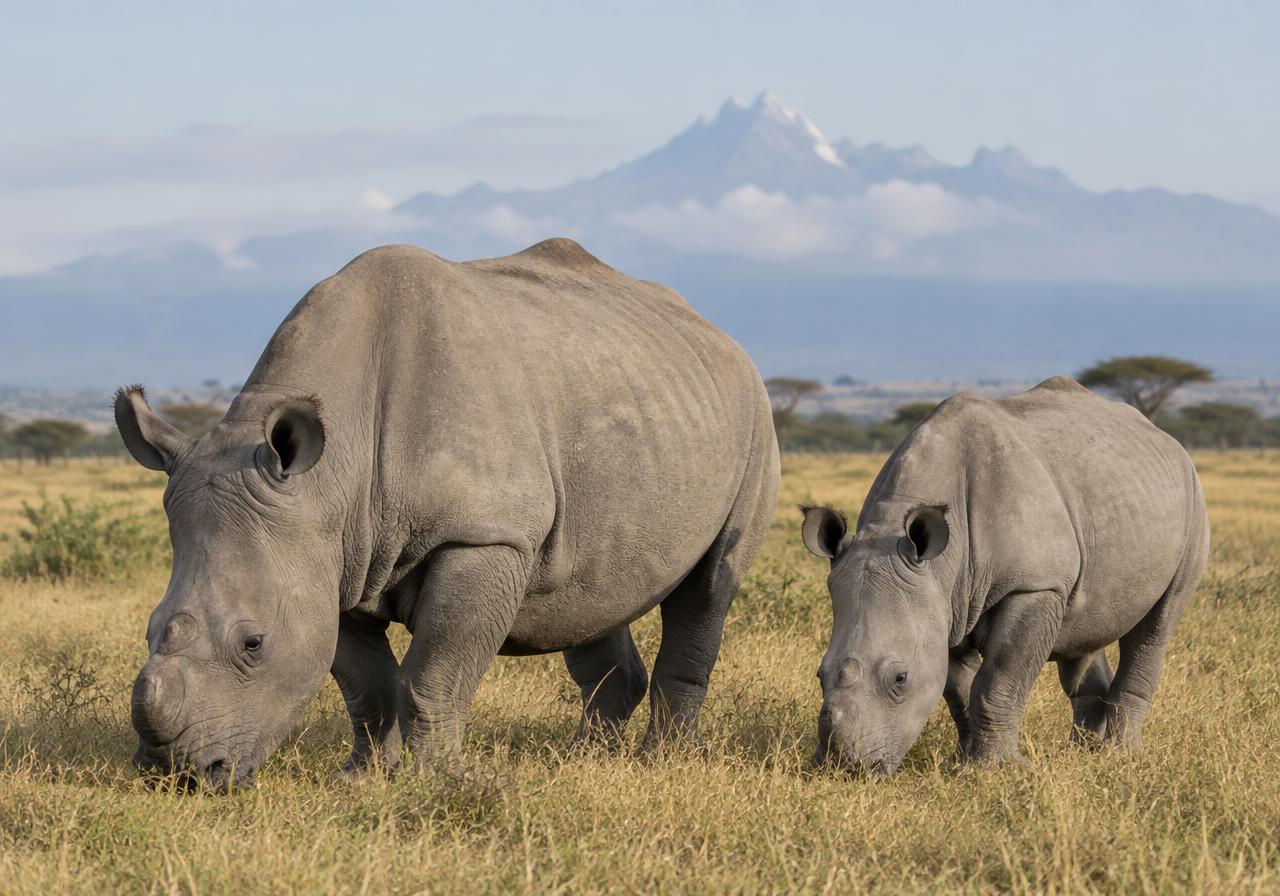 Illustrative depiction
Overview
A gentle grazer
Northern white rhinos graze low savanna grass with wide, square mouths, and wallow in mud to keep cool. In the wild they were calm and social: active in the cool of morning and late afternoon, resting through midday. Females and young lived in small groups of two or three, while males held territories. Compared with southern white rhinos they are shorter, almost hairless, hold their heads higher, and have more calls than any other rhino.
Rhinos as a group have existed for more than 50 million years. Northern and southern white rhinos split between about 500,000 and 1,000,000 years ago, and scientists still debate whether the northern form is a subspecies or a separate species.
Najin was born in 1989 at Dvůr Králové Zoo in the Czech Republic; her daughter Fatu was born there in 2000. Neither can carry a pregnancy. Both have had their horns removed so poachers have no reason to target them. Scientists have collected 308 eggs from them and made 38 embryos, now frozen and waiting for southern white rhino surrogate mothers.
Why it is nearly gone
Horn, war and time
In half a century, poaching cut the northern white rhino from over a thousand to two.
Poaching for horn
Demand for rhino horn, falsely prized as medicine, paid armed gangs to kill rhinos across their range.
War
Civil wars in Sudan and Zaire flooded parks with automatic weapons, leaving rangers outgunned.
Failed captive breeding
Rhinos in zoos rarely bred, and a 16–18 month pregnancy made any recovery slow.
No males left
Since Sudan died in 2018 the subspecies cannot breed naturally. Its future rests on IVF and surrogates.
Conservation history
From thousands to two
| Year | Event |
|---|---|
| 1963 | ~1,100–1,300 in Zaire (now DR Congo), IUCN estimate |
| 1970s–80s | Poachers kill ~485 of the remaining ~500, leaving ~15 |
| 1980–81 | Fewer than 1,000, then fewer than 700 by the end of 1981 (regional estimates) |
| 1990s–2003 | Garamba National Park population recovers from ~15 to ~32 |
| 2006 | No confirmed sightings in Garamba |
| 2008 | Reported extinct in the wild |
| 2015 | Last rhinos at San Diego Zoo Safari Park and Dvůr Králové die; genetic rescue plan drawn up |
| 2018 | Sudan, the last male, is put to sleep at Ol Pejeta on 19 March |
| 2019 | The BioRescue programme formally begins |
| 2024 | First northern white rhino embryo transfers into southern white rhino surrogates |
| 2025 | 38 embryos stored in Germany and Italy |
| Today | 2 left: Najin and Fatu, neither able to carry a calf |
Take action
Who's fighting for the northern white rhino
With no males left, the only hope is IVF: embryos made from Najin and Fatu’s eggs and frozen sperm, carried by southern white rhino mothers. These groups guard the last two and run the science.
Ol Pejeta Conservancy
24-hour armed guards, vet care and a safe home for Najin and Fatu in Kenya
BioRescue (Leibniz-IZW)
Leads the egg harvesting, IVF and embryo work to bring the subspecies back
San Diego Zoo Wildlife Alliance
Its Frozen Zoo stores northern white rhino cells for stem-cell research
Colossal Foundation
Backs BioRescue's genetic rescue work, using stem cells and genome science to help rebuild the subspecies
Everyday actions
What you can do from home
- 01
Give to the frontline
Egg collection, frozen storage and round-the-clock guards all need steady funding.
- 02
Visit a conservancy
Tourism at places like Ol Pejeta pays rangers' wages and protects rhinos.
- 03
Speak up about the horn trade
Share accurate facts and back stronger laws against wildlife trafficking.
- 04
Back biobanking
Frozen cell banks are a safety net for thousands of other species too.
Selected references
- IUCN Red List — Ceratotherium simum
- Ol Pejeta Conservancy
- BioRescue
- San Diego Zoo Wildlife Alliance — Frozen Zoo
- Emslie & Adcock, IUCN SSC African Rhino Specialist Group reports