Northern hairy-nosed wombat
Lasiorhinus krefftii · Central Queensland, Australia
Epping Forest, latest estimate
Down to about 35 animals in the 1980s, this burrowing marsupial has climbed back to around 300 at a single fenced national park.
Source: Australian Wildlife Conservancy estimate (Epping Forest NP)
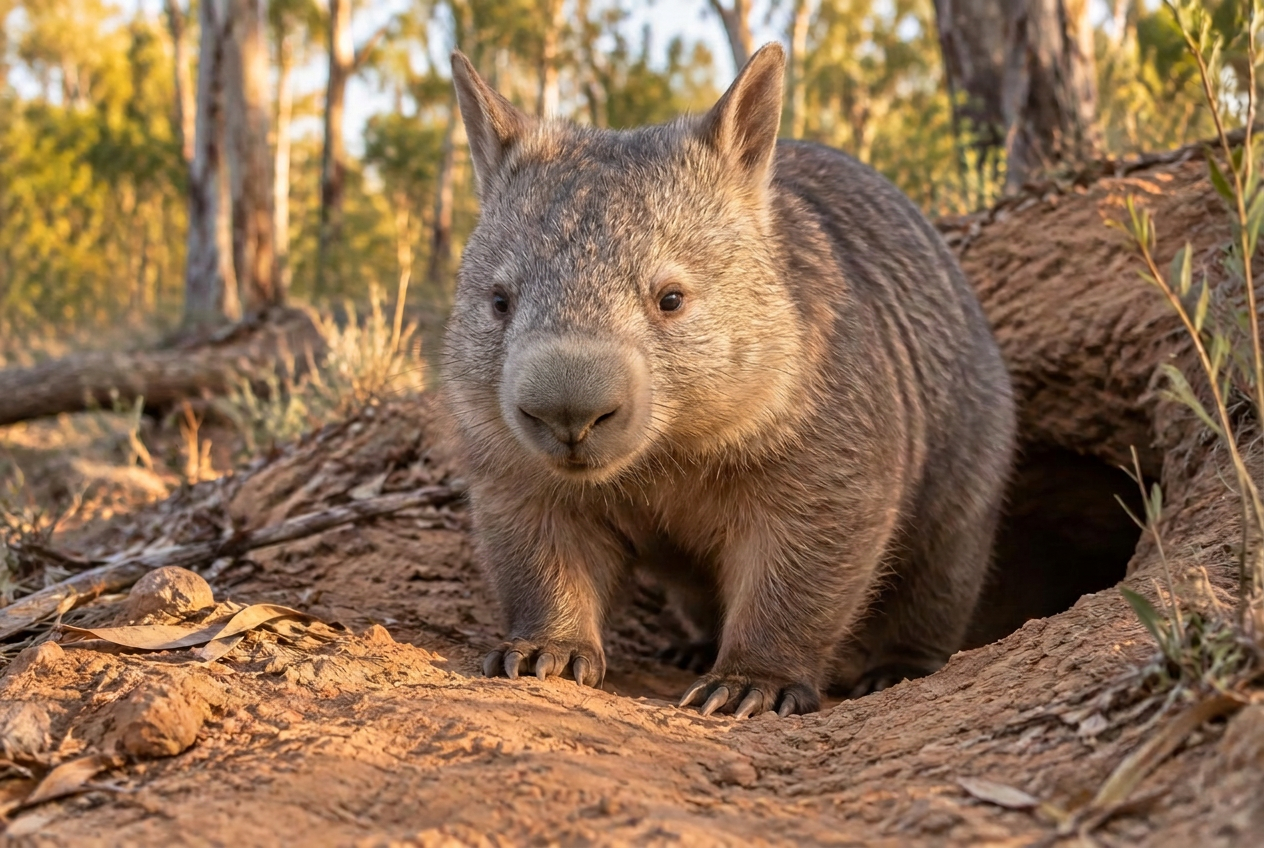 Illustrative depiction
Overview
A wombat on the way back
The northern hairy-nosed wombat is one of the rarest large mammals on Earth. A heavy, burrowing marsupial, it is named for the fine hair on its broad nose, and spends its days in deep burrows dug into sandy soil, emerging at night to graze.
It once lived across parts of New South Wales and Queensland, but by the 1980s only about 35 survived, all at Epping Forest National Park in central Queensland. A predator-proof fence, rangers and decades of monitoring have helped the colony recover to an estimated 300 animals.
Small protected populations have also been established at the Richard Underwood Nature Refuge and at Dhuny Yumba National Park, formerly Powrunna State Forest.
Why it is nearly gone
Too few grasses, too few places
Nearly every wombat lives inside one fenced park, so food shortages and single disasters matter enormously.
Competition for grass
Cattle grazing and introduced buffel grass have replaced the native grasses wombats rely on.
Drought
Long dry spells leave little food and can stop wombats breeding for years.
Predators
Wild dogs (dingoes) attack wombats; a predator-proof fence now protects Epping Forest.
Few populations
Almost all wombats live at one site, so a single fire, flood or disease outbreak could be disastrous.
Conservation history
From 35 to 300
| Year | Event |
|---|---|
| 1800s | Found in scattered populations across New South Wales and Queensland. |
| 1971 | Epping Forest National Park is created to protect the last known colony. |
| 1980s | Population falls to about 35 individuals as cattle grazing and drought take their toll. |
| 2002 | A predator-proof fence is completed around the Epping Forest colony. |
| 2009 | A second population is established at the Richard Underwood Nature Refuge near St George. |
| 2015 | IUCN Red List assessment estimates around 80 individuals. |
| 2024 | Epping Forest population estimated at around 300; a third site at Dhuny Yumba National Park is being established. |
Take action
Who's fighting for the wombat
Park rangers, conservation charities and researchers are protecting the colonies and building new ones.
Australian Wildlife Conservancy
Partners with the Queensland Government on wombat recovery, including the new Dhuny Yumba population.
The Wombat Foundation
Raises funds and awareness for northern hairy-nosed wombat research and recovery.
Queensland Parks & Wildlife Service
Manages Epping Forest National Park (Scientific) and leads monitoring of the wild colonies.
Everyday actions
What you can do from home
- 01
Give to the recovery effort
Donations fund fencing, monitoring and the creation of new wombat colonies.
- 02
Choose native plants
Spreading buffel grass harms native grasslands. Avoid planting invasive pasture grasses.
- 03
Share their story
Few people know this wombat exists. Telling others builds support for its protection.
- 04
Respect closed areas
Epping Forest is closed to the public to protect the wombats. Never try to visit or disturb burrows.
Selected references
- IUCN Red List — Lasiorhinus krefftii (last assessed June 2015)
- Australian Wildlife Conservancy — Northern hairy-nosed wombat
- Queensland Government, 2022. Northern hairy-nosed wombat recovery action plan.
- Horsup, A.B., Austin, J.J., Fewster, R.M., Hansen, B.D., Harper, D.E., Molyneux, J.A., White, L.C. and Taylor, A.C., 2020. Demographic trends and reproductive patterns in the northern hairy-nosed wombat (Lasiorhinus krefftii) at Epping Forest National Park, central Queensland. Australian Mammalogy, 43(1), pp.72-84.
- Martin, A.M. and Carver, S., 2020. Ecology and conservation of the critically endangered northern hairy-nosed wombat (Lasiorhinus krefftii): past, present and future. Australian Mammalogy, 43(1), pp.10-21.