North Atlantic right whale
Eubalaena glacialis · Atlantic coast, US & Canada
about 70 breeding females
Once the “right” whale to hunt, it is now one of the most endangered large whales on Earth.
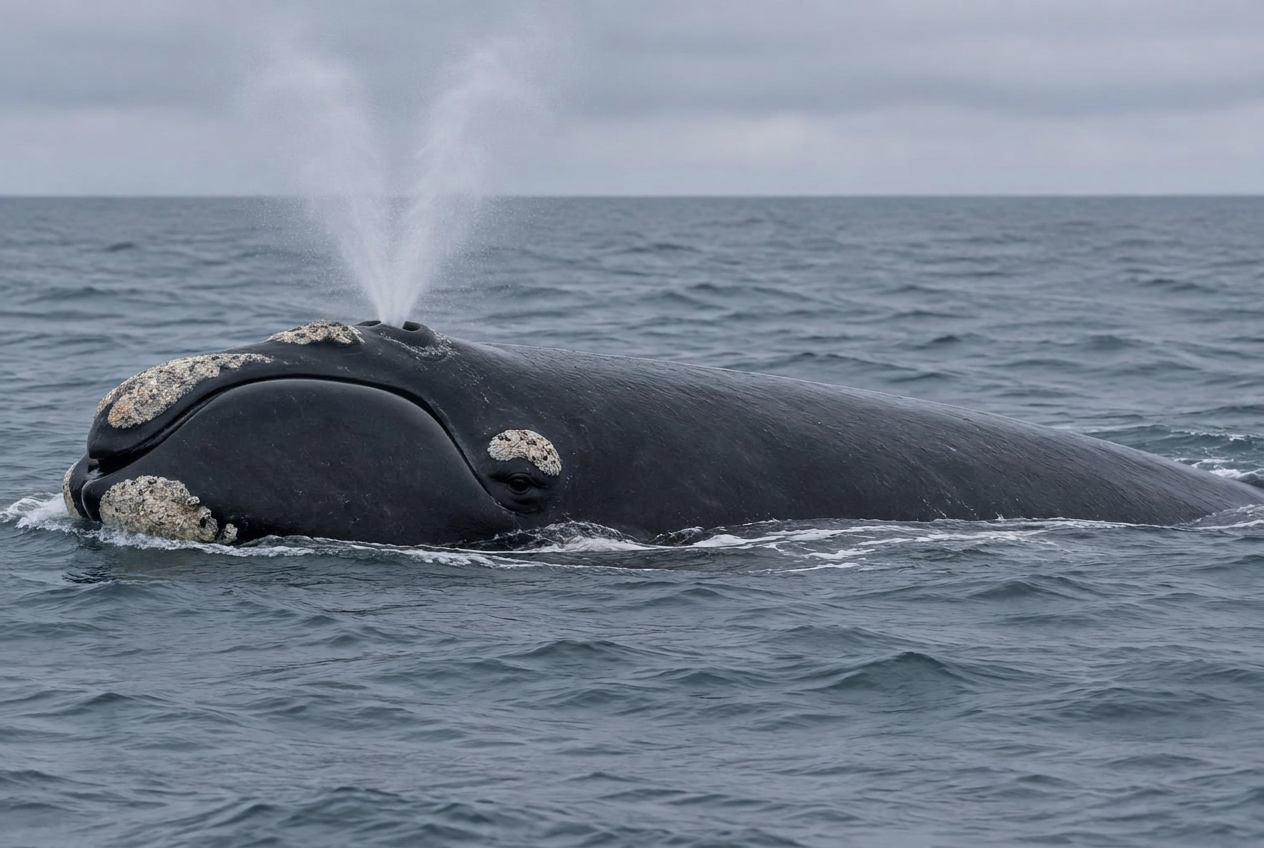 Illustrative depiction
Overview
The “right” whale to hunt
Whalers called it the “right” whale to hunt: it swims slowly, feeds by skimming near the surface and has so much blubber that it floats when killed. Centuries of whaling brought it close to extinction.
Protected from commercial whaling since 1935, it slowly recovered, but today it faces new dangers along the busy coasts of the US and Canada: collisions with ships and entanglement in fishing ropes.
The IUCN's January 2020 assessment counted 200–250 mature adults. IFAW estimates fewer than 360 whales in total, and Whale and Dolphin Conservation says only about 70 breeding females remain.
Why it is nearly gone
Ropes and ships
Almost every right whale death that can be explained is caused by people.
Fishing gear entanglement
Ropes from lobster and crab traps wrap around whales, causing injuries, exhaustion and slow deaths.
Ship strikes
Right whales feed and rest near the surface and are dark and finless, so ships often hit them without seeing them.
Climate change
Warming seas have moved the tiny crustaceans they eat, pushing whales into busy waters with fewer protections.
Too few calves
With only about 70 breeding females, and stress from injuries, too few calves are born to replace the whales that die.
Conservation history
From whaling to ship lanes
| Year | Event |
|---|---|
| 1890s | Commercial whaling has pushed the species to the edge; possibly fewer than 100 left |
| 1935 | International protection from commercial whaling |
| 2010 | Population peaks at roughly 480 whales |
| 2017 | Unusual Mortality Event declared after a sharp rise in deaths from ship strikes and entanglement |
| 2020 | IUCN moves the species to Critically Endangered (200–250 mature adults) |
| Today | Fewer than 360 whales, with only about 70 breeding females |
Take action
Who's fighting for the right whale
These groups track every whale, develop rope-free fishing gear and push for safer shipping rules. Give to them directly.
International Fund for Animal Welfare
Whale Alert technology, rope-free fishing gear trials and whale-safe seafood certification.
Whale and Dolphin Conservation
Campaigns for safer shipping and fishing rules to protect right whales.
Conservation Law Foundation
Uses the law to push for vessel speed limits and safer fishing gear.
IUCN SSC Cetacean Specialist Group
Global experts assessing and advising on whale and dolphin conservation.
North Atlantic Right Whale Consortium
Research partnership that tracks every known right whale and publishes the annual report card.
Everyday actions
What you can do from home
- 01
Choose whale-safe seafood
Look for lobster and crab caught with rope-free or whale-safe gear.
- 02
Back slower ship speeds
Support vessel speed rules in right whale areas — slower ships give whales time to move and make strikes less deadly.
- 03
Report sightings
If you are on the water, report right whale sightings through the Whale Alert app.
- 04
Spread the word
Share the right whale's story: public pressure has driven every protection it has today.
Selected references
- IUCN Red List — Eubalaena glacialis (last assessed January 2020)
- Pettis, H.M., Pace III, R.M. and Hamilton, P.K. (2021). North Atlantic Right Whale Consortium 2020 annual report card. Report to the North Atlantic Right Whale Consortium.
- Meyer-Gutbrod, E.L., Greene, C.H., Davies, K.T. and Johns, D.G. (2021). Ocean regime shift is driving collapse of the North Atlantic right whale population. Oceanography, 34(3), 22–31.
- IFAW — saving the North Atlantic right whale
- Whale and Dolphin Conservation — North Atlantic right whale
- Conservation Law Foundation — saving right whales