Mexican axolotl
Ambystoma mexicanum · Lake Xochimilco, Mexico
in the wild
A salamander that can regrow its own limbs, now surviving in the wild only in the canals of Mexico City.
Source: IUCN Red List (October 2019)
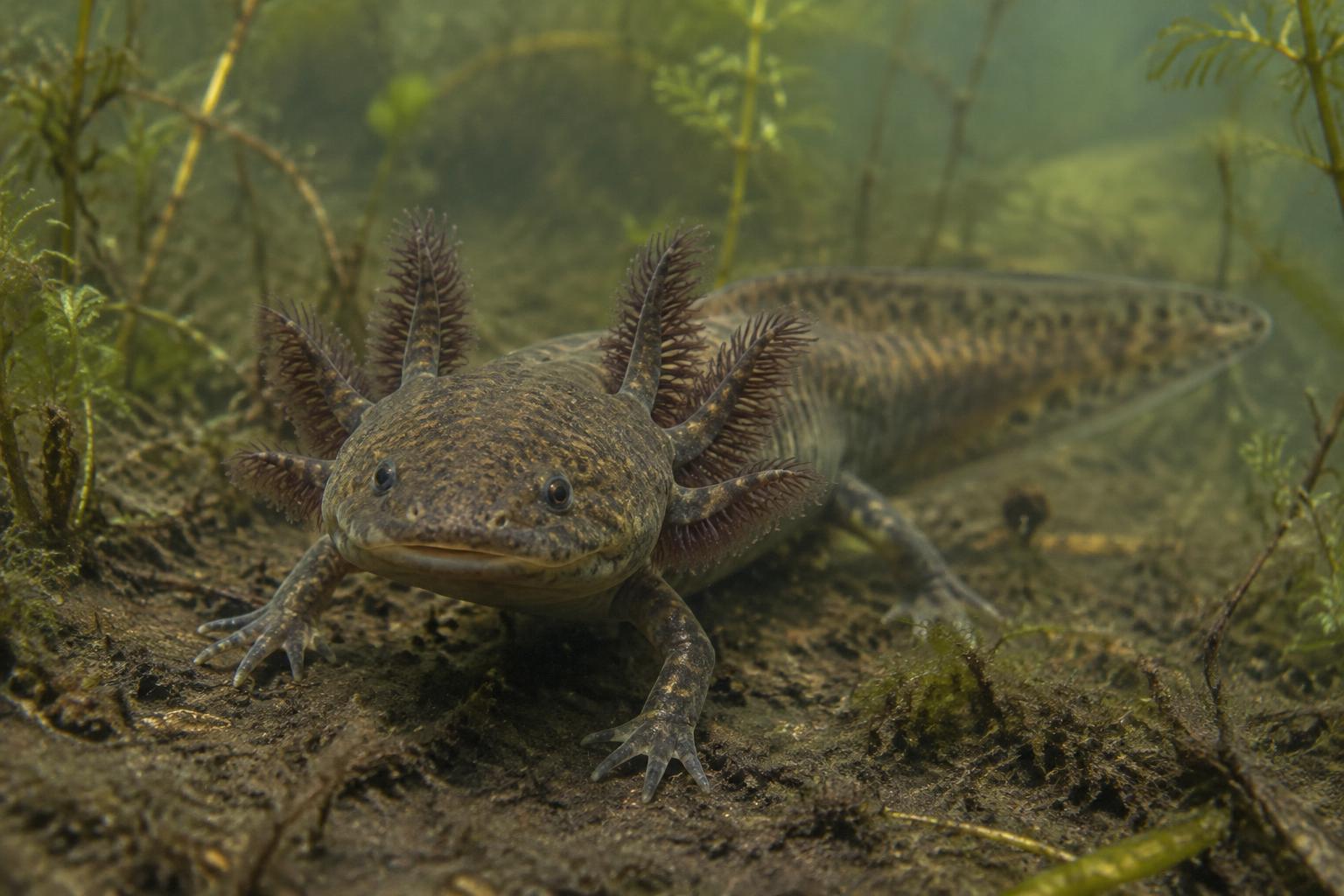 Illustrative depiction
Overview
The water monster of Xochimilco
The Mexican axolotl is a mole salamander that never grows up: it keeps its feathery gills and lives its whole life in water. Its Nahuatl name has been translated as “water slave”, “water sprite” or “water monstrosity”.
It is famous in science. Its genome is about ten times larger than a human's, and it can regenerate tissue, regrowing limbs and tail, and in some cases even eyes and parts of the heart. Four pigmentation genes create the colour variants seen in pet axolotls.
Yet in the wild it is nearly gone. The canals of Lake Xochimilco in Mexico City are one of its last refuges, and the IUCN estimates only 50–1,000 adults remain.
Why it is nearly gone
Poisoned waters
Its last lake is polluted, built over and full of invasive fish.
Water pollution
Untreated sewage and farm run-off pour into Xochimilco's canals, degrading the clean, cool water axolotls need.
Urban sprawl
Mexico City has drained and built over most of the ancient lake system, leaving only fragments of habitat.
Invasive fish
Introduced tilapia and carp eat axolotl eggs and young and compete for food.
A tiny remnant population
With as few as 50 adults possibly left in the wild, every loss matters.
Conservation history
From lake king to last refuge
| Year | Event |
|---|---|
| Aztec era | Axolotls fill the lake system of the Valley of Mexico and feature in Aztec culture; the Nahuatl name has been translated as "water slave", "water sprite" or "water monstrosity". |
| 1864 | Live axolotls are shipped to Paris, founding the laboratory colonies that make it one of the most studied animals in science. |
| 1998 | Surveys in Xochimilco find around 6,000 axolotls per square kilometre. |
| 2008 | Density has fallen to roughly 100 per square kilometre. |
| Oct 2019 | IUCN assessment: Critically Endangered, 50–1,000 adults, decreasing. |
| Today | Lake Xochimilco is one of the last refuges of the wild axolotl; restoration, biofilters and refuge canals aim to bring it back. |
Take action
Who's fighting for the axolotl
These groups restore Xochimilco's waters, run conservation centres and adoption programmes. Give to them directly.
Conservation International
Works to reverse the population decline by restoring the Xochimilco lake system and funding biofilters to clean the water.
MOJA
Protects the axolotl and its habitat, establishing a conservation centre in Xochimilco National Park.
Anfibium – Chapultepec Axolotl Museum
The Axolotl Museum and Amphibian Conservation Center at Chapultepec Wildlife Conservation Center.
UNAM – Adopt an Axolotl
Adopt-an-axolotl campaign run by the National Autonomous University of Mexico (UNAM).
Everyday actions
What you can do from home
- 01
Never release pet fish
Released aquarium and farm fish become invaders that eat axolotl eggs.
- 02
Buy captive-bred only
If you keep an axolotl, make sure it is captive-bred. Never buy wild-caught animals.
- 03
Visit Xochimilco responsibly
Choose eco-tours and chinampa farms that support axolotl refuges.
- 04
Spread the word
Millions know the axolotl as a pet or a game character; few know it is nearly gone in the wild.
Selected references