Mekong giant catfish
Pangasianodon gigas · Mekong River basin, Southeast Asia
but decreasing (IUCN, 2011)
One of the largest freshwater fish on Earth, now surviving in small, scattered groups in the middle and lower Mekong.
Source: IUCN Red List (April 2011)
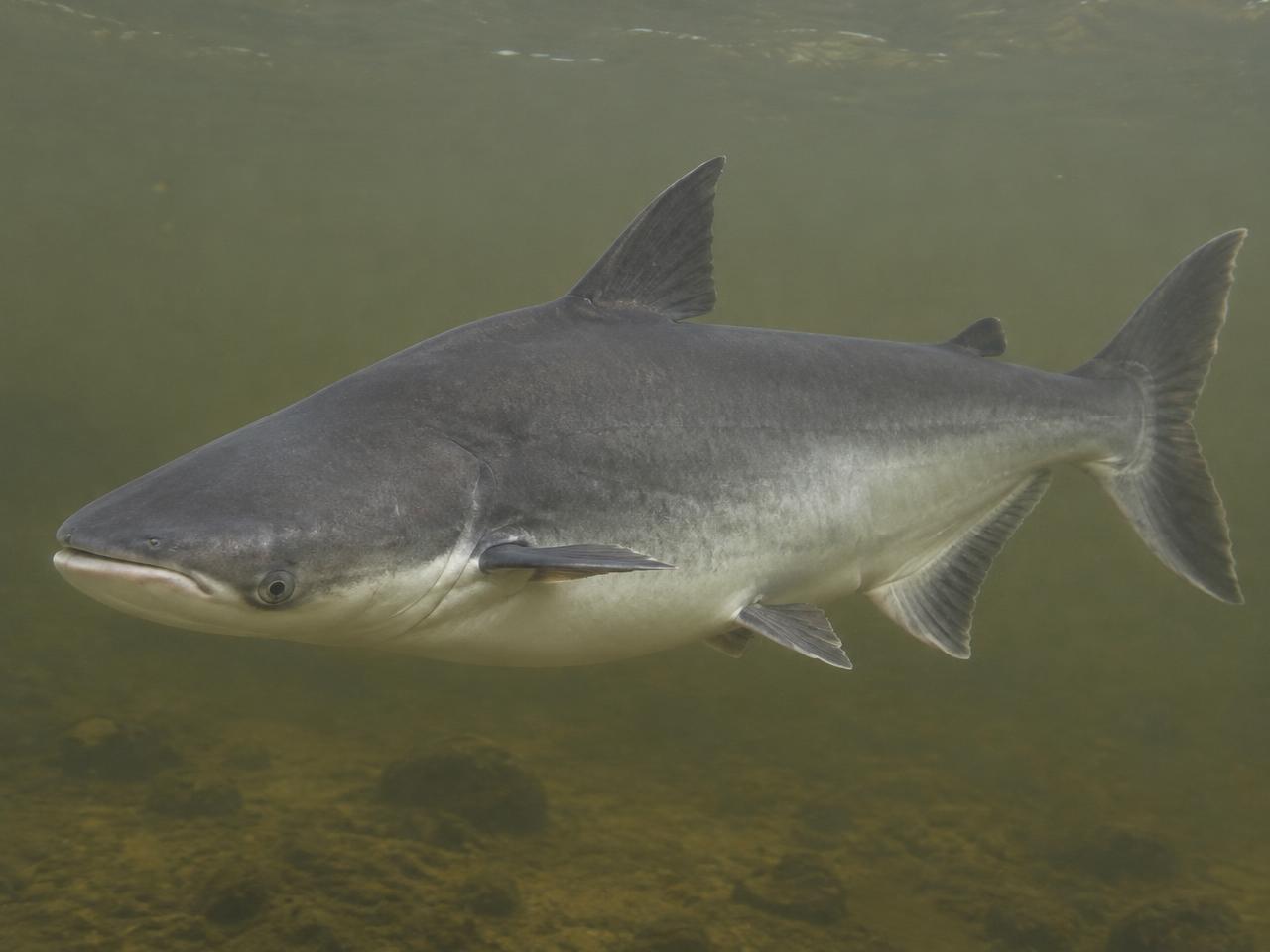 Illustrative depiction
Overview
The giant of the Mekong
The Mekong giant catfish is one of the "shark catfishes", named for the way they swim, and one of the largest freshwater fish in the world. It grows astonishingly fast, reaching 150–200 kg in six years, and is reported to weigh up to 350 kg. It can live for about 60 years.
Found only in the Mekong basin of Cambodia, Laos, Thailand and Viet Nam, it needs deep water and migrates across borders, though its routes are still poorly understood. Young fish eat zooplankton and switch to plants after about a year; their whiskers and teeth disappear by the time they reach 50 cm. It is a flagship species for the lower Mekong, revered in Thai folklore and shown in ancient art along the river.
Nobody knows exactly how many are left. The IUCN listed it as Critically Endangered and decreasing in April 2011. Between 1999 and January 2025, 132 wild fish were recorded as bycatch in Cambodia, and more than 83% survived release (Chan et al., 2026). Catches have risen since 2021, but it is not clear whether that means more fish.
Why it is critically endangered
Cut off by dams and nets
Its numbers are thought to have fallen by about 80% in 15 years.
Dams
Dams block its migrations across borders, so its range has collapsed and the population is broken into small scattered groups.
Overfishing
Heavy fishing in the Mekong has helped drive an estimated 80% fall in numbers.
Accidental capture
Stationary bagnets and seine nets cause 91% of bycatch, mostly from October to January when the fish migrate (Chan et al., 2026).
Pollution
Run-off from farming and forestry lowers the water quality of the river.
Conservation history
Caught, counted and released
| Year | Event |
|---|---|
| 1999 | Monitoring of incidental catches in Cambodia begins; 132 wild fish are recorded as bycatch up to January 2025 (Chan et al., 2026). |
| 2011 | IUCN assesses the species as Critically Endangered and decreasing, after an estimated 80% decline. |
| 2022–2024 | Incidental captures rise: 9 in 2022, 11 in 2023 and 14 in 2024. |
| Dec 2024 | Six giant catfish are caught and released in Cambodia, a sign of hope for the species. |
| Dec 2025 | Mohamed bin Zayed Species Conservation Fund awards a grant to sustain the last wild population in Cambodia. |
| 2026 | Chan et al. report that over 83% of bycaught fish survive release. |
| Sep 2026 | A 136 kg giant catfish is released in Pursat, Cambodia. |
| Oct 2026 | Several endangered giant fish, including a Mekong giant catfish, are caught by accident and released in Krakor district, Cambodia. |
Take action
Who's fighting for the Mekong giant catfish
Fisheries scientists, funders and fishing communities working to free bycaught fish and keep the river open.
Critical Ecosystem Partnership Fund
Funds community projects: local law education, capacity building and catch-and-release support in migratory corridors such as Kampong Cham.
WWF Laos
Works to protect the Mekong and the livelihoods and wildlife that depend on it.
Mohamed bin Zayed Species Conservation Fund
Grant (Dec 2025) for local education, incident reporting and rapid-response teams to reduce capture deaths in Cambodia.
Wonders of the Mekong & Cambodian Fisheries Administration
Joint programme with the Inland Fisheries Research & Development Institute; has caught, tagged and released about 100 giant catfish.
Mekong Giant Catfish Working Group
Brings researchers and agencies together to coordinate conservation of the species.
Everyday actions
What you can do from home
- 01
Support catch-and-release
Give to groups that train fishers and fund teams to free giant catfish caught by accident.
- 02
Back a free-flowing Mekong
Support campaigns for river-friendly dam planning that keeps migration routes open.
- 03
Choose sustainable fish
Ask where river fish come from and avoid catches from unmanaged fisheries.
- 04
Share its story
Revered in Thai folklore and ancient Mekong art, this giant deserves to be known worldwide.
Selected references
- IUCN Red List — Pangasianodon gigas (last assessed April 2011)
- Chan, B., Hogan, Z.S., Chea, S., Heng, K., Thach, P., Ngor, P.B., Baker, G.B., Brosse, S. and Yeo, D.C., 2026. Bycatch reveals patterns of occurrence and post-release mortality of the critically endangered Mekong giant catfish (Pangasianodon gigas): implications for conservation and threat mitigation. Global Ecology and Conservation, e04166.
- IUCN — Freshwater fish underrepresented in the Convention on Migratory Species
- The Guardian, 2024 — Six rare Mekong giant catfish found in Cambodia
- Fisheries (Wiley) — doi:10.1002/fsh.10920
- Khmer Times — Wonders of the Mekong launches fish conservation initiative
- Phnom Penh Post, 2026 — Endangered mega fish released into Mekong
- FishBase — Pangasianodon gigas