Māui dolphin
Cephalorhynchus hectori maui · New Zealand
estimated (2021)
The world's smallest and rarest dolphin, found only off the west coast of New Zealand's North Island.
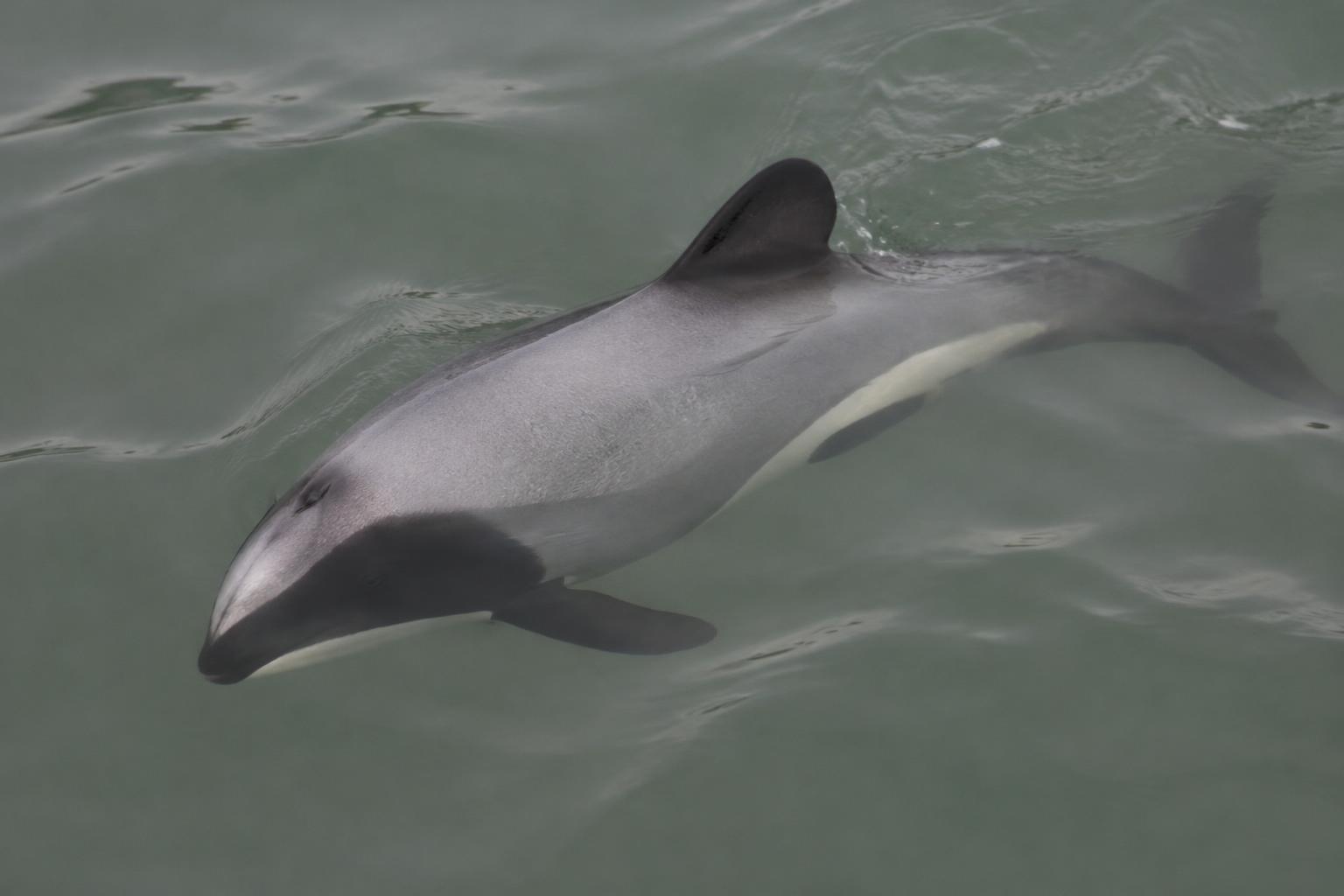 Illustrative depiction
Overview
The world's rarest dolphin
The Māui dolphin is the world's smallest and rarest dolphin, and New Zealand's only endemic cetacean. Unlike most dolphins it has no beak, and it carries a rounded black dorsal fin.
Once known as the North Island Hector's dolphin, it was classified as a subspecies in 2002. It is thought to have been separated from Hector's dolphins for 15,000–16,000 years, and lives only in the murky waters off the North Island's west coast.
A 2021 government estimate counted about 54 adults. Recent deaths suggest there may now be fewer than 40.
Why it is nearly gone
Caught in the nets
Fishing, disease, industry and boat traffic all threaten the last Māui dolphins.
Fishing nets
Dolphins drown when caught in set nets and trawl nets, the biggest human cause of death.
Disease
Toxoplasmosis and other diseases washed into the sea from land are killing dolphins.
Industry and boats
Oil and gas exploration, seabed mining, boat strikes, tourism and underwater noise all add pressure.
Slow breeding
A single calf every two to four years means the population cannot bounce back from losses.
Conservation history
A countdown to extinction
| Year | Event |
|---|---|
| 2002 | Formally classified as a subspecies of Hector's dolphin, separate from the South Island population. |
| 2012–2013 | Adult population estimated at just 55. Interim set-net bans and a small extension of the West Coast North Island Marine Mammal Sanctuary. |
| 2016–2019 | Survey estimates about 63. NGOs push for protection out to 100 m depth and seek US seafood import bans through US courts. |
| 2020 | Threat Management Plan overhauled: wider set-net and trawl bans, drift nets banned, oil and gas limits, and a Toxoplasmosis Action Plan. |
| 2021–2024 | Adult population revised to 54. Onboard cameras rolled out on fishing boats to monitor bycatch; tracking drones trialled. |
| 2025–2026 | A juvenile is found dead near Port Waikato. The Environmental Law Initiative challenges fishing rules in the Wellington High Court. |
Take action
Who's fighting for the Māui dolphin
New Zealand groups campaign, patrol and go to court for stronger protection of the dolphin's home waters.
Māui and Hector's Dolphin Defenders
The only charity dedicated solely to Māui and Hector's dolphins, campaigning for full protection of their habitat.
Everyday actions
What you can do from home
- 01
Choose dolphin-safe seafood
Avoid fish caught with set nets or trawl nets in New Zealand waters.
- 02
Keep cats indoors
Toxoplasmosis spreads from cat waste washed into the sea; responsible disposal helps.
- 03
Keep your distance on the water
If boating off the North Island's west coast, slow down and give dolphins space.
- 04
Speak up
Back campaigns and petitions calling for full protection of the Māui dolphin's habitat.
Selected references
- IUCN Red List — Cephalorhynchus hectori (Hector's dolphin)
- New Zealand Department of Conservation — Māui dolphin facts
- New Zealand Government — Hector's and Māui dolphin Threat Management Plan
- New Zealand Government — Timeline of research and protection events
- Sea Shepherd New Zealand — Māui dolphin
- Slooten, E., Dawson, S., Rayment, W. and Childerhouse, S., 2006. A new abundance estimate for Maui's dolphin: what does it mean for managing this critically endangered species?. Biological Conservation, 128(4), pp.576-581.
- de Jager, M., Hengeveld, G.M., Mooij, W.M. and Slooten, E., 2019. Modelling the spatial dynamics of Maui dolphins using individual-based models. Ecological Modelling, 402, pp.59-65.