
Largetooth sawfish
Pristis pristis · Tropical rivers, estuaries & coasts
March 2016
A shark-like ray with an extraordinary toothed saw, disappearing from rivers and coasts across much of its former range.
Source: Supplied March 2016 estimate · IUCN Red List reference
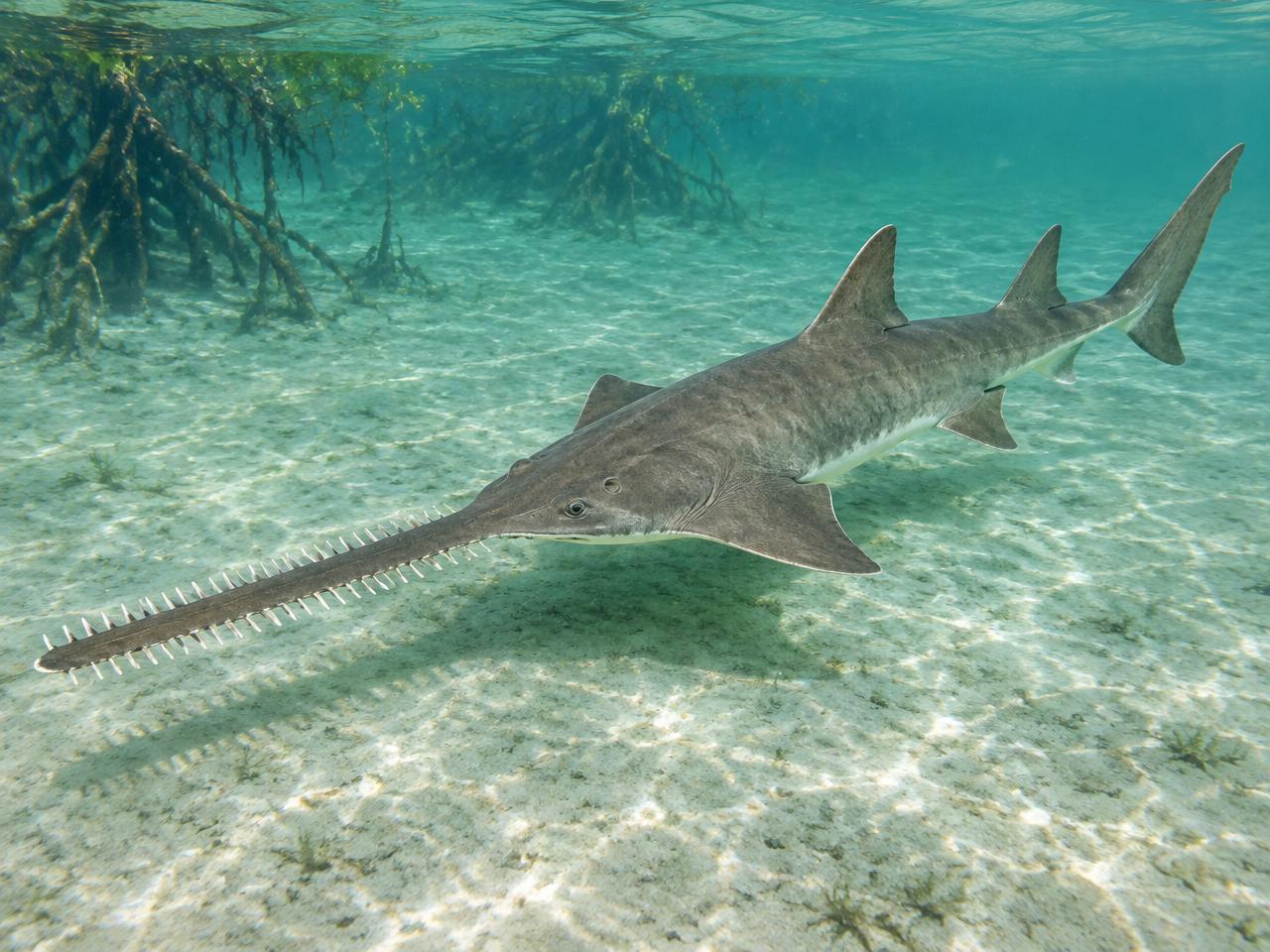 Illustrative depiction
Overview
A life between river and sea
The largetooth sawfish is a ray with a shark-like body and a long, flattened rostrum edged with teeth. It slashes this saw through shoals of fish while feeding, making prey easier to catch.
Juveniles live in freshwater. As they grow, they move into estuaries and coastal marine habitats, at depths up to 26 metres. The species has disappeared from much of its former range around Africa, Southeast Asia, Oceania and South America. All five sawfish species are endangered.
The population figure shown here is the supplied March 2016 estimate, rather than an independently verified global census. The cited IUCN assessment is dated March 2016 and describes a declining, Critically Endangered species.
At the time of the IUCN 2016 assessment, no action recovery plan, systematic monitoring or ex-situ conservation were in place. In 2020 the Convention on Migratory Species agreed to take ‘concerted action’ to protect habitat and coordinate international protection. Organisations below support research, citizen science and work with fishers.
International trade in all sawfish species is banned under CITES Appendix I, but a trade ban alone does not prevent capture or accidental entanglement.
Why it is critically endangered
A remarkable saw, a deadly vulnerability
Fishing, harvesting and deteriorating habitat threaten this river-to-sea ray.
Caught by its own saw
Its toothed rostrum easily becomes entangled in fishing nets. Accidental bycatch adds to losses from targeted fishing.
Harvested for more than food
Sawfish have been caught for food, medicine, handicrafts and apparel. Their distinctive saws have also been kept as collectors’ items.
Habitat deterioration
Damage to rivers, estuaries and shallow coastal habitats threatens the connected environments it needs as it grows.
Coastal development
Tourist activities and oil and gas drilling place further pressure on its habitat, alongside fishing and harvesting.
Conservation history
Assessments, research and remaining strongholds
| Year | Event |
|---|---|
| 2014 | Fernandez-Carvalho and colleagues examined the status and potential extinction of largetooth sawfish in the Atlantic Ocean. |
| March 2016 | IUCN assessment cited in these notes: Critically Endangered and declining. Supplied population estimate: 49. |
| 2016 | IUCN assessment: ‘No action recovery plan, systematic monitoring, or ex-situ conservation in place.’ |
| 2020 | Convention on Migratory Species concerted action begins: echo-sounding, eDNA, catch data and distribution studies. |
| 2021 | Kyne and colleagues compiled life-history data for population assessment and demographic modelling. |
Take action
Who's fighting for the largetooth sawfish
Support research and protection, help document sawfish saws, or learn about fishers safeguarding the remaining populations.
Sawfish Conservation Society
Supports sawfish conservation through research, education and collaboration.
IUCN SSC Shark Specialist Group
Brings together experts assessing and protecting sharks and rays, including sawfish.
Shark Trust
Help researchers through See a Saw: report sawfish saws to support citizen-science research.
Save Our Seas Foundation
Funds field research, including genetic and environmental DNA projects tracking remaining sawfish strongholds.
MarAlliance
Works in Panama’s Pacific rivers and estuaries, training artisanal fishers as Sawfish Guardians to release accidental catches.
Australian Marine Conservation Society
Watch the supplied video about saving largetooth sawfish.
Everyday actions
What you can do from home
- 01
Report a saw
If you encounter a sawfish saw, contribute a record through Shark Trust’s See a Saw citizen-science project.
- 02
Never buy sawfish souvenirs
Avoid sawfish rostra and other wildlife products. International trade in all sawfish species is banned under CITES Appendix I.
- 03
Support safer fisheries
Support work with local fishers to reduce net entanglement and safely release accidentally caught sawfish.
- 04
Protect rivers and estuaries
Back conservation of freshwater nurseries and coastal habitats, and share the work of the organisations below.
Selected references
- IUCN Red List — Pristis pristis (last assessed March 2016)
- Mohamed bin Zayed Species Conservation Fund — largetooth sawfish
- Kyne, P.M., Oetinger, M., Grant, M.I. and Feutry, P., 2021. Life history of the Critically Endangered largetooth sawfish: a compilation of data for population assessment and demographic modelling. Endangered Species Research, 44, pp.79–88.
- Fernandez-Carvalho, J., Imhoff, J.L., Faria, V.V., Carlson, J.K. and Burgess, G.H., 2014. Status and the potential for extinction of the largetooth sawfish Pristis pristis in the Atlantic Ocean. Aquatic Conservation: Marine and Freshwater Ecosystems, 24(4), pp.478–497.
- Convention on Migratory Species — Concerted action for the common guitarfish and largetooth sawfish