Kākāpō
Strigops habroptilus · Offshore islands, New Zealand
up from under 50 in 1995
The world's only flightless parrot: a gentle, owl-faced "night parrot" bouncing back from the brink on predator-free islands.
Source: Kākāpō Recovery Programme (Sept 2026) · IUCN Red List
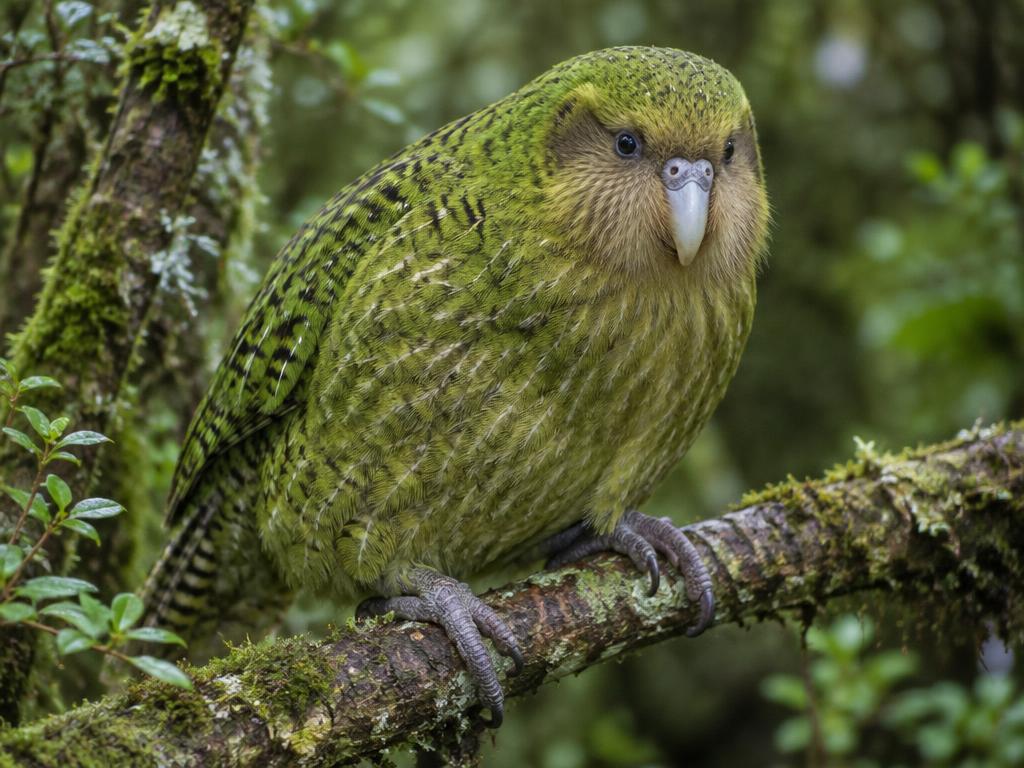 Illustrative depiction
Overview
An owl-faced parrot that gave up flying
Found only in New Zealand, the kākāpō takes its Māori name from kākā (parrot) and pō (night). Standing up to 64 cm tall and weighing up to 4 kg, it outweighs the largest flying parrots, and can live to 100.
It evolved for 33–44 million years on islands with no land mammals, giving up flight to save energy. It is still a superb climber, scaling tall trees and gliding down. Its moss-green feathers and habit of freezing when startled hid it from ancient birds of prey.
Today every bird is named, tracked with a backpack transmitter and cared for by the Kākāpō Recovery Programme, which has lifted numbers from under 50 in 1995.
Why it is critically endangered
Defenceless against a new kind of hunter
Introduced predators
Cats, ferrets, stoats and ship rats hunt by scent. The kākāpō's instinct to freeze, which fooled ancient birds of prey, leaves it defenceless.
A genetic bottleneck
Falling below 50 birds in 1995 left low genetic diversity and high egg infertility that still threaten chick survival.
Some of the slowest breeding on Earth
It breeds only when rimu trees fruit heavily, every 2–5 years. Females raise chicks alone, leaving nests exposed while they forage at night.
All eggs in island baskets
Every bird lives on a few predator-free islands. One stowaway rat or disease outbreak could be devastating.
Conservation history
From below fifty to a fragile rebound
| Year | Event |
|---|---|
| Pre-human | New Zealand's third most common bird |
| 1970s | Only ~18 known, all males, in remote Fiordland |
| 1977 | Breeding population of ~150 discovered on Stewart Island |
| 1995 | Population crashes to below 50, a genetic bottleneck |
| 1998 | 54 known, only 49 genetically unique |
| 2007 | 86 adults counted across the sanctuary islands |
| 2020 | Population reaches 208 |
| 2023 | Trial return to the mainland at Sanctuary Mountain Maungatautari |
| Today | ~235 (IUCN / World Parrot Trust) |
Take action
Who's fighting for the kākāpō
Vetted organisations behind the Kākāpō Recovery Programme, from island sanctuaries to tracking and genetics. Give to them directly.
Department of Conservation — Kākāpō Recovery
The official New Zealand recovery programme, run with Ngāi Tahu, rangers, scientists and volunteers
Re:wild
Official supporter backing the island sanctuaries, tracking network and recovery goals
World Parrot Trust
Supplementary diet, artificial insemination, fertility and disease screening since 1995
Island Conservation
Protects and restores the predator-free islands the kākāpō depends on
Adopt a kākāpō
Symbolic adoption of a named bird through the Kākāpō Recovery Programme
Everyday actions
What you can do from home
- 01
Don't bring pests to New Zealand
When visiting, declare and clean all gear, boots and food so no stowaway reaches a sanctuary island.
- 02
Support predator-free initiatives
Back community trapping groups and fenced sanctuaries like Sanctuary Mountain Maungatautari.
- 03
Follow and share the birds' stories
Every kākāpō has a name. Share updates and keep public attention, and funding, on the recovery.
- 04
Choose native, not exotic
Support native-forest restoration and reject products that drive clearing of New Zealand's bush.
Selected references
- IUCN Red List — Strigops habroptilus (last assessed August 2018)
- The Guardian (Sept 2026) — Record breeding season for the world’s heaviest parrot
- New Zealand Department of Conservation — Kākāpō Recovery
- re:wild — Kākāpō
- World Parrot Trust — Kākāpō Recovery Efforts
- Elliott 2006 — Productivity of kakapo on offshore island refuges. Notornis 53(1): 138–142
- Harper, Elliott, Eason & Moorhouse 2006 — What triggers nesting of kakapo? Notornis 53(1): 160
- Farrimond, Elliott & Clout 2006 — Growth and fledging of kakapo. Notornis 53(1): 112