Javan Rhino
Rhinoceros sondaicus · Ujung Kulon, Java
single population
The rarest of all rhinos. Every living Javan rhino shares one small park on the western tip of Java, in the shadow of the active volcano Anak Krakatau.
Source: IUCN Red List & peer-reviewed literature · 2026 estimate
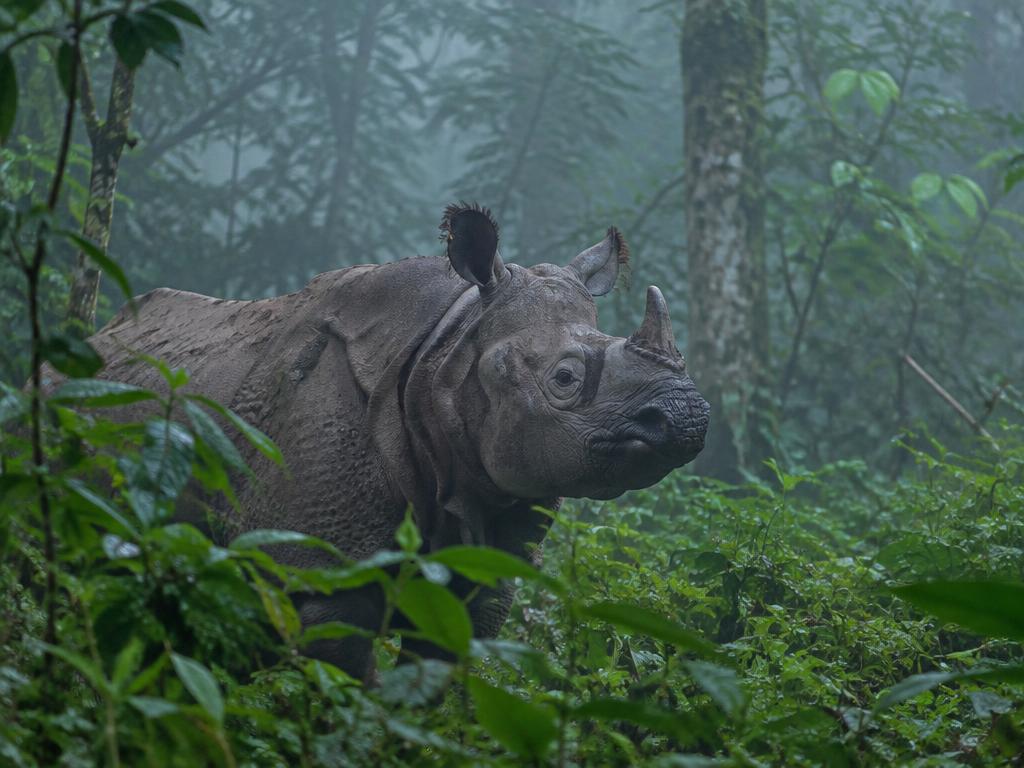 Illustrative depiction
Overview
An ancient giant, armour-plated and alone
Smaller than its closest relative, the Indian rhino, the Javan rhino has armour-like folds of thick skin and a long, pointed upper lip for grasping plants. Males carry a single horn; females often have none. It uses the horn to scrape wallows and clear paths — it fights with long, sharp lower incisors instead.
Solitary except when breeding, it has poor eyesight but keen smell and hearing, runs at up to 50 km/h and swims well. It diverged from the Indian rhino around 4.3 million years ago.
Once found from India and southern China to Sumatra, it was wiped out almost everywhere by hunting for horn. With slow breeding, a shallow gene pool and roughly two males for every female, recovery is fragile.
Conservation history
From thousands to around fifty
| Year | Event |
|---|---|
| Early 1900s | Global population estimated at 40–70 (Loch, 1937) |
| 1967 | Ujung Kulon population falls to a low of 25 |
| 1980 | Rebounds to ~50 after anti-poaching drives |
| 2006 | Fewer than 60 in Ujung Kulon (Fernando et al. 2006) |
| 2010 | Last Javan rhino in Vietnam found poached in Cat Tien National Park |
| 2020 | ~74 estimated survivors |
| 2022 | Estimated high of ~76 |
| 2019–23 | Poachers admit killing 26 rhinos (Indonesian court case) |
| 2026 | ~50 — current best estimate |
Take action
Who's fighting for the Javan rhino
Vetted organisations patrolling Ujung Kulon, restoring habitat and monitoring the last individuals. Give to them directly.
See the rangers at work: National Geographic short film
Selected references
- Fernando et al. (2006) — review of the Javan rhinoceros in Ujung Kulon
- Brook, S.M. et al. (2014) — conservation status of the Javan rhinoceros
- Darney et al. (2025) — proposed integrated monitoring of the Javan rhino
- IUCN Red List — Rhinoceros sondaicus (last assessed May 2019)