Hawaiian crow
Corvus hawaiiensis · ʻAlalā · Hawaiʻi Island
under 120 in total (2025)
A clever, tool-using crow honoured in the Hawaiian creation chant. Gone from the wild in 2002, it is now taking its first steps back.
Source: The ʻAlalā Project · IUCN Red List
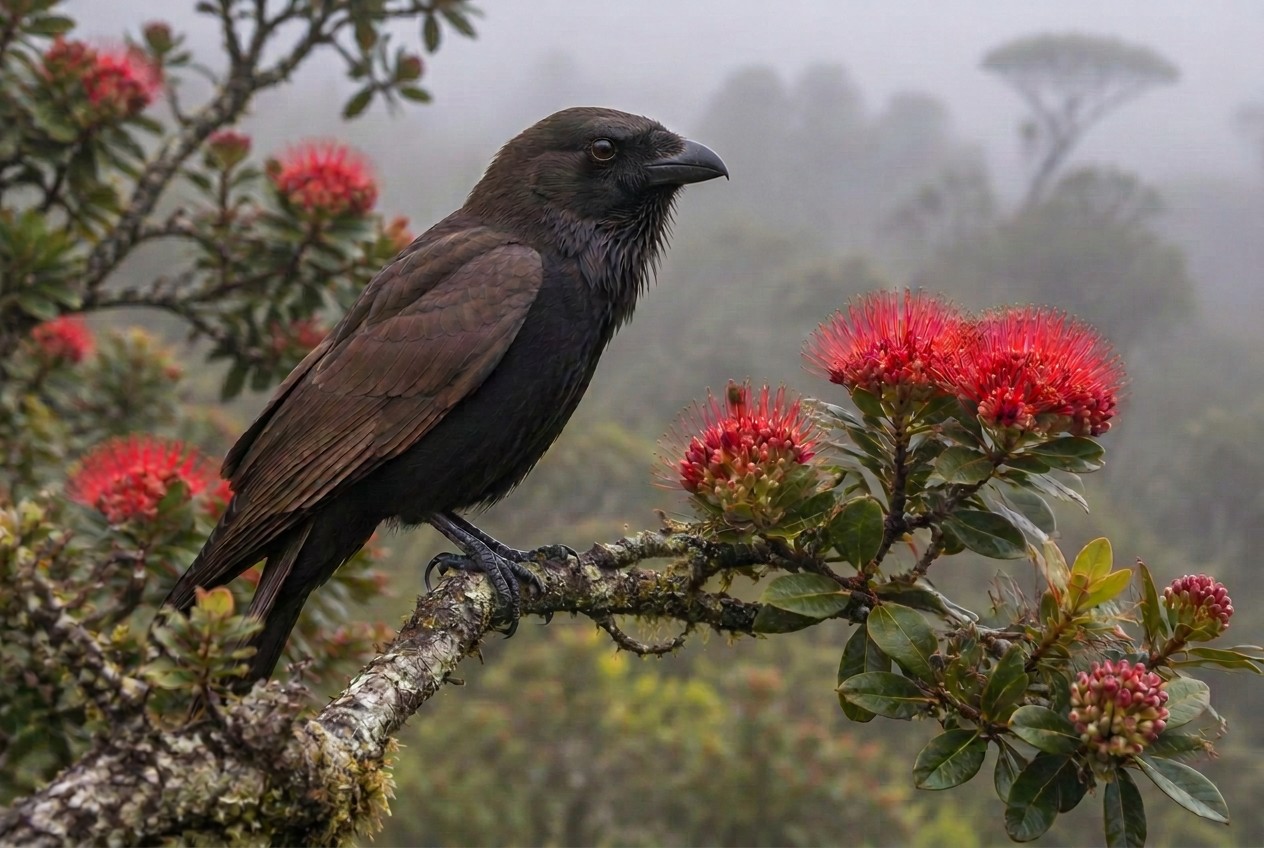 Illustrative depiction
Overview
Hawaiʻi's clever crow
The ʻalalā is the most endangered member of the crow family. Up to 50 cm long, it has a black bill and legs, brownish wings and soft grey neck feathers. It is one of only two crows known to use tools in the wild, prising insects from bark with sticks, and it has at least 24 distinct calls.
It once lived only on Hawaiʻi Island, in dry and damp forests on the slopes of Mauna Loa and Hualālai. By eating native fruit and spreading the seeds, it helped plant the forest. Pairs nest in ōhiʻa trees in March and April; usually only one or two chicks fledge, and they stay with their parents for about a year.
In Hawaiian culture the ʻalalā is named in the Kumulipo creation chant and was honoured as an ʻaumakua, a family guardian. Its call was heard as a warning against entering forbidden places.
Why it is nearly gone
Disease, predators and lost forest
Once one of Hawaiʻi’s most common forest birds, the ʻalalā outlived four other native crows, but not by much.
Forest loss and shooting
Logging and ranching stripped the crow's upland forests, and settlers shot the birds for sport.
Avian malaria
Introduced mosquitoes spread a disease Hawaiian birds have no defence against.
Introduced predators
Rats, mongooses and feral cats eat eggs, chicks and young birds before they can fly.
Too few, too close together
Every bird descends from 8 founders, and one hurricane or wildfire could wipe out most of them.
Conservation history
Lost from the wild, slowly coming back
| Year | Event |
|---|---|
| Before 1778 | Polynesian settlers clear native lowland forest |
| 1800s–1900s | Logging, ranching and sport shooting; avian malaria and introduced predators spread |
| 1950s | First conservation efforts |
| 1973 | First formal conservation breeding programme, with low success |
| 1996 | Intensive breeding restarts at the Maui and Keauhou Bird Conservation Centers |
| 2002 | The last two wild birds disappear; extinct in the wild |
| Late 2024 | 5 birds released into native forest |
| 2025 | All 5 survive more than a year; under 120 birds in total, all from 8 founders |
Take action
Who's fighting for the ʻalalā
Birds are raised with crow-shaped hand puppets to keep them wild, trained to avoid the Hawaiian hawk, and released with daily food stations and cameras.
Maui Forest Bird Recovery Project
Releases birds and monitors them daily in the forest
San Diego Zoo Wildlife Alliance
Runs the Hawaiʻi Endangered Bird Conservation Program that breeds the ʻalalā
Everyday actions
What you can do from home
- 01
Plant native trees
Back projects planting ōhiʻa and koa to rebuild the forest canopy.
- 02
Keep cats indoors
Support spay and neuter programmes to reduce feral cats that kill forest birds.
- 03
Clean your boots in Hawaiʻi
Wipe gear with 70% rubbing alcohol to stop Rapid ʻŌhiʻa Death spreading.
- 04
Never move soil, plants or firewood
They can carry insects, bird diseases and predators into island forests.
Selected references
- IUCN Red List — Corvus hawaiiensis (last assessed August 2024)
- The ʻAlalā Project
- Maui Forest Bird Recovery Project
- Flanagan, A.M., Masuda, B., Komarczyk, L., Kuhar, A., Farabaugh, S. and Swaisgood, R.R., 2023. Adapting conservation breeding techniques using a data‐driven approach to restore the ʻAlalā (Hawaiian crow, Corvus hawaiiensis). Zoo Biology, 42(6), pp.834–839.