Hainan Gibbon
Nomascus hainanus · Hainan Island, China
up from 13 in 2003
The rarest ape on Earth: a dawn song holding an entire species back from the brink.
Source: 2024 field study · IUCN Red List
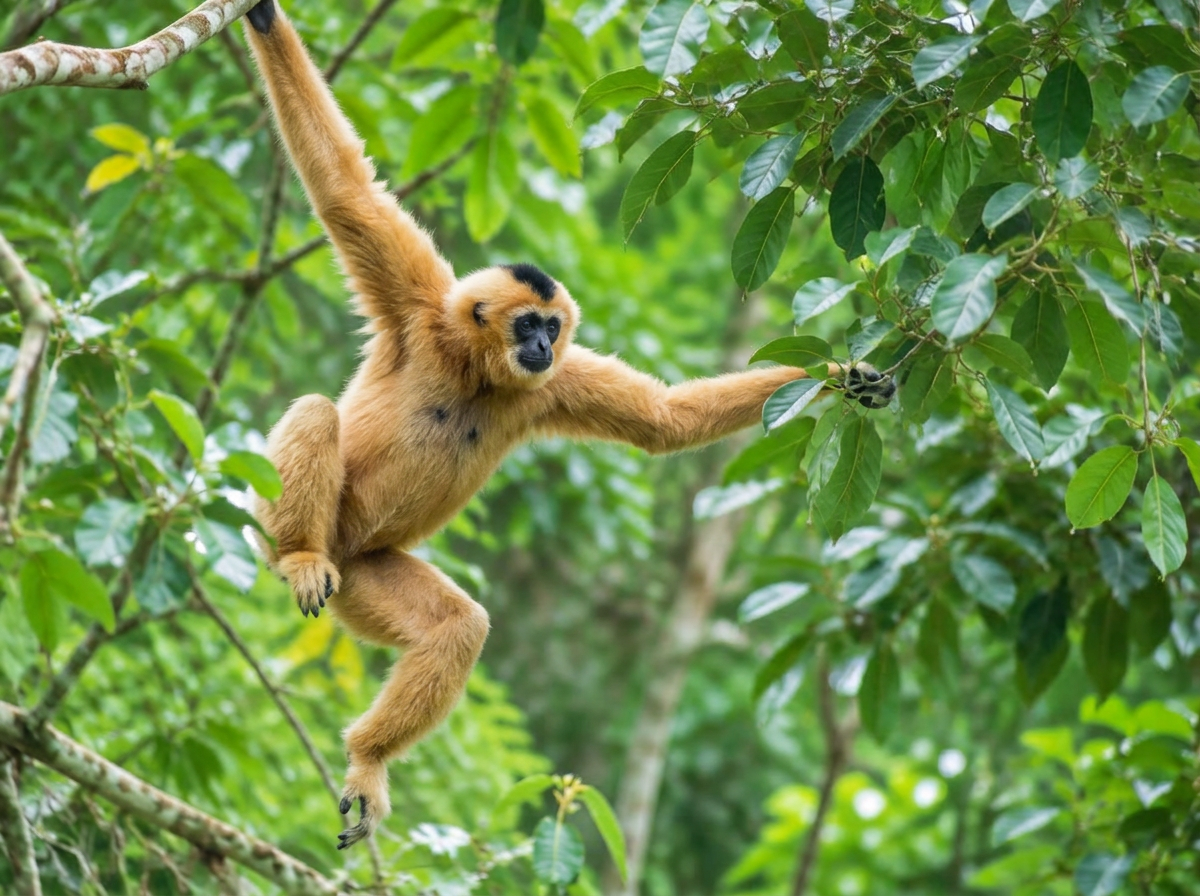 Illustrative depiction
Overview
A small ape with a song that carries for miles
Found only on Hainan Island in southern China, the Hainan black-crested gibbon is one of the world's "small apes". Tailless, slender and with a 170 cm arm span, it swings through the treetops, waking the forest at dawn with duetting songs.
Males are jet-black, sometimes with golden cheek tufts; females are golden-cream. Both have a dark crest. They feast on figs and lychees, nap at midday and sleep high in the tallest trees to avoid predators.
Once found across a much larger part of China, the species now survives only in the Hainan Tropical Rainforest National Park. To cope with tiny numbers, families often form around one male and two females.
Why it is critically endangered
From half of China to a single forest
Habitat loss and logging
Most of Hainan's original forest was cleared for logging and development, and 1970s logging wiped out the gibbons of Jianfengling Mountain.
Hunting and trafficking
Gibbons were hunted for traditional medicine, their bones prized for arthritis creams, and taken for the wildlife trade.
A single tiny population
Every gibbon lives in one block of forest. One typhoon, landslide or disease outbreak could wipe out the remaining families.
A shallow gene pool
Passing through a low of about 13 animals left the survivors closely related, though scientists have found surprising resilience.
Conservation history
From thirteen to a fragile rebound
| Year | Event |
|---|---|
| 1950s | Over 2,000 individuals across Hainan |
| 1970s | Logging wipes out gibbons on Jianfengling Mountain |
| 1983 | Estimated 40–50 individuals remaining |
| 1990s | Bawangling reserve established and logging banned |
| 2003 | Rock bottom: just 13 surviving individuals |
| 2013 | Around 23 individuals as recovery begins |
| 2014 | Landslide damages habitat; canopy rope bridges built |
| 2019 | Around 32 individuals |
| 2020 | Hainan Tropical Rainforest National Park founded, with the gibbon as its flagship species |
| Today | ~42, the highest count in decades (2024 field study) |
Take action
Who's fighting for the Hainan gibbon
Vetted organisations working on reforestation, canopy bridges and round-the-clock monitoring of every family group. Support them directly.
Kadoorie Conservation China
Reforestation and canopy corridors reconnecting the gibbon's fragmented forest
ZSL EDGE of Existence
Champions evolutionarily distinct, globally endangered species, including the Hainan gibbon
IUCN SSC Primate Specialist Group
Scientific guidance for ranger patrols and national park protection
Hainan Tropical Rainforest National Park
Rangers and cameras monitoring every surviving family group
Everyday actions
What you can do from home
- 01
Never buy wild primate parts or 'medicines'
Refuse any product made from wild primates, and report wildlife-trade listings you come across online or abroad.
- 02
Choose sustainable timber and paper
Buying only FSC-certified wood and paper shrinks the market driving forest clearing.
- 03
Support reforestation
Back programmes that replant native trees and rebuild canopy links between isolated forest patches.
- 04
Keep the gibbon's song in the headlines
Share its story and follow the rangers' updates. Public attention drives the funding the park needs.
Selected references
- IUCN Red List — Nomascus hainanus (last assessed November 2015)
- 2024 field study — population estimate
- IUCN — Hainan gibbon conservation (2022)
- Kadoorie Conservation China
- Kadoorie Farm & Botanic Garden — Hainan gibbon conservation: saving a species rarer than the giant panda
- ZSL EDGE of Existence
- IUCN SSC Primate Specialist Group
- New England Primate Conservancy — Hainan Gibbon