Great Indian bustard
Ardeotis nigriceps · Godawan · Rajasthan & Gujarat, India
gone from 90% of its range
One of the heaviest flying birds on Earth, once the monarch of the Indian subcontinent's open plains.
Source: IUCN Red List
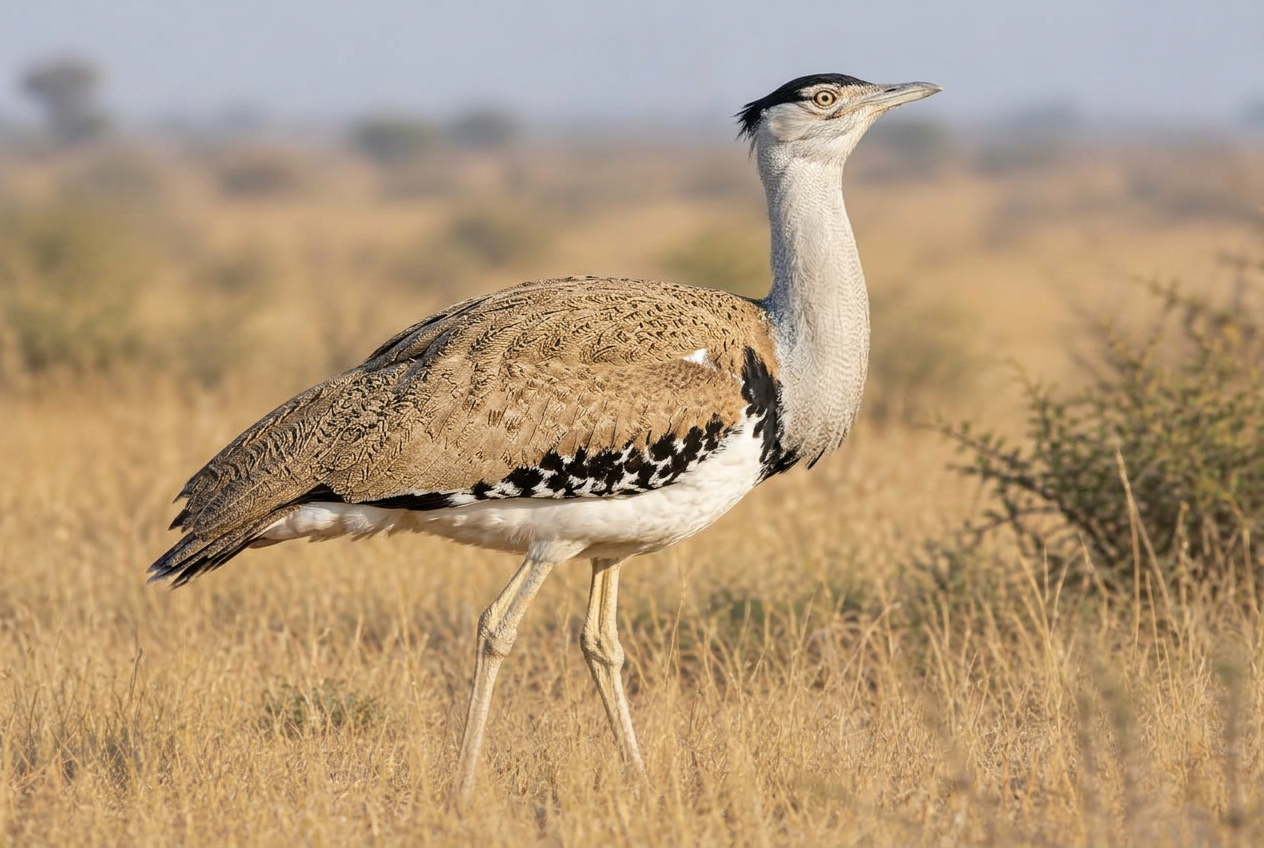 Illustrative depiction
Overview
A grassland monarch with a booming voice
Standing about a metre tall, it is smaller only than the kori bustard and the great bustard in its family. It has a stark black cap, a long pale neck and a brownish-buff body. In the breeding season males grow a black chest band and puff out white feathers to court females.
Males have a pouch under the tongue that swells into a heavy sack down the neck, producing a booming call heard over half a kilometre away. They strut, leap and sometimes lock heads in fights at traditional display grounds. To drink, a bustard sits down, sips, then stretches its neck upward to swallow. Hens raise their single chick alone, crouching over it and tucking it under a wing when danger comes.
Its family line began in Africa about 77 million years ago. It once ranged across at least 12 Indian states and into Pakistan, moving with the rains. Today it survives in scattered pockets of six states: Rajasthan, Gujarat, Maharashtra, Karnataka, Andhra Pradesh and Madhya Pradesh.
Why it is nearly gone
Power lines across a vanishing plain
It has lost more than 90% of its range, and the pockets left are too small for its old nomadic wanderings.
Power lines
High-voltage lines from solar and wind farms in Rajasthan and Gujarat cross its last grasslands. Bustards see poorly straight ahead in flight, so collisions are a major cause of death.
Farming changes
Canal irrigation has replaced rain-fed millet and sorghum with tall, dense sugarcane and grapes, which bustards cannot walk or nest in.
Grasslands called “wastelands”
Forestry departments long treated native grassland as wasteland and planted trees on open plains the bustard needs to watch for predators.
Slow breeding and nest losses
A single egg per clutch, laid on bare ground, leaves no margin. Droughts, free-ranging dogs and other predators take a heavy toll.
Conservation history
From over 1,200 birds to fewer than 150
| Year | Event |
|---|---|
| ~77 million years ago | The bustard family line arises in Africa, later spreading across the grasslands of the Old World. |
| Historically | Found across at least 12 Indian states and into eastern Pakistan. |
| 1969 | About 1,260 birds estimated in the wild. |
| 1972 | Protected under India's Wildlife Protection Act. |
| 1978 | About 745 birds — the population nearly halved in under a decade. |
| 1980s | First sanctuaries declared; most prove too small for a nomadic bird, or too large to enforce. |
| 2010 | About 300 birds left; models give an 80% risk of extinction within 100 years. |
| 2018 | Down to about 150 birds. Breeding centre opens at Sam, Desert National Park, Jaisalmer. |
| Today | Fewer than 150 in the wild, in pockets of six Indian states. 94 birds in captivity, including 26 chicks hatched in one breeding season. |
Take action
Who's fighting for the Great Indian bustard
Grassland restoration, bird-safe power lines and field monitoring. A captive breeding programme at Desert National Park is building a backup population.
The Corbett Foundation
Works with communities in Kutch and Rajasthan to restore grazing land, fit bird diverters on power lines and promote bustard-friendly organic farming.
Wildlife Trust of India
Works with state forest departments on habitat protection, community awareness and reducing the danger from power lines across India's grasslands.
Everyday actions
What you can do from home
- 01
Visit responsibly
In Desert National Park or Gujarat's grasslands, stay on marked trails, hire local guides and never drive off-road into nesting areas.
- 02
Back bird-safe clean energy
Support policies and companies that bury power cables or fit bird diverters near grasslands.
- 03
Speak up for grasslands
Share the bustard's story and push for legal protection of natural plains, so they are no longer labelled wasteland.
- 04
Share verified updates
Spread news from the groups working on the ground.
Selected references
- IUCN Red List — Ardeotis nigriceps (last assessed August 2018)
- Wildlife Institute of India — Great Indian Bustard Species Recovery Programme
- Bombay Natural History Society
- The Corbett Foundation
- Dutta, S., Rahmani, A.R. and Jhala, Y.V., 2011. Running out of time? The great Indian bustard Ardeotis nigriceps—status, viability, and conservation strategies. European Journal of Wildlife Research, 57(3), pp.615–625.
- Khan, S., Talukdar, G. and Habib, B., 2026. In Search of Safe Havens: Identifying priority conservation areas for a critically endangered bird, the Great Indian Bustard, in the Deccan Landscape of India. PLoS One, 21(8), p.e0355780.