Golden bamboo lemur
Hapalemur aureus · Southeastern Madagascar
in the wild
A rare bamboo specialist found only in southeastern Madagascar, with a declining population estimated at 5–249 individuals.
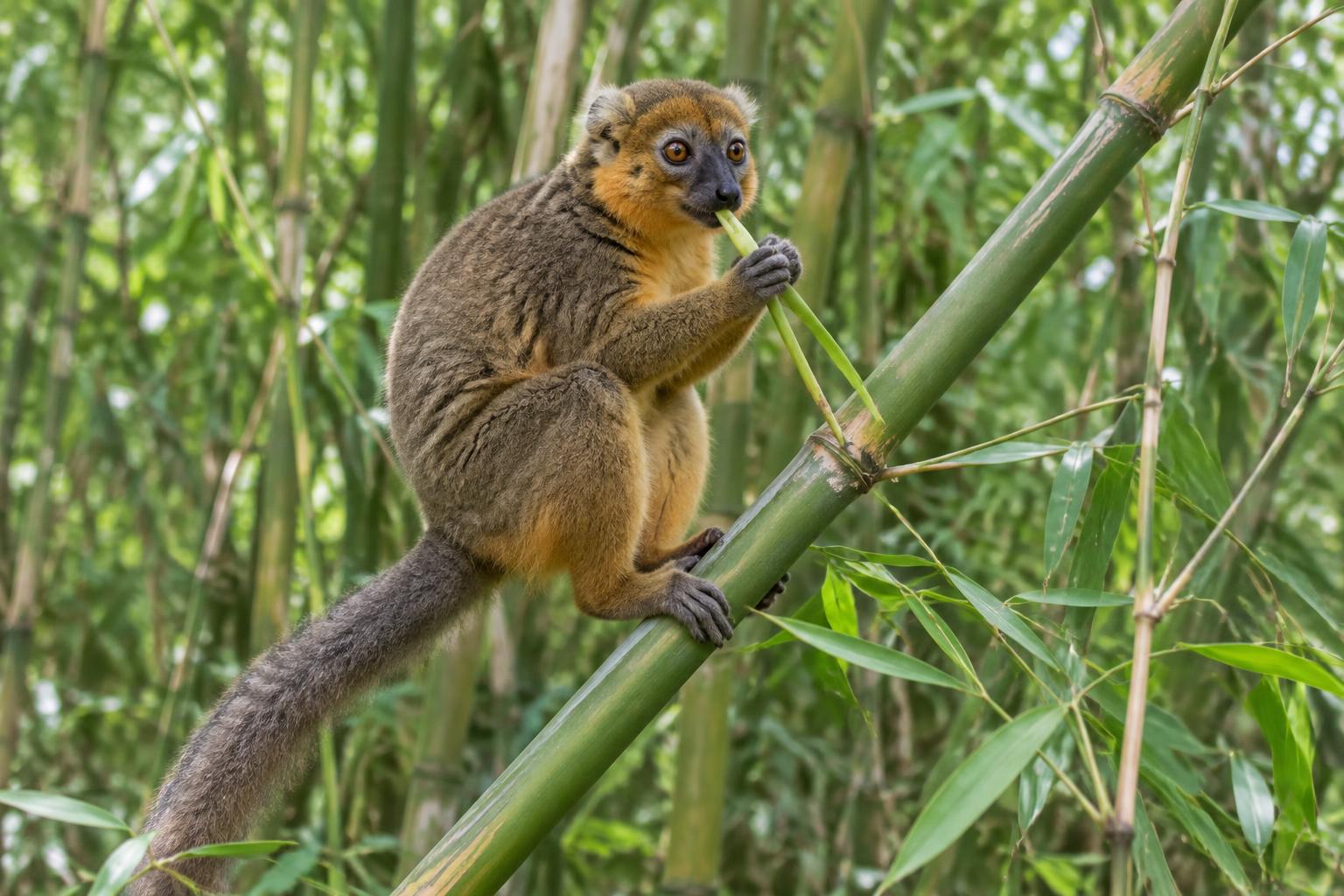 Illustrative depiction
Overview
A life built around bamboo
First described in 1987, the golden bamboo lemur is endemic to southeastern Madagascar. It lives in bamboo forests and wetlands between 600 and 1,400 metres above sea level, moving in small groups and travelling less than 400 metres a day.
Its diet includes the shoots of Madagascar’s giant bamboo. These contain high levels of cyanide: the lemurs consume around twelve times a dose that would kill other species of a similar size.
Mating takes place in July, and females give birth to a single infant in November or December. Mothers hide their highly dependent young in dense vegetation for the first two weeks. Forest clearance, bamboo harvesting and snares threaten this specialised way of life.
Why it is nearly gone
Losing its forest home
Forest clearance and bamboo harvesting remove its habitat and food, while snares threaten animals directly.
Slash-and-burn agriculture
Clearing and burning forest for agriculture removes the bamboo habitat this lemur depends on.
Bamboo harvesting
Bamboo is harvested for construction and other uses, taking away both food and shelter.
Snares
Snares threaten lemurs in parts of their range, adding direct losses to an already declining population.
Conservation history
A lemur on the brink
| Year | Event |
|---|---|
| 1987 | Golden bamboo lemur is first described as a species. |
| 1989 | Glander and colleagues publish research on its consumption of cyanogenic bamboo. |
| 2016 | Ballhorn and colleagues examine the coevolution of cyanogenic bamboos and bamboo lemurs in Madagascar. |
| January 2020 | IUCN assessment estimates 5–249 individuals and a declining population. |
Take action
Who's fighting for the golden bamboo lemur
These organisations support research, habitat protection, community-based conservation and awareness. Visit their work or give to them directly.
Centre ValBio
Works directly in Ranomafana National Park, conducting research, community outreach and protection for local golden bamboo lemur populations.
New England Primate Conservancy
Shares conservation status, ecological information and threats, including slash-and-burn agriculture and bamboo harvesting.
Lemur Conservation Network
Unites more than 60 organisations, zoos and global partners supporting habitat protection, research and community-based conservation across Madagascar.
World Animal Rescue Network
Advocates for wild golden bamboo lemurs and protection of their montane rainforest habitats.
IUCN SSC Primate Specialist Group
Specialist network supporting primate research and conservation.
Everyday actions
What you can do from home
- 01
Support habitat protection
Give to organisations protecting Madagascar’s bamboo forests and working alongside local communities.
- 02
Choose responsible forest products
Look for traceable, responsibly sourced timber and bamboo products.
- 03
Travel responsibly
If visiting Madagascar, choose conservation-minded local guides and avoid disturbing wildlife.
- 04
Share its story
Help more people discover the golden bamboo lemur and the organisations working to protect it.
Selected references
- IUCN Red List — Hapalemur aureus (last assessed January 2020)
- Ballhorn, D.J., Rakotoarivelo, F.P. and Kautz, S., 2016. Coevolution of cyanogenic bamboos and bamboo lemurs on Madagascar. PLOS ONE, 11(8), e0158935.
- Farris, Z.J., Chan, S., Rafaliarison, R. and Valenta, K., 2019. Occupancy modeling reveals interspecific variation in habitat use and negative effects of dogs on lemur populations. International Journal of Primatology, 40(6), pp.706–720.
- Glander, K.E., Wright, P.C., Seigler, D.S., Randrianasolo, V. and Randrianasolo, B., 1989. Consumption of cyanogenic bamboo by a newly discovered species of bamboo lemur. American Journal of Primatology, 19(2), pp.119–124.