Gharial
Gavialis gangeticus · India & lowland Nepal
down 94% since 1946
The living fossil of the Ganges: a fish-eating river crocodilian, last of its genus, clinging on in about 14 isolated river sites.
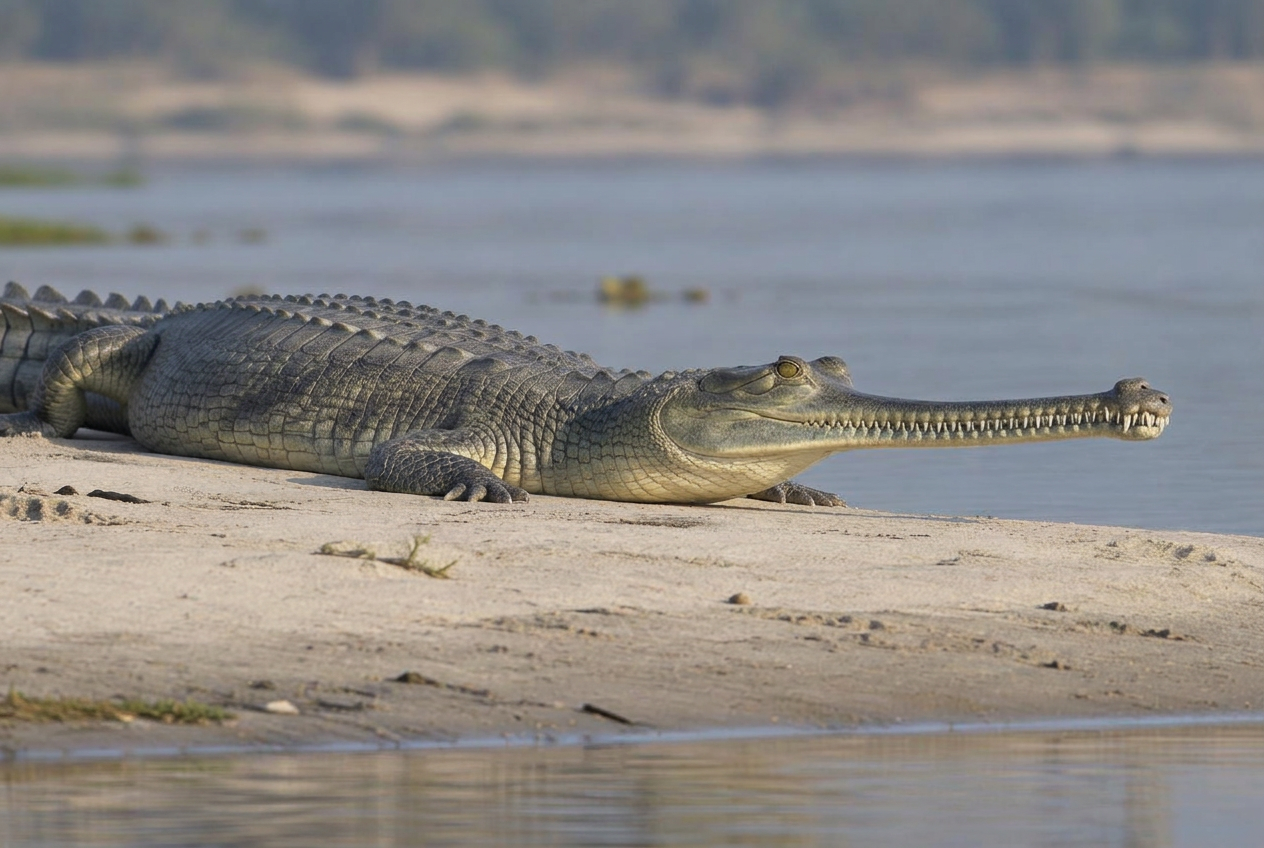 Illustrative depiction
Overview
The last of an ancient branch
The gharial is the only surviving member of its branch of the crocodile family; every other species in it is extinct. Fossils from the Sivalik Hills and the Narmada valley show it has lived on the Indian subcontinent since the Pliocene. It is a priority species for ZSL's EDGE programme, which ranks animals that are both unusual and threatened.
Its long, very narrow snout cuts through water so it can snap up fish quickly. Grown males develop a bulbous lump at the snout tip called a ghara, after the Hindi word for a clay pot. It helps them make a loud hiss that carries up to 75 m. Gharials spend more time in water than any other crocodilian and have weak legs, so they belly-slide on land.
In South Asian tradition the gharial is linked to sacred rivers, as the mount of the goddess Ganga and of Varuna, lord of the waters. Without decades of protection it would probably already be extinct, and numbers have begun to rebound from historic lows.
Why it is Critically Endangered
Rivers that no longer have room for it
Hunting for hides, medicines and trophies wiped out most gharials in the mid-1900s. Today the main dangers are in the rivers themselves.
Fishing nets
Gharials get tangled in nylon gillnets and drown. Fishermen sometimes cut off their snouts or kill them to free the nets.
Sand mining
Gharials need high, quiet sandbanks to bask and nest. Unregulated sand mining destroys these banks and the eggs buried in them.
Dams and pollution
Dams, barrages and sewage break up rivers, change their flow, flood nests during incubation and foul the water.
Climate change
Glacial melt and shifting monsoons bring flash floods to Himalayan rivers, washing away sandbanks and nests.
Conservation history
Pulled back from the brink, twice
| Year | Event |
|---|---|
| Until 1940s | Thought to number 5,000–10,000 across the Indian subcontinent |
| 1950s–60s | Rapid decline of over 80% before any conservation programme |
| 1972 | Placed under Schedule I of India's Wildlife (Protection) Act |
| 1974 | Survey finds only 50–60 left in India, with a few in Nepal, Pakistan and Bangladesh |
| 1975 | India launches Project Crocodile; India and Nepal begin rear-and-release |
| 1976 | Found in only about 2% of its original range |
| Mid-1990s | Government funding withdrawn, on the assumption numbers would recover |
| Late 1990s | Populations crash again after the programme stops |
| 2006–07 | Around 200–250 thought to survive in the wild |
| 2010 | Survey confirms 15 gharials in the Indian stretch of the Gandak river |
| 2017 | IUCN Red List estimates 300–900 in the wild |
| Mar 2025 | IUCN best estimate puts the wild population at about 650 |
| Today | About 14 isolated sites in northern India and lowland Nepal |
Take action
Who's guarding the gharial
The organisations tracking, breeding and protecting gharials on India's and Nepal's rivers.
Madras Crocodile Bank Trust
Runs the Gharial Ecology Project, satellite-tracking gharials on the Chambal river. Donations are in Indian rupees.
Gharial Conservation Alliance (IRCF)
International team of scientists working on surveys, captive breeding and government lobbying
Wildlife Trust of India
Gandak river gharial recovery project with local communities
National Trust for Nature Conservation, Nepal
Crocodile monitoring in Chitwan and Bardia national parks
ZSL EDGE of Existence
The gharial is a priority EDGE species; learn about its profile and the science behind it
Everyday actions
What you can do from home
- 01
Cut single-use plastic
Plastic breaks down into microplastics that poison river food chains.
- 02
Choose responsibly caught fish
Less demand for broad-net fishing means fewer gillnets that drown gharials.
- 03
Pick organic cotton
Farm chemicals run off into the river basins gharials live in.
- 04
Travel with care
Choose eco-certified operators that fund nest guarding and support local communities.
Selected references
- IUCN Red List — Gavialis gangeticus (last assessed March 2025)
- ZSL EDGE of Existence — Gharial
- Panda, A.K. et al. (2023). Population status and factors influencing the distribution of Critically Endangered gharial in a regulated unprotected river system in India. Global Ecology and Conservation, 46, e02547.
- Abedin, I. et al. (2025). Riverine realities: Evaluating climate change impacts on habitat dynamics of the critically endangered gharial in the Indian landscape. Animals, 15(6), 896.
- Lang, J.W., Andrews, H.V. and Whitaker, R. (2019). Gharial population decline of 94% since 1946.
- Stevenson, C.J. (2015). Conservation of the Indian Gharial Gavialis gangeticus: successes and failures. International Zoo Yearbook.