Galápagos pink land iguana
Conolophus marthae · Wolf Volcano, Isabela Island, Galápagos, Ecuador
International Iguana Foundation
A pink iguana that lives on just one active volcano.
Source: International Iguana Foundation
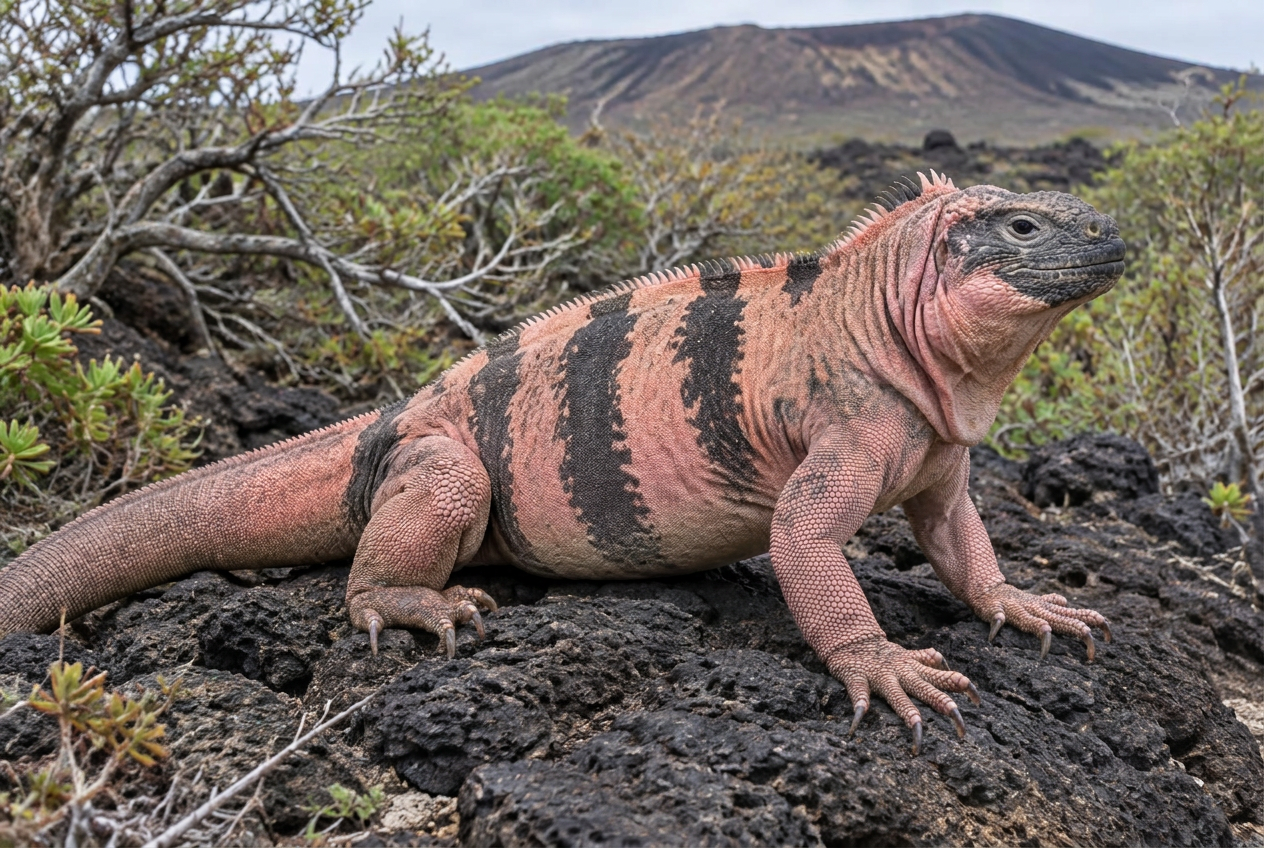 Illustrative depiction
Overview
Pink, and hiding in plain sight
The Galápagos pink land iguana is a large, heavy-bodied lizard with pink skin crossed by dark bands. It lives only on the upper slopes of Wolf Volcano, at the northern tip of Isabela Island.
Park rangers first noticed pink iguanas in the 1980s, but it was only formally described as a separate species in 2009. Its whole range covers about 25 km².
The last IUCN assessment, in February 2012, estimated 192 mature individuals. The International Iguana Foundation now estimates fewer than 200. Eruptions and introduced cats and rats remain the main dangers, and the first evidence of young surviving in the wild was only published in 2024.
Why it is nearly gone
Living on a volcano
Every pink iguana lives in one small area of one active volcano.
Volcanic eruption
The entire population lives on the slopes of Wolf, an active volcano. A single large eruption could destroy most of its habitat.
Feral cats
Introduced cats hunt young iguanas, which is why hatchlings were almost never seen for decades.
Black rats
Introduced rats eat eggs and hatchlings, further limiting how many young survive.
One tiny range
With every iguana in about 25 km² of one island, disease or any local disaster could hit the whole species at once.
Conservation history
A new species, just in time
| Year | Event |
|---|---|
| 1986 | Park rangers first notice pink iguanas on Wolf Volcano. |
| 2009 | Described as a new species, Conolophus marthae. |
| 2012 | IUCN assessment estimates 192 mature individuals; listed Critically Endangered. |
| 2021 | First hatchlings documented, after years with no evidence of young. |
| 2023 | IUCN conservation and management plan estimates about 300 individuals across around 25 km². |
Take action
Who's fighting for the pink iguana
Ecuadorian and international groups are monitoring the iguanas, controlling predators and studying their health.
Fundación Jocotoco
Ecuadorian conservation group running pink iguana protection work on Wolf Volcano.
Galápagos Conservancy
Funds the Iniciativa Galápagos restoration work, including predator control.
Charles Darwin Foundation
Research station studying the iguana's health, including a newly found herpesvirus.
San Diego Zoo Wildlife Alliance
Has supported field research on the pink iguana with Galápagos partners.
Everyday actions
What you can do from home
- 01
Visit Galápagos responsibly
Choose licensed operators, stay on marked trails and never bring plants, animals or food between islands.
- 02
Support predator control
Donations to island restoration fund the removal of feral cats and rats.
- 03
Share its story
The pink iguana was only described in 2009. Awareness helps keep funding flowing to protect it.
- 04
Back conservation science
Monitoring and health research guide every decision about the species.
Selected references
- IUCN Red List — Conolophus marthae (last assessed February 2012)
- IUCN Library — Galápagos pink land iguana conservation and management plan
- Gentile, G., Marquez, C., Snell, H.L., Tapia, W. and Izurieta, A., 2015. Conservation of a new flagship species: the Galápagos Pink Land Iguana (Conolophus marthae Gentile and Snell, 2009). In Problematic wildlife: a cross-disciplinary approach (pp. 315–336). Cham: Springer International Publishing.
- Garizio, L., Gargano, M., Colosimo, G., Gratton, P., Gerber, G.P., Lewbart, G., Sevilla, C. and Gentile, G., 2024. First evidence of recruitment in critically endangered Galápagos pink land iguanas (Conolophus marthae). Conservation Science and Practice, 6(4), e13108.
- Fundación Jocotoco — Galápagos pink iguana conservation
- Charles Darwin Foundation — novel herpesvirus in the pink land iguana