Dusky gopher frog
Lithobates sevosus · Southern Mississippi, USA
one wild breeding pond
A knobbly native of the southern coastal plains, one of North America's rarest amphibians, hopping back from the brink.
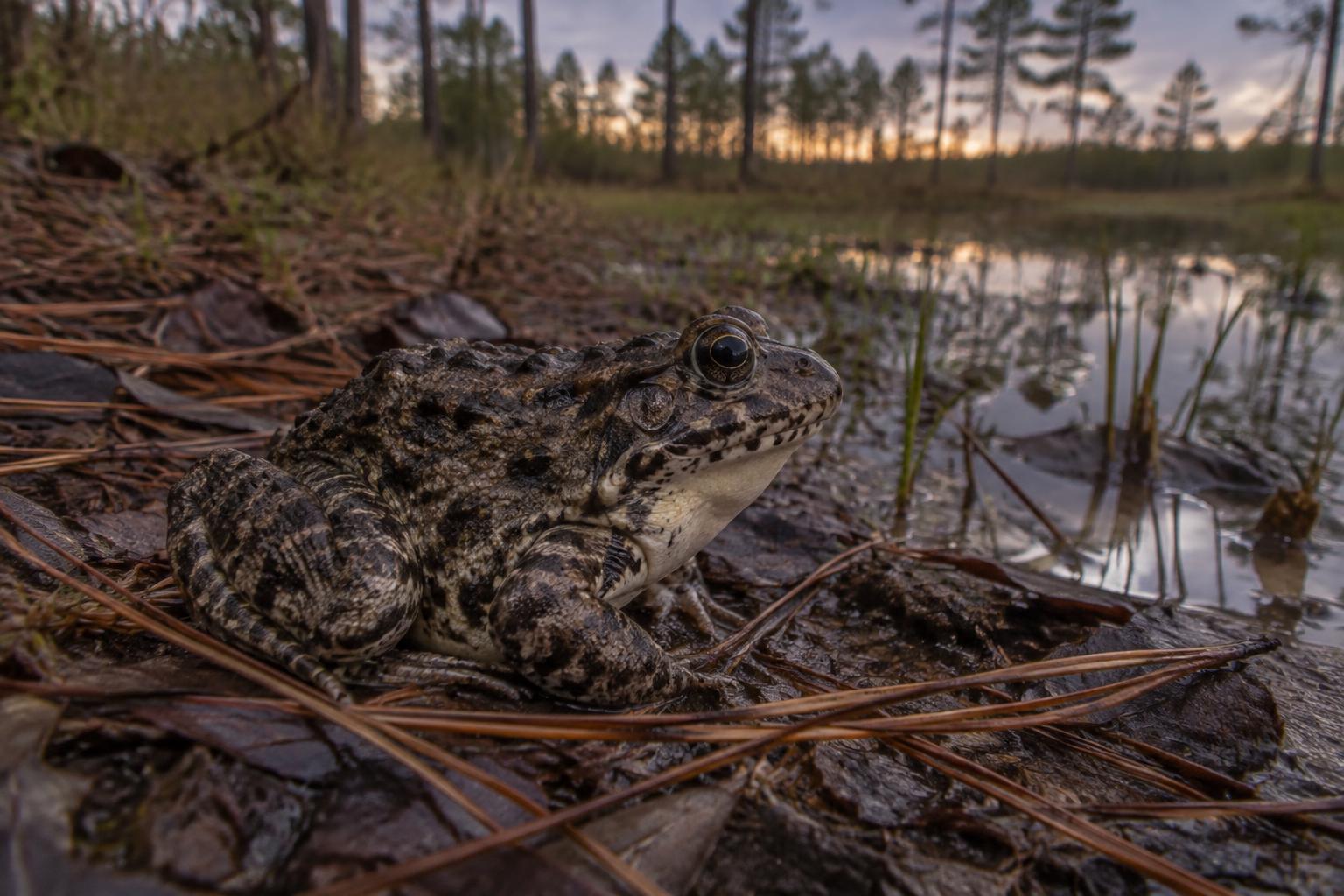 Illustrative depiction
Overview
The frog that covers its eyes
Stand at the edge of a longleaf pine forest in southern Mississippi on a cool, rainy winter night and you may hear a low, snoring rumble. That is the dusky gopher frog: warty, stocky and timid. When frightened it tucks its head down, covers its eyes with its front feet and plays dead.
It lives two lives. It breeds in shallow, fish-free ponds that fill with winter rain and dry by summer, then travels up to a kilometre into the dry pine uplands to shelter in gopher tortoise burrows, stump holes and small mammal tunnels. Lose either habitat, or the open savanna between them, and the frog disappears.
Once common across the Gulf Coastal Plain, it was down to one wild breeding pond by 2000. Zoos now use hormone-induced spawning, IVF and frozen sperm to breed it, and release young frogs into restored ponds. It is a rescue, not yet a recovery: the lab-born frogs need restored habitat to come home to.
Why it is nearly gone
Squeezed into a single pond
No single villain: overlapping pressures pushed a once-common frog down to one breeding site.
Longleaf pine loss
Longleaf pine once covered an estimated 90 million acres of the Southeast; less than 5% remains. Logging, farming and building erased the open savanna the frog crosses between ponds and burrows.
Fire suppression
The pine savanna needs frequent fire. Without it, brush closes in and fills the seasonal ponds where the frog breeds.
Chytrid fungus
The amphibian chytrid fungus, which has killed frogs worldwide, has been found in gopher frogs. With so few left, an outbreak could be catastrophic.
Drought and climate change
Ponds that dry out before tadpoles turn into froglets can wipe out a whole year's young.
Invasive species
Fire ants and feral hogs eat eggs, tadpoles and froglets, and cogongrass chokes the open ground.
Low genetic diversity
Decades at a single pond have left the survivors inbred and less able to cope with disease and change.
Conservation history
From the whole coastal plain to one pond
| Year | Event |
|---|---|
| Historically | Common across the Gulf Coastal Plain, where longleaf pine once covered an estimated 90 million acres. |
| 20th century | Logging, farming, development and fire suppression destroy over 95% of the longleaf pine ecosystem. |
| By 2000 | Reduced to a single wild breeding population at Glen's Pond, Harrison County, Mississippi. |
| 2001 | Listed as Endangered under the US Endangered Species Act. |
| 2019 | First dusky gopher frogs born through IVF hatch at Memphis Zoo. |
| Today | About 60–100 adults; captive colonies at several zoos and head-started froglets released into restored ponds. |
Take action
Who's fighting for the dusky gopher frog
Federal biologists, reproductive scientists and zoos breed, bank and release the frog, while land trusts restore its longleaf pine home. Support them directly.
Memphis Zoo
Leads the assisted reproduction work, producing the first IVF-born dusky gopher frogs and rearing young for release.
Detroit Zoological Society
Keeps a backup captive colony and helps with breeding, head-starting and releases.
The Nature Conservancy — Mississippi
Restores longleaf pine and seasonal wetlands with prescribed fire and land protection.
Amphibian Ark
Coordinates the global effort to keep backup colonies of threatened amphibians.
Omaha's Henry Doorly Zoo & Aquarium
Breeding partner supporting backup colonies and reintroduction research.
U.S. Fish and Wildlife Service
Listed the frog as Endangered in 2001 and runs its recovery plan, critical habitat and reintroduction trials.
AZA Amphibian Taxon Advisory Group
Coordinates North American zoo breeding and reintroduction programmes for threatened amphibians, including the dusky gopher frog.
Everyday actions
What you can do from home
- 01
Support longleaf pine restoration
Back groups like The Nature Conservancy that plant longleaf pine and restore seasonal wetlands across the Southeast.
- 02
Back prescribed fire
Controlled burns keep the savanna open and stop ponds filling in. Support state and federal fire programmes.
- 03
Protect seasonal wetlands
Fish-free winter ponds are the only places it can breed. Support wetland protection and never fill or drain them on your land.
- 04
Share its story
Share the frog's story and press decision-makers to fund the habitat its lab-born young need to come home to.
Selected references