Devil's Hole pupfish
Cyprinodon diabolis · Devils Hole, Nevada, USA
spring 2026, one pool
The rarest fish on the planet, surviving 60,000 years in a single desert rock pool.
Source: National Park Service spring 2026 count · IUCN Red List
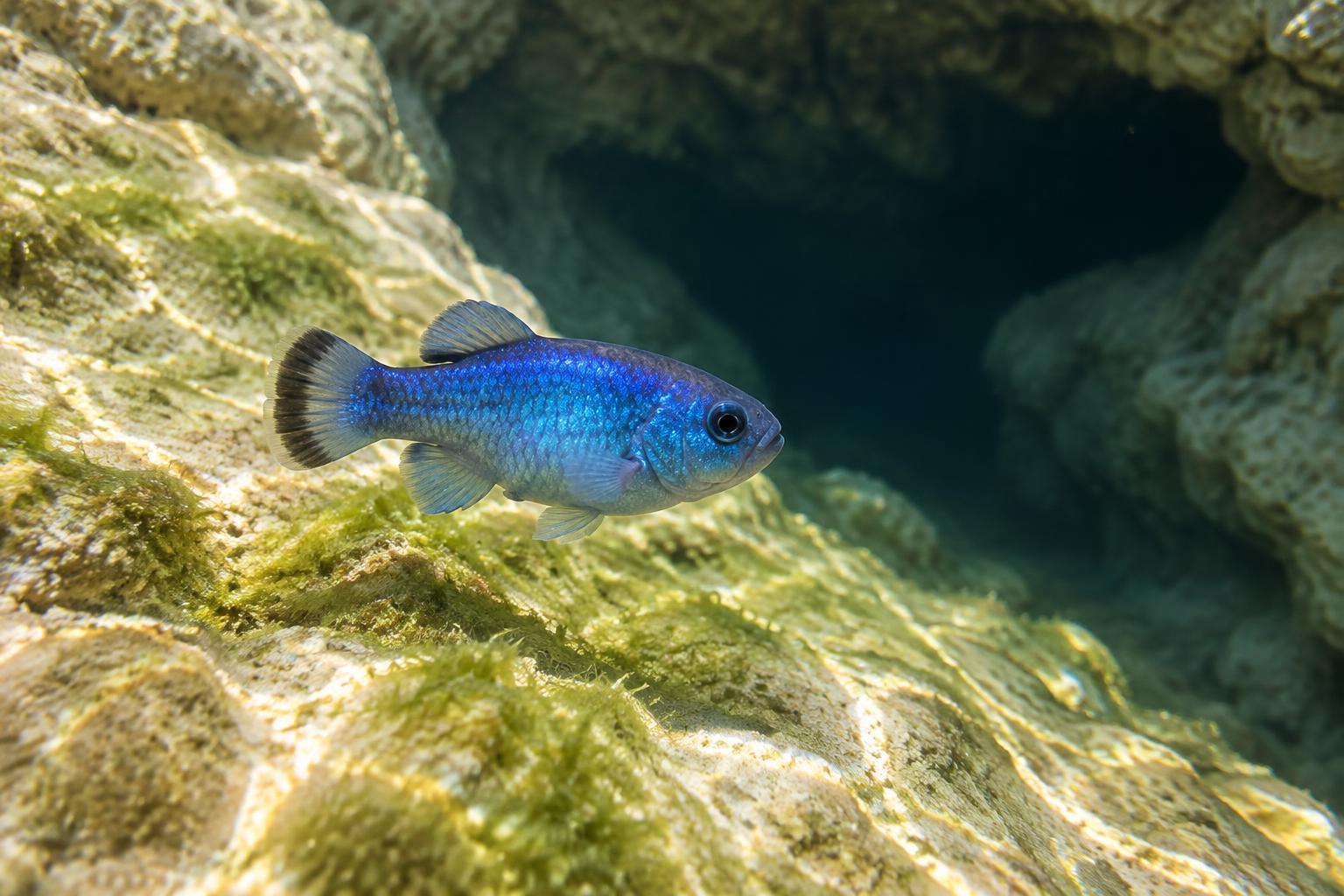 Illustrative depiction
Overview
A paperclip-sized fish in a hot desert abyss
First described in 1930, it grows to just 30 mm long. Males shimmer metallic blue; females and young are olive-yellow. It has a large head and dark eyes, and lives only 10 to 14 months.
Its whole world is the top 30 metres of one water-filled limestone fissure in the Mojave Desert, near Death Valley. Adults shelter in the warm, low-oxygen depths and rise each day to a single sunlit 3 × 6 m shelf, where algae grows and every egg is laid. Spawning happens all year, peaking in spring and autumn.
Genome studies suggest the fish was cut off naturally when a geological event sealed the cavern around 60,000 years ago. The cave walls also hold one of the longest known records of past climate.
Why it is nearly gone
One shelf, four ways to lose it
The whole species feeds and breeds on one sunlit 3 × 6 m ledge. Any one of these threats could end it.
Groundwater pumping
In the 1960s, farm wells drew down the regional aquifer and began exposing the spawning shelf. Without the shelf, the fish can neither feed nor breed.
Extreme inbreeding
Thousands of years in one tiny pool have left some of the highest inbreeding levels recorded in any vertebrate, including gene losses that weaken sperm and tolerance of low oxygen.
Earthquake waves
Distant quakes send waves sloshing through the narrow fissure. In December 2024 a magnitude 7.0 quake off Northern California stripped algae and eggs off the shelf.
No margin for change
Warm water at about 34 °C and near-lethal oxygen levels leave the fish almost no room to cope with any shift in climate or water.
Conservation history
Crashes and comebacks in a single pool
| Year | Event |
|---|---|
| ~60,000 years ago | A geological event seals the cavern, isolating the pupfish in a single pool. |
| 1930 | First described by scientists. |
| 1960s | Agricultural groundwater pumping drops the water level and starts exposing the spawning shelf. |
| 1967 | Among the first animals protected under the 1966 Endangered Species Preservation Act. |
| 1970s | Peak counts of about 400–550 fish. First backup pools built; they later fail. |
| 1976 | US Supreme Court (Cappaert v. United States) sets a legal minimum water level for Devils Hole. |
| 2007 | Population falls to 38 fish. |
| 2013 | All-time low of 35 fish. |
| Sept 2022 | Rebound to 263 fish. |
| Dec 2024 | A magnitude 7.0 earthquake off Northern California sends 6-foot waves through the cavern, scouring algae and eggs off the shelf. |
| Early 2025 | Count crashes to about 20–38 fish. First-ever release of captive-bred fish (19) from the Ash Meadows replica refuge back into Devils Hole. |
| Spring 2026 | 77 fish counted; released fish have adapted and are breeding. |
Take action
Who's fighting for the Devil's Hole pupfish
Federal agencies, scientists and local groups guard the pool, count the fish and keep a backup population in a full-size replica of the cavern.
Desert Fishes Council
International scientific group protecting North America's desert fishes through research and policy.
U.S. Fish & Wildlife Service — Ash Meadows Fish Conservation Facility
Runs the 100,000-gallon replica of Devils Hole, breeds the backup population and leads releases back into the wild cavern.
National Park Service — Death Valley National Park
Guards Devils Hole on site, monitors its ecology and runs the twice-yearly dive and surface counts.
Nevada Department of Wildlife
Leads state recovery work for aquatic species and research partnerships on desert fish.
Everyday actions
What you can do from home
- 01
Save water in dry regions
Desert aquifers take centuries to refill. Use less water, plant desert-friendly gardens and back local groundwater limits.
- 02
Back water-wise clean energy
Support renewable projects that are properly checked for their effect on groundwater and desert springs.
- 03
Speak up for public lands
The Ash Meadows refuge and dive counts depend on steady public funding. Support protection and funding for wildlife agencies.
- 04
Share verified updates
Spread news from the National Park Service and the groups working on the ground.
Selected references
- IUCN Red List — Cyprinodon diabolis (last assessed August 2014)
- National Park Service — Devils Hole pupfish
- U.S. Fish & Wildlife Service — Ash Meadows National Wildlife Refuge
- Cappaert v. United States, 426 U.S. 128 (1976)