Southern corroboree frog
Pseudophryne corroboree · Snowy Mountains, Australia
in the wild
Now considered functionally extinct in the wild, with no viable wild populations. It survives mainly in zoo breeding programmes.
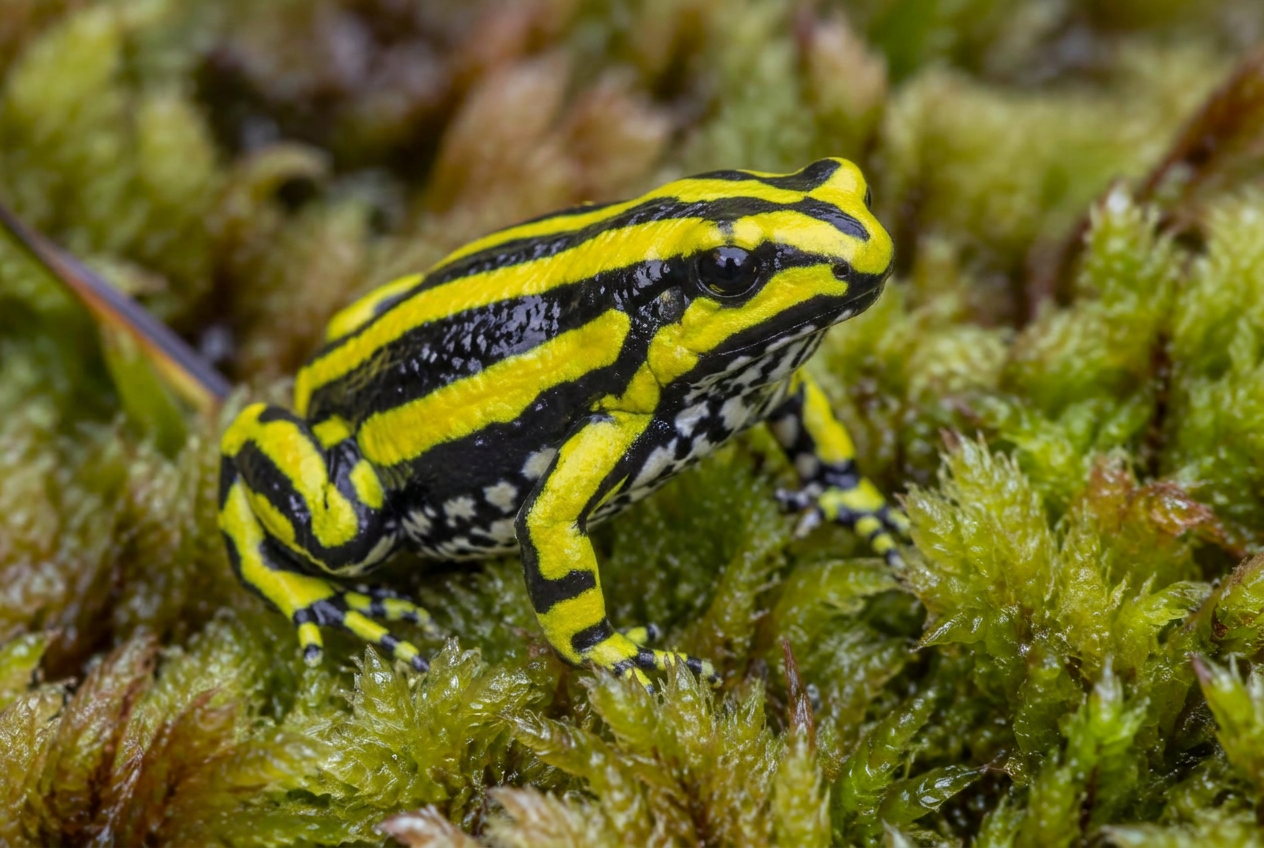 Illustrative depiction
Overview
Australia's most iconic frog
The southern corroboree frog is a tiny, boldly striped frog found only in sphagnum peat bogs between 1,300 and 1,760 metres in the Snowy Mountains of New South Wales.
Since the 1980s the deadly chytrid fungus has wiped out almost all wild frogs. The IUCN's 2022 assessment estimates just 4–50 remain in the wild, and the species is now considered functionally extinct there, with no viable wild populations.
It survives mainly in zoo breeding programmes. In 2025 University of Melbourne researchers completed its genome, which they plan to use to help reintroduce the frog to its natural habitat in the Snowy Mountains.
Why it is nearly gone
Disease, drought and fire
Its only home is a handful of high-altitude bogs in the Snowy Mountains.
Chytrid fungus
This skin disease swept through the Australian Alps from the 1980s and is the main reason wild populations collapsed.
Drought and climate change
The frogs need wet bogs to breed. Drier, warmer seasons dry out nest sites before tadpoles can develop.
Bushfire
Fires such as the 2003 and 2019–20 blazes burn through the fragile sphagnum bogs the frogs depend on.
Habitat damage
Feral horses, pigs and deer trample and churn up the peat bogs.
Conservation history
From alpine bogs to zoo arks
| Year | Event |
|---|---|
| 1953 | Southern corroboree frog formally described by science. |
| 1980s | Wild numbers start crashing as chytrid fungus spreads through the Australian Alps. |
| 1997 | Captive breeding begins to create an insurance population. |
| 2012 | National Recovery Plan published for the southern and northern corroboree frogs. |
| 2022 | IUCN assessment estimates just 4–50 wild individuals; considered functionally extinct in the wild. |
| 2025 | University of Melbourne researchers complete its genome to help plan reintroductions to the Snowy Mountains. |
Take action
Who's fighting for the southern corroboree frog
Zoos, park rangers and community groups breed frogs, build disease-free enclosures and plan returns to the wild.
Taronga Conservation Society Australia
Runs major captive-breeding and insurance-colony programmes for both southern and northern corroboree frogs.
NSW National Parks and Wildlife Service
Leads the Southern Corroboree Frog Conservation Project, including disease-free release enclosures in Kosciuszko National Park.
ACT Herpetological Association
Volunteer reptile and frog society supporting amphibian conservation and research in the Australian Capital Territory region.
Everyday actions
What you can do from home
- 01
Support zoo breeding programmes
Captive colonies are now the species' lifeline and depend on public support.
- 02
Clean your boots in the high country
Washing and drying gear between wetlands helps stop chytrid fungus spreading.
- 03
Record frogs with FrogID
Sharing frog calls through the FrogID app helps scientists track Australian frogs.
- 04
Back action on climate and feral animals
Support policies that protect alpine bogs from drought, fire and trampling.
Selected references
- IUCN Red List — Pseudophryne corroboree (northern and southern corroboree frogs; last assessed March 2022)
- Kosch, T.A. et al., 2025. Wellcome Open Research, 10, 228.
- Frog, S.C., 2012. National Recovery Plan for the southern corroboree frog Pseudophryne corroboree and northern corroboree frog Pseudophryne pengilleyi.
- Hunter, D.A., Speare, R., Marantelli, G., Mendez, D., Pietsch, R. and Osborne, W., 2010. Presence of the amphibian chytrid fungus Batrachochytrium dendrobatidis in threatened corroboree frog populations in the Australian Alps. Diseases of Aquatic Organisms, 92, pp.209–216.
- University of Melbourne — Scientists map the genome of Australia's most iconic and endangered frog (2025)