Chinese giant salamander
Andrias davidianus species complex · China
no reliable estimate
Unknown, but thought to be extremely low and on the verge of collapse — wild populations have crashed by over 80% since the 1950s.
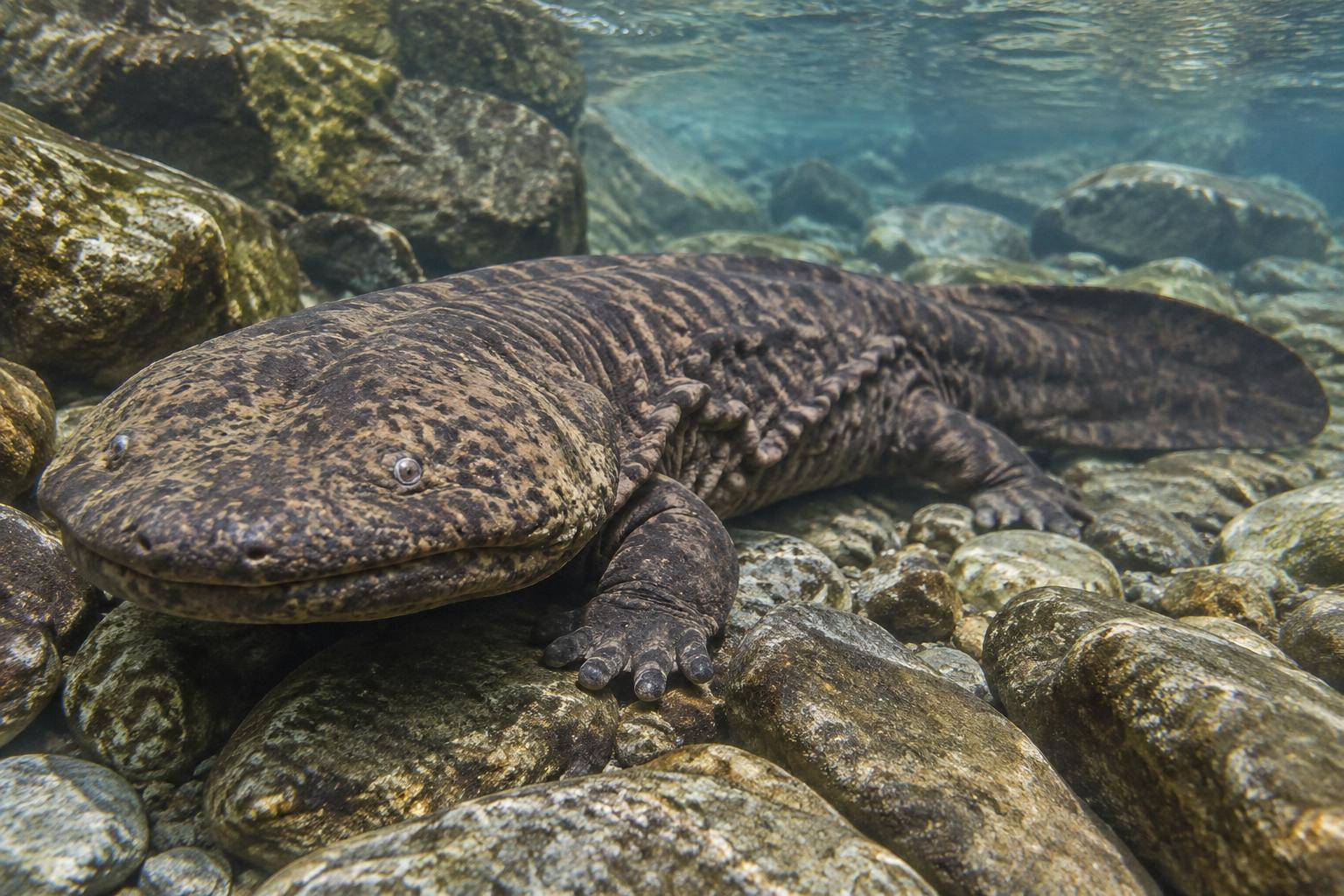 Illustrative depiction
Overview
One giant, up to nine species
The Chinese giant salamander is the largest amphibian in the world, growing up to 1.8 m long. It lives in rocky streams and lakes in the Yangtze River basin and absorbs most of its oxygen through its wrinkled skin. Its lineage split from other amphibians about 170 million years ago, making it a ZSL EDGE species.
Wild populations have crashed by over 80% since the 1950s. It is eaten as a delicacy and used in traditional medicine, and since the early 2000s a huge farming industry has drawn even more animals from the wild. Large numbers are now kept in farms around China and moved between them.
Recent ZSL research shows it is really up to nine different species. That means each one is far rarer than once thought — and with only four named so far, protecting them is even harder.
Why it is nearly gone
Eaten, farmed and moved
A lineage that survived 170 million years is being emptied from its rivers in a few decades.
Overharvesting for food
Considered a delicacy, it supplies a luxury food market in China.
Traditional medicine
Body parts are used in traditional Chinese medicine, adding to demand.
The farming industry
Farming took off in the early 2000s, driving a surge in animals taken from the wild. Farmed animals of different species are mixed and moved around China, and releases can blur the separate wild lineages.
Poaching and habitat destruction
Illegal collection, dams, pollution and stream damage have hit the remaining wild animals hard.
Conservation history
From wild decline to hidden species
| Year | Event |
|---|---|
| 1950s onward | Wild populations begin a long decline from harvesting for food and medicine — down by more than 80% since. |
| Early 2000s | Commercial farming industry takes off, driving a surge in animals taken from the wild. |
| 2018–2019 | ZSL-led genetic research reveals the "Chinese giant salamander" is actually several distinct species. |
| 2024 | A conservation action plan for Chinese giant salamanders is published with the IUCN Amphibian Specialist Group. |
Take action
Who's fighting for the Chinese giant salamander
Zoos, researchers and Chinese conservation groups working to find and protect each species.
ZSL London Zoo
Cares for Chinese giant salamanders at London Zoo and supports ZSL's field programme.
ZSL EDGE of Existence
Lists the giant salamander as an EDGE species — evolutionarily distinct and globally endangered.
Ocean Park Conservation Foundation, Hong Kong
Funds field research, community education and collaborative breeding programmes to safeguard remaining wild populations.
Everyday actions
What you can do from home
- 01
Never eat or buy giant salamander
Refuse salamander meat and medicines, wherever they're offered.
- 02
Support genetic research
Knowing which of the up to nine species each animal belongs to is essential before any can be protected or released.
- 03
Back clean, free-flowing rivers
Support groups working against pollution and damaging dams in the Yangtze basin.
- 04
Visit and support zoo programmes
Zoos such as London Zoo fund field work and research on these salamanders.
- 05
Share the story
Few people know the world's largest amphibian is quietly disappearing.
Selected references
- Mao J. et al. 2024. A conservation action plan for Chinese giant salamanders. IUCN SSC Amphibian Specialist Group.
- Wang X.M. et al. 2004. The decline of the Chinese giant salamander Andrias davidianus and implications for its conservation. Oryx 38(2): 197–202.
- ZSL — Chinese giant salamander conservation
- London Zoo — Chinese giant salamander
- EDGE of Existence — Giant salamander conservation in China
- IUCN Red List — Andrias davidianus (last assessed December 2020)