Cherry-throated tanager
Nemosia rourei · Saíra-apunhalada · Espírito Santo, Brazil
none in captivity
A red, black and white jewel of Brazil's Atlantic Forest canopy, rediscovered in 1998 after more than a century of silence.
Source: IUCN Red List
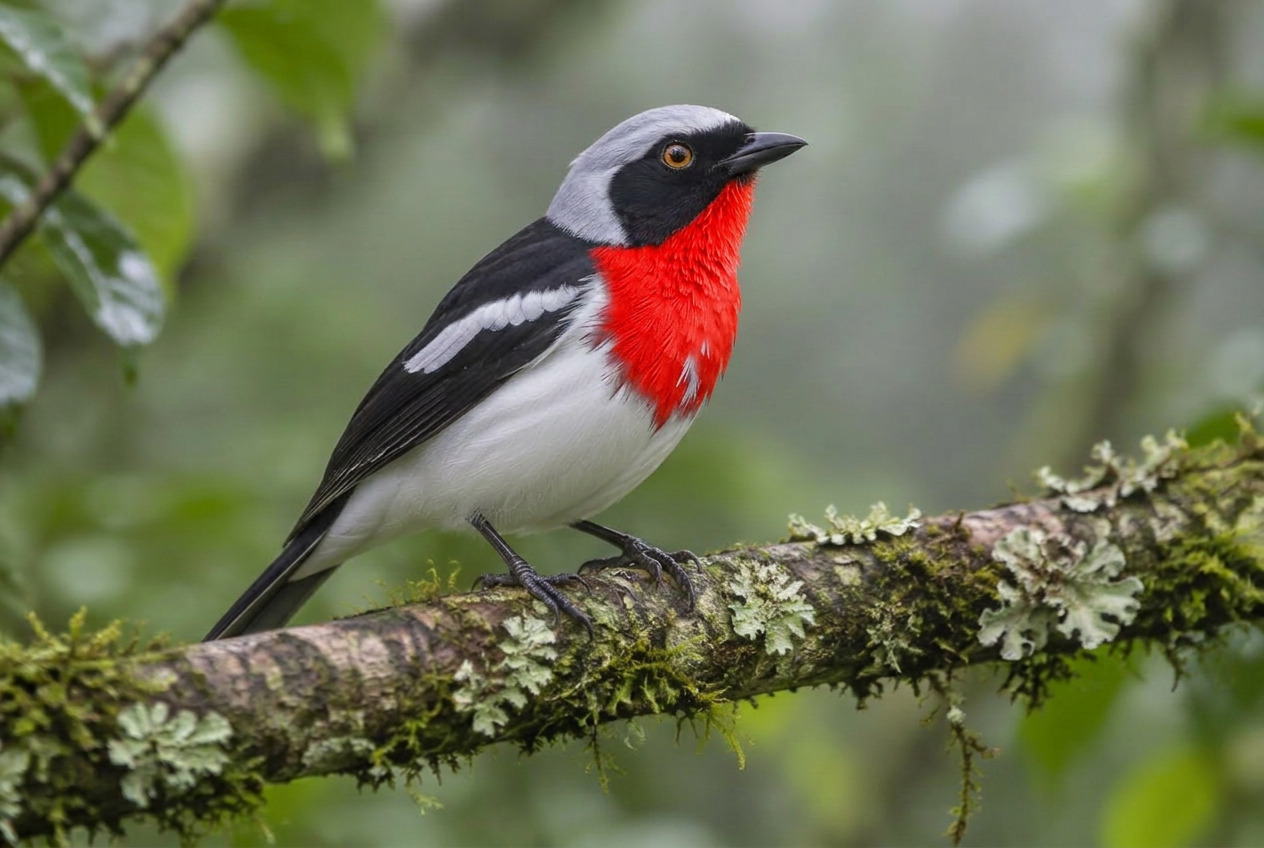 Illustrative depiction
Overview
A miraculous survival in red, white and black
Just 12.5 cm long and about 22 g, it has a black face mask, pale grey crown, yellow or amber eyes and white underparts, with a red throat patch tapering like a dagger — the reason for its local name, saíra-apunhalada, the “stabbed tanager.” Its only close relative is the hooded tanager.
It breeds cooperatively: up to six flock members help a pair build the nest, feed chicks and chase off predators. Nests are shallow cups of lichen and spider silk 20–25 m up on horizontal branches. Flocks of about eight roam up to 420 hectares, often with other insect-eating birds, with one bird keeping watch from higher up. Its far-carrying “peuu” call gives it away.
It lives only in tall, old-growth montane Atlantic Forest at 850–1,250 m, mainly in the Mata dos Caetés forest and the Augusto Ruschi Biological Reserve in Espírito Santo. No birds are kept in captivity.
Why it is nearly gone
Only 12% of its forest is left
Brazil's Atlantic Forest has been cut back to about 12% of its original extent by farming, cities and mining.
Forest loss and fragmentation
Coffee, eucalyptus and pine plantations have replaced the old-growth forest it needs; young regrowth is no use to it for decades. Clearance at Fazenda Pindobas wiped out a local group by 2006.
Mining and disturbance
Granite, marble and limestone quarries fill nearby forest with noise, and illegal off-road races have driven birds from forest patches.
Pesticides and palm-heart cutting
Farm pesticides kill the insects it feeds on, and felling for palm heart breaks up the layered rainforest.
Too few, in too small an area
Under 30 mature birds in about 31 km² can be wiped out by a storm or disease. Playing recorded songs to attract birds can exhaust breeding adults.
Conservation history
From a single specimen to about 30 birds
| Year | Event |
|---|---|
| 1870 | Described from a single specimen sent to Berlin by Swiss collector Carl Euler — the only one he saw in 30 years of collecting. |
| 1870–1998 | No confirmed records for over a century; widely presumed extinct. |
| 1998 | Rediscovered: a small group seen in Espírito Santo. |
| 2005 | Known population falls to just 14 birds. |
| 2006 | Lost from Fazenda Pindobas after forest clearance there. |
| 2008 | Up to 20 birds recorded. |
| 2020 | Around 10 birds recorded. |
| Today | About 20–30 mature birds, mainly in the Mata dos Caetés forest and Augusto Ruschi Biological Reserve. |
Take action
Who's fighting for the cherry-throated tanager
Field research, nest monitoring and land purchases in Brazil. With no birds in captivity, protecting the forest is the only lifeline.
Instituto Marcos Daniel
Leads the saíra-apunhalada conservation programme: long-term field research, acoustic and drone-assisted nest monitoring, and land purchases such as the Caetés Forest reserve.
Rainforest Trust
Works with local partners like IMD to buy and permanently protect threatened Atlantic Forest.
American Bird Conservancy
Works with Brazilian researchers to fund habitat management and monitoring for critically endangered birds.
Everyday actions
What you can do from home
- 01
Choose bird-friendly coffee and FSC wood
Plantations have choked the Atlantic Forest; shade-grown coffee and certified timber ease the pressure.
- 02
Fund forest purchases
Support groups buying private land to reconnect forest fragments in Espírito Santo.
- 03
Watch birds responsibly
Keep your distance and never use song playback, which can stress birds during nesting.
- 04
Share verified updates
Spread news from frontline groups and press for strong forest protection laws.
Selected references
- IUCN Red List — Nemosia rourei (last assessed August 2018)
- Instituto Marcos Daniel — saíra-apunhalada programme
- SAVE Brasil
- Bauer, C., Pacheco, J.F., Venturini, A.C. and Whitney, B.M., 2000. Rediscovery of the cherry-throated tanager Nemosia rourei in southern Espírito Santo, Brazil. Bird Conservation International, 10(2), pp.97–108.
- Develey, P.F. and Phalan, B.T., 2021. Bird extinctions in Brazil's Atlantic Forest and how they can be prevented. Frontiers in Ecology and Evolution, 9, p.624587.