California condor
Gymnogyps californianus · California, Arizona, Utah and Baja California
up from 22 in 1982
North America's largest soaring bird, briefly extinct in the wild and now riding the thermals again.
Source: California Condor Recovery Team census, Dec 2025 (607 in total incl. captivity) · IUCN Red List
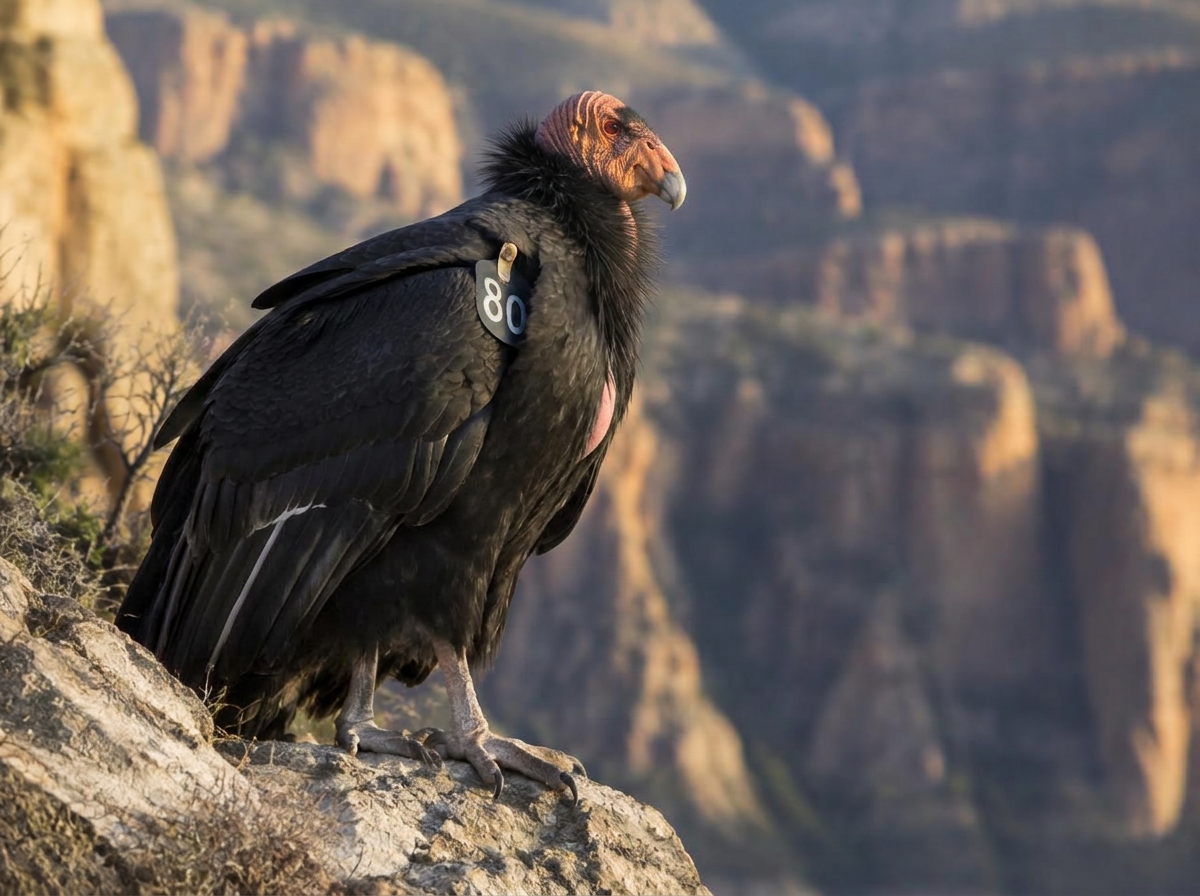 Illustrative depiction
Overview
The last of an ancient lineage
The California condor is the only surviving member of its genus, a scavenger whose shape has barely changed in 26,000 years. It once lived alongside mammoths and mastodons across North America, and has the widest wingspan of any bird on the continent.
It mostly soars on rising warm air, flapping only to take off, and can cover 250 km a day looking for carcasses. Its bald head stays clean while it feeds, and its skin can flush from yellow to reddish-orange. Pairs mate for life.
The condor is sacred to many Native Californian nations, with 65 known tribal names. After the last wild bird was caught in 1987, captive breeding and releases brought it back. It now nests in the wild again, but still depends on people testing and treating birds for lead poisoning.
Why it is critically endangered
Poisoned by what it eats
Lead poisoning
Condors eat carcasses shot with lead ammunition. Lead caused 28% of all wild deaths from 1992 to 2025, and recovery isn't possible while it continues.
Microtrash fed to chicks
Parents mistake bottle caps, bolts, wire and plastic for food. It is a main cause of nestling death; chicks are now checked every month.
DDT, shooting and power lines
DDT once thinned eggshells until they broke. Today shooting, power lines and fire still account for a share of deaths.
Habitat loss
The range once covered much of North America. Habitat loss pushed the condor back towards the Pacific coast.
Conservation history
From 22 birds to the open sky
| Year | Event |
|---|---|
| Pleistocene | Tens of thousands across North America, alongside mammoths and mastodons |
| 1797 | Described by George Shaw |
| Late 1880s | Still sighted in British Columbia |
| By 1940s | Condors rare after rapid 20th-century decline |
| 1967 | First protected under the US Endangered Species Preservation Act |
| 1973 | California Condor Recovery Team founded, led by the US Fish & Wildlife Service |
| 1982 | Only 22 condors remain |
| 1987 | Last wild bird taken into captivity; extinct in the wild |
| 1988 | First captive breeding success |
| 1992 | First captive-bred condors released |
| 1996–2003 | Release sites added in Arizona, Big Sur, Baja California and Pinnacles |
| 2003 | First chick from a wild nest fledges |
| 2008 | Over 300 condors in total; lead ammunition banned in California's condor range |
| Aug 2020 | Dolan fire kills 12 wild condors at the Big Sur sanctuary |
| 2025 | 46 birds released, 67 eggs laid; Big Sur sanctuary rebuilt |
| 31 Dec 2025 | 392 wild, 607 in total, 215 in captivity (Recovery Team census) |
Take action
Who's fighting for the condor
Vetted organisations raising, releasing and protecting condors. Give to them directly.
Ventana Wildlife Society
Runs the Big Sur and San Simeon condor sanctuaries, release sites, lead testing and live condor cams
Friends of California Condors Wild and Free
Volunteer group supporting recovery through education, outreach, research and stewardship
The Peregrine Fund
California condor recovery, captive rearing and release
San Diego Zoo Wildlife Alliance
Captive breeding for the condor. Note: donations support its general work, not condors alone
U.S. Fish and Wildlife Service
Leads the California Condor Recovery Program with state, tribal and nonprofit partners
Everyday actions
What you can do from home
- 01
Choose non-lead ammunition
If you hunt, or know hunters, switching to non-lead bullets is the most direct way to keep wild condors alive.
- 02
Pack out all microtrash
Take every scrap home when you visit condor country, so parents can't feed it to their chicks.
- 03
Back wildlife corridors
Support land protection that lets condors keep spreading across their old range.
- 04
Speak up on lead
Share the condor's story and support laws that take lead ammunition out of the food chain.
Selected references
- California Condor Recovery Team — population census, Feb 2026 (count at 31 Dec 2025)
- IUCN Red List — Gymnogyps californianus (last assessed January 2023)
- Robinson et al. 2021 — Genome-wide diversity in the California condor tracks its prehistoric abundance and decline. Current Biology 31(13): 2939–2946
- Walters et al. 2010 — Status of the California Condor and efforts to achieve its recovery. The Auk 127(4): 969–1001
- Snyder & Schmitt 2002 — California Condor (Gymnogyps californianus). Birds of North America
- Snyder & Snyder 1989 — Biology and conservation of the California Condor
- Cade 2007 — Exposure of California Condors to lead from spent ammunition. Journal of Wildlife Management
- Tuleyome — The significance of the California condor to Native Californians
- The Peregrine Fund — California condor