Black-footed ferret
Mustela nigripes · Great Plains, North America
in the wild
North America's only native ferret, once declared extinct and rebuilt from just 18 survivors on the prairie.
Source: WWF
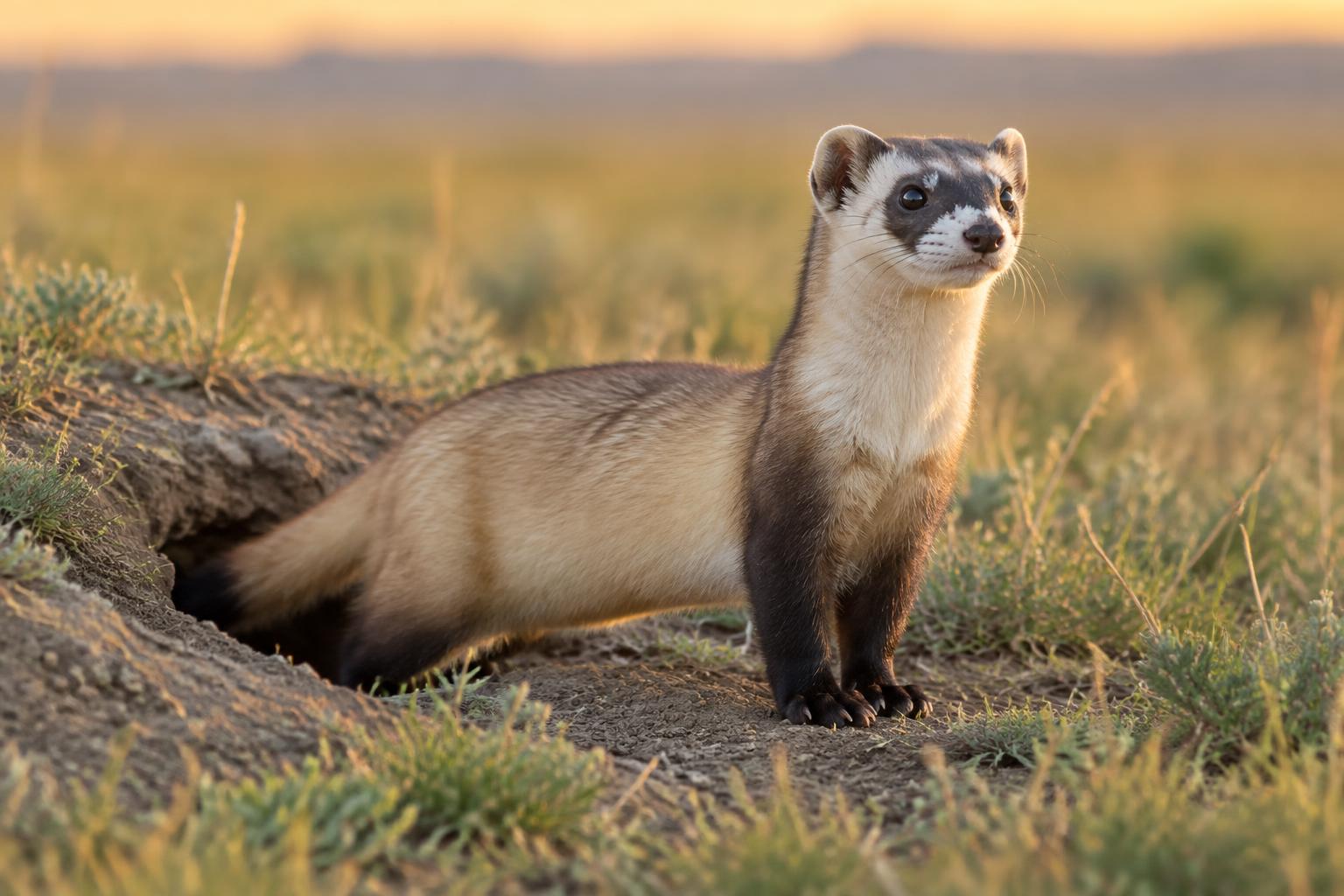 Illustrative depiction
Overview
The masked hunter of the prairie
The black-footed ferret is a member of the weasel family and the only ferret native to North America. With its dark eye mask, pale body and black legs, it looks much like the steppe polecats of Europe and Asia.
It is solitary and nocturnal, except when breeding and raising young, and spends most of its life in prairie dog burrows across the Great Plains, hunting the prairie dogs themselves.
Its numbers collapsed through the 20th century as prairie dogs were poisoned and the prairie was ploughed. It was thought extinct until a colony was found in Wyoming in 1981. The last 18 wild animals were taken into captivity, and their descendants have since been released at sites across the USA, Canada and Mexico.
Why it is nearly gone
Its food and home disappeared
The ferret depends entirely on prairie dogs, so their decline and disease brought it to the edge.
Loss of prairie dogs
Ferrets eat almost nothing but prairie dogs and live in their burrows. Poisoning and shooting of prairie dogs removed most of their food and homes.
Sylvatic plague
This introduced disease kills both prairie dogs and ferrets, and can wipe out a whole colony in a season.
Lost prairie
Ploughing and development have destroyed most of the short- and mixed-grass prairie the ferret needs.
Low genetic diversity
Every living ferret descends from just seven animals, leaving the species vulnerable to disease and inbreeding.
Conservation history
Back from 18 animals
| Year | Event |
|---|---|
| 1900s | Prairie dog poisoning, ploughing of the prairie and plague wipe out most of the ferret's prey and habitat across the Great Plains. |
| 1979 | The last known captive ferret dies; the species is feared extinct. |
| 1981 | A ranch dog brings home a dead ferret near Meeteetse, Wyoming, revealing a surviving wild colony. |
| 1985–87 | Plague and canine distemper sweep the colony; the last 18 wild ferrets are taken into captivity to start a breeding programme. |
| 1991 | Captive-bred ferrets are first released back into the wild in Wyoming. |
| May 2015 | IUCN assessment: Endangered, with about 206 mature individuals in the wild. |
| 2020 | Elizabeth Ann, a clone made from cells stored since 1988, is born to bring lost genetic diversity back into the population. |
| Today | Fewer than 500 live in the wild across reintroduction sites in the USA, Canada and Mexico (WWF). |
Take action
Who's fighting for the black-footed ferret
These groups breed ferrets, return them to the wild and protect the prairie. Give to them directly.
Black-footed Ferret Conservation Foundation
Funds recovery work, research and public education for the black-footed ferret.
Black-footed Ferret Recovery Implementation Team
Coordinates the partners working to recover the species across North America.
Center for Biological Diversity
Campaigns and takes legal action to protect the ferret and the prairie dog colonies it depends on.
Smithsonian's National Zoo and Conservation Biology Institute
Manages core captive-breeding populations and genetic preservation.
Revive & Restore
Leads genomic research and genetic rescue, including cloning to restore genetic diversity.
Cheyenne Mountain Zoo
A partner in the recovery programme, breeding ferrets for release. Zoos across the Association of Zoos and Aquariums also support breeding and fundraising.
U.S. Fish and Wildlife Service – National Black-footed Ferret Conservation Center
Oversees the main captive-breeding and recovery facilities in Colorado and Wyoming.
WWF
Works with ranchers and tribes to restore prairie and reintroduce ferrets.
Everyday actions
What you can do from home
- 01
Support prairie dogs
Back efforts to protect prairie dog colonies — without them, ferrets cannot survive.
- 02
Buy grassland-friendly
Choose beef and products from ranches that keep native prairie intact and wildlife-friendly.
- 03
Adopt a ferret
Symbolic adoptions help fund captive breeding and reintroductions.
- 04
Spread the word
Share how a species once declared extinct was brought back from just 18 animals.
Selected references