Bali myna
Leucopsar rothschildi · Bali, Indonesia
up from 20 in 1990
Bali's faunal emblem, a snow-white starling that is still ten times rarer in the wild than in cages.
Source: IUCN Red List
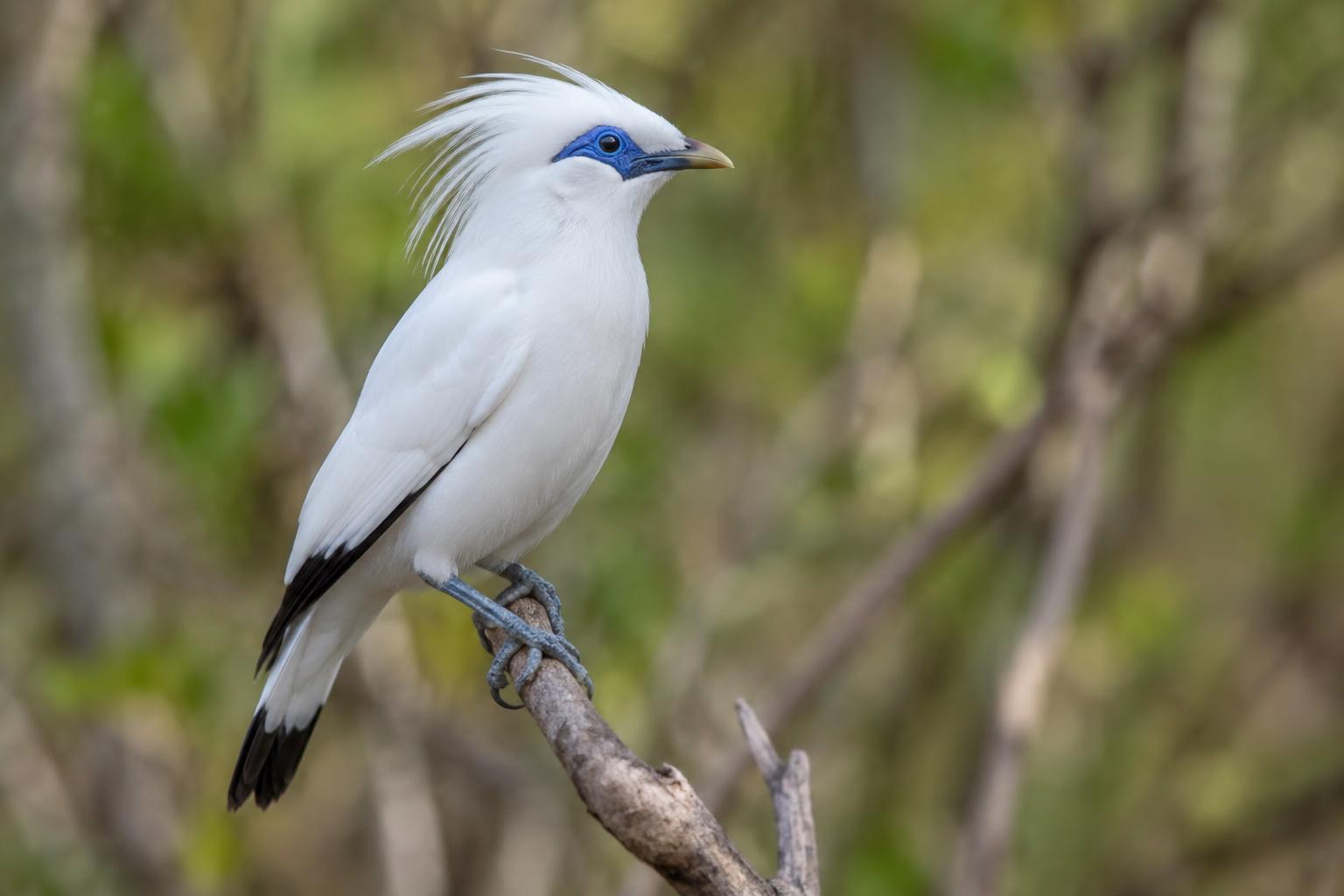 Illustrative depiction
Overview
A white bird whose beauty was its undoing
Known locally as the Jalak Bali, this starling lives only on Bali. It was described by Western science in 1911, and its genus name comes from the Greek leukos (white) and psar (starling). It grows to about 25 cm, with snow-white plumage, black wingtips and tail tip, a floppy crest and a patch of bare blue skin around each eye.
It breeds in the rainy season. Males bob up and down and call loudly to attract females, and pairs nest in tree cavities. Females lay 2–3 eggs, and both parents feed the chicks.
Its home was the dry, savannah-like forest of north-west Bali, and Bali Barat National Park is still its stronghold. A second population now lives on Nusa Penida, off Bali's south-east coast, where village agreements protect it. It became Bali's faunal emblem in 1991 and appears on the 200 rupiah coin.
Why it is nearly gone
Hunted for its looks
Habitat loss started the decline; the cage-bird trade nearly finished it.
The cage-bird trade
A breeding pair can fetch $2,000 or more on the black market. Collector demand from the 1970s drove poaching that cut the wild population to 20 birds.
A culture of caged songbirds
In parts of Bali and Java up to a third of households keep caged birds, keeping demand high.
Habitat loss
Clearing of north-west Bali's dry, savannah-like forest through the 20th century shrank its only home.
Fragile releases
Early reintroductions of captive-bred birds were poorly monitored, and many released birds did not survive.
Conservation history
From 20 birds to a hard-won comeback
| Year | Event |
|---|---|
| 1911 | First described by Western science, from north-west Bali. |
| 1970s | Collector demand for the cage-bird trade explodes; poaching empties the forest. |
| 1990 | Rock bottom: just 20 birds left in the wild. |
| 1991 | Named Bali's faunal emblem. |
| 2015 | Despite many releases, few birds found surviving independently in the wild. |
| Today | Over 100 wild birds across West Bali National Park, Nusa Penida and newer release sites; around 1,000 in cages. |
Take action
Who's fighting for the Bali myna
Community sanctuaries, captive breeding and habitat protection are bringing the Jalak Bali back. Give to them directly.
Everyday actions
What you can do from home
- 01
Never buy a wild-caught songbird
Refuse any caged bird without verified captive-bred papers, and report suspicious trade listings online or in markets.
- 02
Back captive-bred, not wild-caught
Choosing only licensed, captive-bred birds, and asking sellers for proof, starves the poaching economy.
- 03
Support habitat protection in West Bali
Back groups protecting and restoring Bali Barat National Park, the species' main stronghold.
- 04
Share its story
Share the Bali myna's story, follow the sanctuaries' updates and press decision-makers to fund community-led protection.
Selected references