Amur tiger
Panthera tigris tigris · Russian Far East
in the wild
The largest cat on the planet, also known as the Siberian tiger, brought back from the brink in the snowy forests of the Russian Far East.
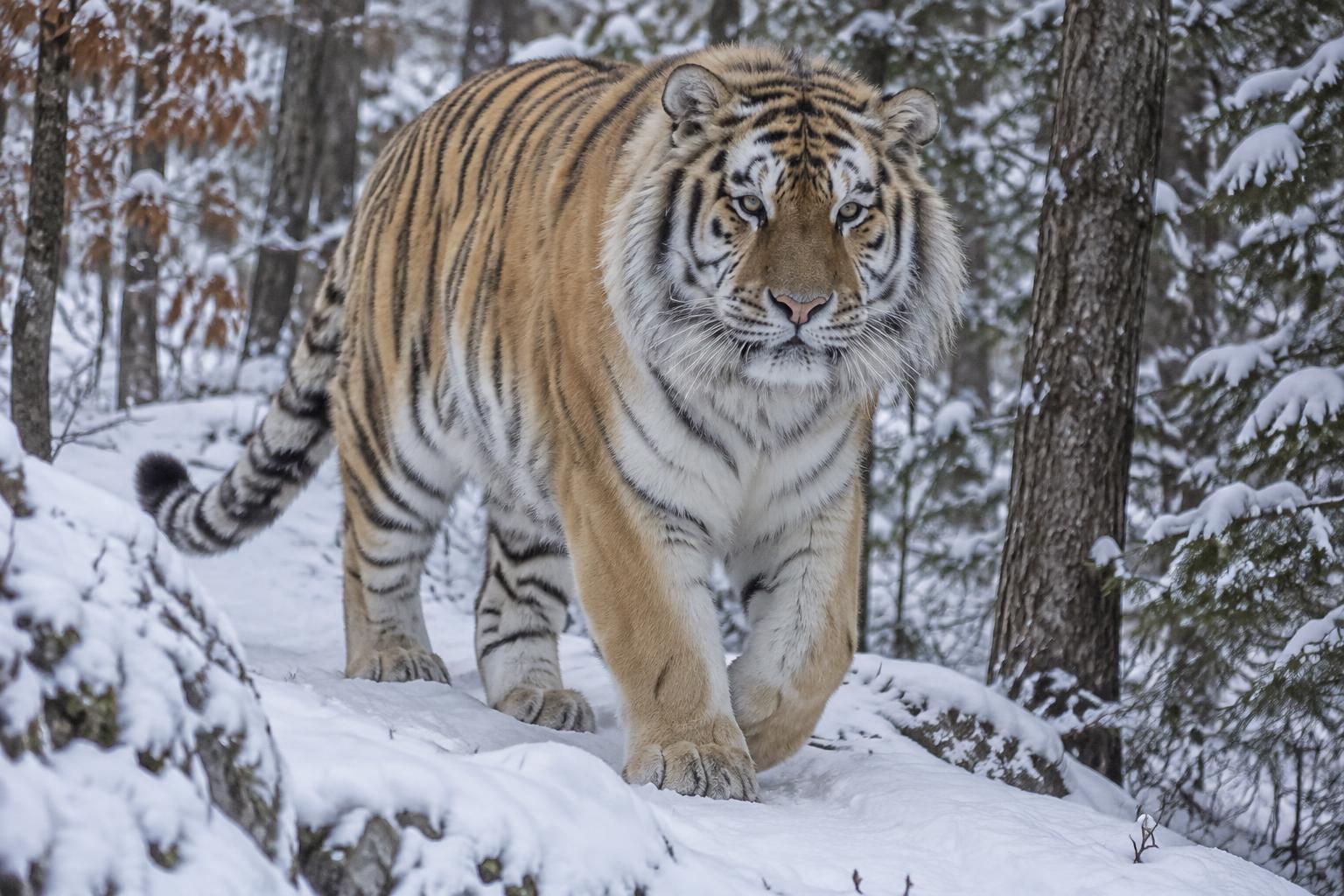 Illustrative depiction
Overview
The tiger of the snows
The Amur tiger, also known as the Siberian tiger, is the largest cat on the planet. A thick, pale winter coat lets it survive some of the coldest forests any tiger lives in.
It once ranged across the Russian Far East, northeastern China and the Korean peninsula, but it was wiped out in Korea during Japanese rule. By the 1930s hunting had left as few as 20–30 animals in Russia.
Hunting bans and protection brought it back. The IUCN moved it from Critically Endangered to Endangered in 2008, and a 2015 census counted 480–540 tigers, mostly in the Sikhote-Alin mountains. It is recovering, but still vulnerable.
Why it is nearly gone
Hunted and squeezed out
Poaching, logging and road building still threaten a population that was nearly wiped out.
Poaching
Tigers are killed for their skins and for bones and body parts used in traditional medicine.
Prey loss
Hunting of deer and wild boar leaves tigers short of food and pushes them towards villages and livestock.
Logging and roads
Logging of Korean pine and oak forests, and the roads it brings, break up habitat and open it to poachers.
A small, isolated population
Nearly all Amur tigers live in one region, so disease, fire or a poaching surge could hit the whole population.
Conservation history
Back from 20–30 animals
| Year | Event |
|---|---|
| Early 1900s–1945 | The tiger is wiped out on the Korean peninsula during Japanese rule. |
| 1930s | Hunting and habitat loss leave as few as 20–30 Amur tigers in Russia (Kaplanov, 1948). |
| 2008 | IUCN moves the Amur tiger from Critically Endangered to Endangered as numbers recover. |
| Feb 2010 | IUCN assessment estimates about 360 Amur tigers in the wild. |
| 2011 | Mohamed bin Zayed Species Conservation Fund awards a grant for Amur tiger conservation. |
| 2015 | A census counts 480–540 tigers in the Russian Far East, including about 100 cubs. |
| Today | Most survive in the Sikhote-Alin mountains of the Russian Far East. |
Take action
Who's fighting for the Amur tiger
These groups count tigers, stop poachers and protect their forests. Give to them directly.
Wild Cats Conservation Alliance
Funds tiger conservation coalitions and field projects protecting wild cats, including the Amur tiger.
Wildlife Conservation Society (Tigers)
Long-running field research and anti-poaching work for tigers, including in the Russian Far East.
Save Wild Tigers
UK charity raising awareness and funds to protect wild tigers and their habitats.
Amur Tiger Center
Russian organisation monitoring Amur tigers, running censuses and protecting their habitat.
Panthera
Global wild cat conservation organisation working to protect tigers and their prey across their range.
Global Tiger Initiative
World Bank-led partnership of tiger range countries aiming to double wild tiger numbers.
Mohamed bin Zayed Species Conservation Fund (Amur tiger)
Awarded a grant for Amur tiger conservation in 2011.
Everyday actions
What you can do from home
- 01
Never buy tiger products
Refuse skins, bone wine, balms or charms that claim to contain tiger parts.
- 02
Choose certified wood
Look for FSC-certified timber and furniture, so your purchases don't fuel illegal logging in tiger forests.
- 03
Avoid cub-petting attractions
Captive tiger selfies and cub petting keep demand for tigers as commodities alive.
- 04
Spread the word
Share how the Amur tiger came back from just 20–30 animals, and that it still needs protection.
Selected references
- IUCN Red List — Panthera tigris (all tigers)
- IUCN Red List — Panthera tigris altaica assessment (last assessed February 2010)
- Kaplanov, L. G. (1948). Tigers in Sikhote-Alin.
- Amur Tiger Center
- Global Tiger Initiative (World Bank)