Amur leopard
Panthera pardus orientalis · Russian Far East & north-east China
up from ~30 in the 1970s
The rarest big cat on Earth, surviving in a sliver of forest on the Russia–China border.
Source: WWF
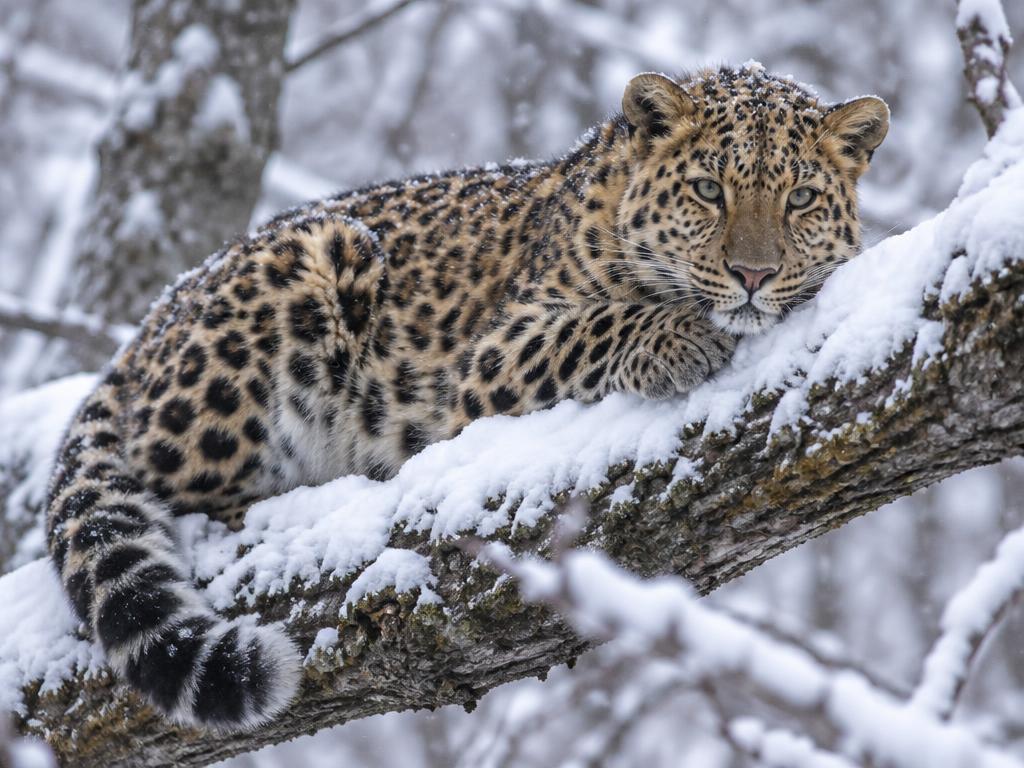 Illustrative depiction
Overview
Built for the cold, squeezed to the edge
The Amur leopard, also called the Siberian leopard, is the rarest of the eight leopard subspecies. Its long, thick, pale cream winter coat and wide-spaced rosettes set it apart from every other leopard.
It lives in temperate coniferous and broad-leaved forests on the Russia–China border, protected by Russia's "Land of the Leopard" National Park and China's North East Tiger and Leopard National Park. Camera traps now cover much of its territory on both sides.
A solitary top predator, it hunts roe deer, sika deer and wild boar. Females raise 2–3 cubs, which stay with them for two years. Mothers may move their cubs several times to keep them safe.
Why it is critically endangered
Hunted, fenced in and running out of prey
Poaching and the fur trade
Long hunted for its skin. On the Korean peninsula, leopards were exterminated at scale in the early 20th century, and the last one was captured in 1970.
Habitat loss
Deforestation, farming and fires shrank the range to under 10,000 km² by 2015. Isolated cats must travel further to find scarce prey.
A shallow gene pool
With the wild population once as low as ~30, genetic diversity remains dangerously low.
Disease and competition
With prey scarce, leopards also take dogs, risking canine distemper virus. Amur tigers can prey on them too.
Conservation history
From across East Asia to a sliver of forest
| Year | Event |
|---|---|
| Peak range | Roamed ~400,000 km² across south-east China, the Russian Far East and Korea |
| Early 1900s | Hunted at scale on the Korean peninsula for skins and to remove risks to people and livestock |
| 1970 | Last individual captured on the Korean peninsula; now thought extinct there |
| 1970s | Range reduced to ~70,000 km²; wild population as low as ~30, a severe genetic bottleneck |
| 2015 | Range estimated at under 10,000 km², less than 3% of its original territory |
| Today | ~130 in the wild and rebounding; ~200 in captivity |
Take action
Who's fighting for the Amur leopard
Vetted organisations running patrols, camera traps and captive breeding, plus zoo adoption schemes. Give to them directly.
Wild Cats Conservation Alliance
Funds camera-trap monitoring that identifies leopards by their spots
World Association of Zoos and Aquariums
Global Species Management Plan for captive breeding and reintroduction
Phoenix Fund
Russian NGO running anti-poaching patrols and monitoring
Everyday actions
What you can do from home
- 01
Reject fur and wildlife products
Never buy, gift or wear leopard skins, fur or wildlife curios. Demand is what puts a price on the last cats.
- 02
Choose sustainable timber and paper
Look for FSC-certified wood and paper to push producers away from clearing the forests of the Russian Far East.
- 03
Don't fuel the wildlife trade
Avoid curios, 'antiques' and traditional products of unknown origin, and report suspected trade.
- 04
Spread the story
Share its story, sign anti-poaching petitions and press governments to fund conservation across the border.
Selected references