Amsterdam albatross
Diomedea amsterdamensis · Amsterdam Island, southern Indian Ocean
in the wild
Sentinel of the polar winds: the rarest albatross in the world, gliding away from oblivion above the Southern Ocean.
Source: IUCN Red List (2018)
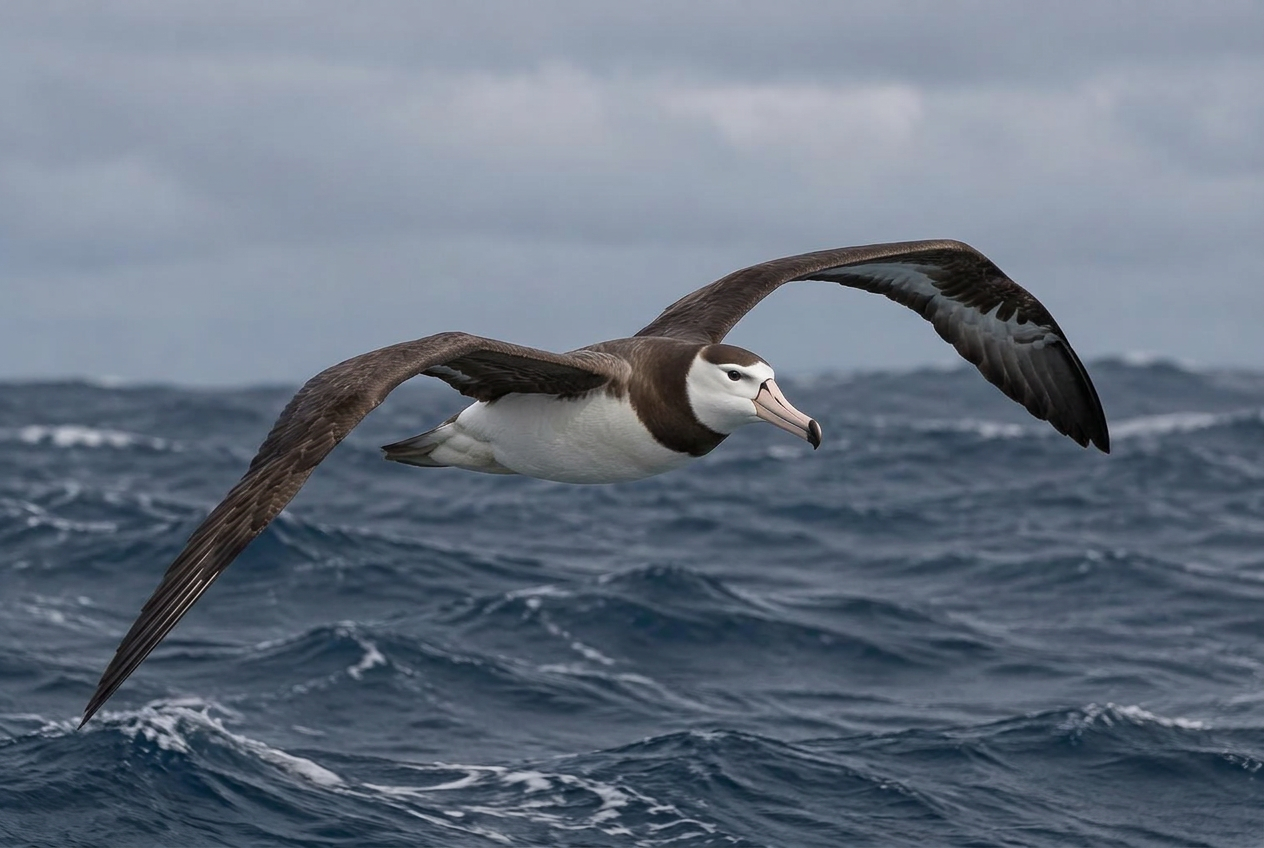 Illustrative depiction
Overview
A giant of the Southern Ocean skies
A true “great albatross” of the family Diomedeidae, it weighs up to 8 kg and has a wingspan of up to 3.4 m. It belongs to the wandering albatross complex but split from the Tristan albatross roughly 225,000–265,000 years ago, and unlike its relatives it keeps chocolate-brown upperparts as an adult, with a white face mask, throat and belly, a dark breast band and a pink bill with dark cutting edges.
Its whole life on land is bound to Amsterdam Island, a 53 km² volcanic island in the southern Indian Ocean, some 3,000 km from anywhere. The birds nest widely spaced across the marshy peat bogs of the Plateau des Tourbières. Pairs raise a single chick every two years; fledglings then stay at sea for around five years and do not breed until about age 9.
Using dynamic soaring and “wing locks” that hold their wings open, they travel up to 1,000 km from the nest when breeding and up to 3,900 km otherwise, reaching the seas off Africa and Australia. Monitoring since the early 1980s shows a slow, steady recovery to around 80–90 birds, about 40 breeding pairs.
Why it is nearly gone
Perched on the edge of extinction
A long life, few chicks and late breeding make every adult death count.
Commercial longline fishing
Tuna longlines trail miles of baited hooks that drag seabirds underwater. They may kill 2 to 16 Amsterdam albatrosses a year; losing just 6 breeding adults a year would spell extinction.
Habitat damage & alien species
Feral cattle, descended from five animals brought in the late 19th century, trampled the marshy nesting grounds and drained peat bogs. Ship rats and feral cats have also upset the island's ecosystem.
Disease outbreaks
Avian cholera and Erysipelothrix bacteria have been found in the island's seabirds. Widely scattered nests on the high plateau seem to have spared the albatross the worst so far.
A genetic bottleneck
Genetic diversity is less than half that of wandering albatrosses. The species seems to cope, but its tiny numbers leave it exposed to any sudden catastrophe.
Conservation history
A slow, steady recovery — but no room for error
| Year | Event |
|---|---|
| 1983 | First described as a distinct species (Roux et al.), separated from the wandering albatross complex. |
| Early 1980s | Long-term monitoring begins on Amsterdam Island; the population is found at a perilously low level. |
| 2010 | The feral cattle herd, descended from five animals introduced in the late 19th century, is removed; nest trampling ends. |
| 2011–2015 | France runs a National Plan of Action covering monitoring, disease surveillance and bycatch mitigation. |
| August 2018 | IUCN assessment: 92 mature individuals, increasing. |
| Today | ~80–90 birds (around 40 breeding pairs), a slow but steady climb from the historic low. |
Take action
Who's fighting for the Amsterdam albatross
These groups work at sea, on the island and in policy halls, from training fishing crews to tracking disease. Support them directly.
BirdLife International — Albatross Task Force
Founded by the RSPB and BirdLife, its instructors work on fishing vessels across the Southern Hemisphere, training crews to use bird-scaring lines, weighted hooks and night-time setting so albatrosses are not hooked and drowned.
RSPB
Co-founder of the Albatross Task Force with BirdLife International, putting mitigation instructors on longline vessels in the Southern Hemisphere.
Ligue pour la Protection des Oiseaux (LPO)
BirdLife International's French partner, helping put field conservation and action plans into practice.
Ceva Biovac Campus
Collaborates on research and health studies to combat diseases such as avian cholera affecting the island's bird populations.
Indian Ocean Tuna Commission
Works to reduce accidental seabird bycatch in the region's longline tuna fisheries.
Everyday actions
What you can do from home
- 01
Demand bird-safe certified seafood
Longline bycatch is the number one threat at sea. Buy MSC-certified or pole-and-line / troll-caught tuna and swordfish from fisheries that use weighted lines, night setting and tori lines.
- 02
Eliminate single-use plastics
Albatrosses mistake floating plastic for squid and fish eggs and feed it to their chicks. Cut single-use plastic, join beach cleanups and support circular packaging.
- 03
Support international treaty advocacy
The birds fly through waters managed by South Africa, Australia, Madagascar, Mauritius, Namibia and the high seas. Back groups pushing for compliance with ACAP.
- 04
Donate to on-the-ground work
Donations fund on-board bycatch instructors, peat-bog restoration on the Plateau des Tourbières and disease surveillance on Amsterdam Island.
Selected references
- IUCN Red List — Diomedea amsterdamensis (last assessed August 2018)
- Agreement on the Conservation of Albatrosses and Petrels (ACAP)
- CNRS & TAAF (Terres australes et antarctiques françaises) — research and monitoring on Amsterdam Island
- One Earth — Species of the week: Amsterdam albatross
- BirdLife International — Albatross Task Force
- Ceva — Protecting the Amsterdam Island albatross