African wedgefish
Rhynchobatus luebberti · Gulf of Guinea & West African coast
but decreasing (IUCN, 2018)
A huge, shark-like ray of West Africa's shallow coasts, disappearing into the global shark-fin trade before anyone could count it.
Source: IUCN Red List (December 2018)
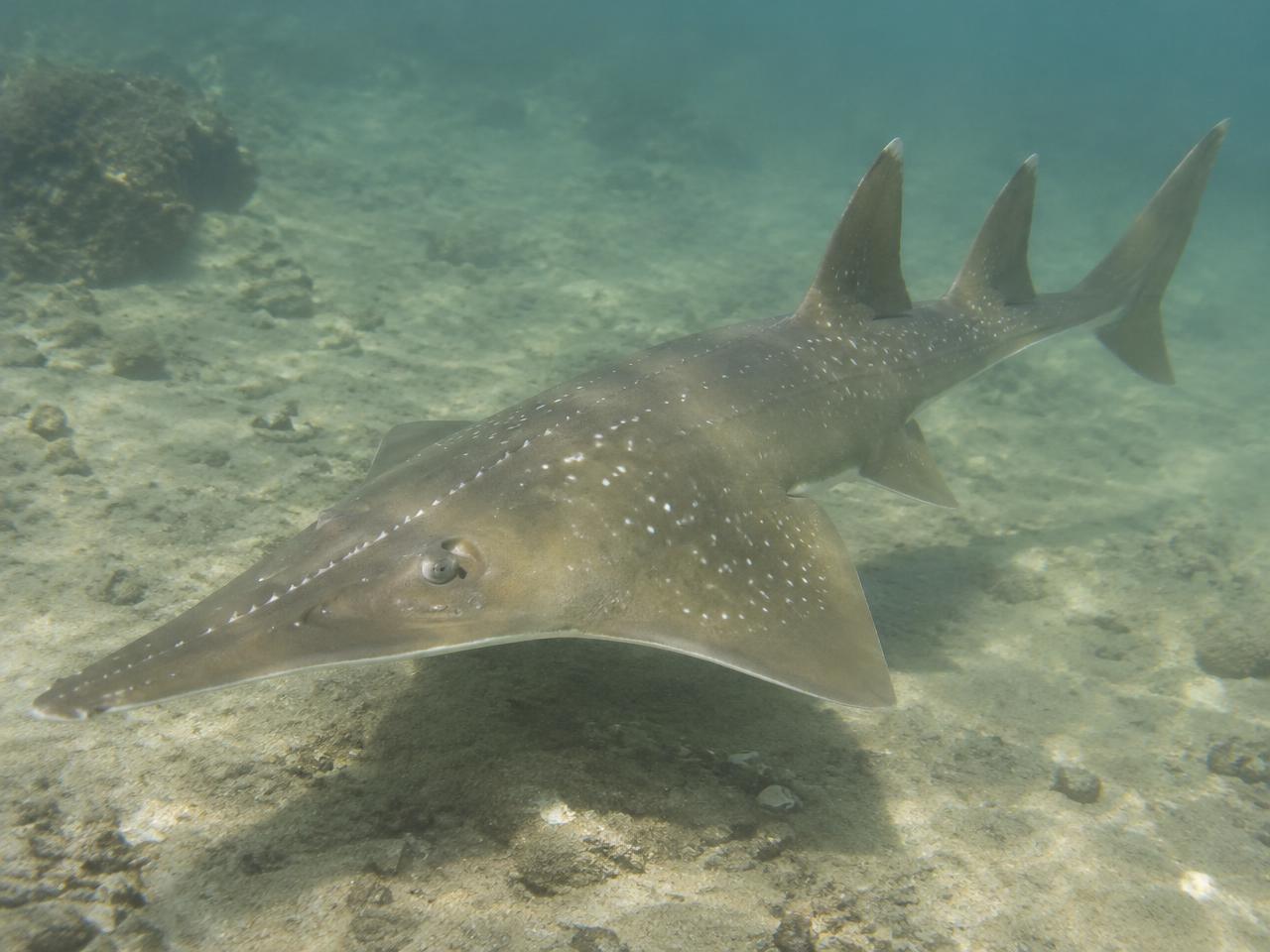 Illustrative depiction
Overview
Half shark, half ray
The African wedgefish, also called the spikenose wedgefish or Lubbert's guitarfish, is one of the shovelnose rays. It has a flat, pointed, wedge-shaped head and a thick shark-like body and tail, and can grow to about 3 m long. Its pale grey to olive-brown back is scattered with white spots, with thorns along the ridges of its snout.
It lives in warm, shallow coastal waters of the eastern Atlantic, along much of Africa's west coast and centred on the Gulf of Guinea, down to about 35 m deep. Mostly active at night, it feeds on small fishes and invertebrates on the seabed.
No one knows how many are left, but numbers are falling fast. In December 2018 the IUCN assessed it as Critically Endangered. Its eggs hatch inside the mother, and it lives only about 15 years, so it cannot recover quickly from heavy fishing.
Why it is critically endangered
Worth more for its fins than alive
Wedgefishes are among the most threatened fish families on Earth (Kyne et al., 2020).
The fin trade
Wedgefishes, sawfishes and giant guitarfishes have 'white' fins, among the most valuable in the trade for shark-fin soup in Asia.
Overfishing
Coastal fisheries along West Africa catch wedgefish with nets and lines, both as a target and for their meat.
Bycatch
Many are caught by accident in trawls and gillnets set for other fish, and few survive.
Habitat loss
The shallow coastal waters it depends on are being degraded by development and pollution along the West African coast.
Conservation history
From overlooked to Critically Endangered
| Year | Event |
|---|---|
| 1915 | Described by science as Rhynchobatus luebberti. |
| 2006 | Listed by the IUCN as Endangered. |
| 2018 | IUCN reassesses it as Critically Endangered, after steep declines across West Africa. |
| 2019 | Wedgefishes added to CITES Appendix II, so international trade in their fins must be regulated. |
| 2020 | Kyne et al. find wedgefishes and giant guitarfishes are among the most threatened fish families on Earth. |
Take action
Who's fighting for the African wedgefish
Researchers and local communities tracking wedgefish in markets and at sea, and building protection in Ghana and beyond.
Save Our Seas Foundation
Funds DNA barcoding and biomonitoring to track the African wedgefish in markets and the wild.
Conservation Leadership Programme
Supports research and community-led conservation of giant guitarfishes and wedgefishes in Ghana.
Oceanographic Research Institute (SAAMBR)
Scientific studies mapping the coastal movements and habitat vulnerabilities of wedgefish populations.
Van Tienhoven Foundation
Funds a project to save the African wedgefish and blackchin guitarfish in Ghana.
Everyday actions
What you can do from home
- 01
Never eat shark-fin soup
Refuse shark-fin soup and fin products. Wedgefish fins are among the most prized, so demand drives the killing.
- 02
Choose sustainable seafood
Buy from well-managed fisheries, using guides such as the Marine Stewardship Council label, to reduce bycatch.
- 03
Support marine protected areas
Back campaigns for protected coastal areas in West Africa, where wedgefish feed and breed.
- 04
Spread the story
Few people have heard of wedgefishes. Share their story so they get the same attention as sharks.
Selected references
- IUCN Red List — Rhynchobatus luebberti (last assessed December 2018)
- FishBase — Rhynchobatus luebberti
- Jabado, R.W., 2019. Wedgefishes and giant guitarfishes: a guide to species identification. Wildlife Conservation Society, New York.
- Kyne, P.M., Jabado, R.W., Rigby, C.L., Dharmadi, Gore, M.A., Pollock, C.M., Herman, K.B., Cheok, J., Ebert, D.A., Simpfendorfer, C.A. and Dulvy, N.K., 2020. The thin edge of the wedge: extremely high extinction risk in wedgefishes and giant guitarfishes. Aquatic Conservation: Marine and Freshwater Ecosystems, 30(7), pp.1337–1361.
- Save Our Seas Foundation — Barcode for survival: protecting Africa's wedgefish through genetics
- Fins United — African wedgefish (archived)