Addax
Addax nasomaculatus · Niger, Sahara
The white antelope of the Sahara has lost 99% of its range. Thousands live in zoos and on ranches, but almost none remain free.
Source: IUCN Red List (April 2016)
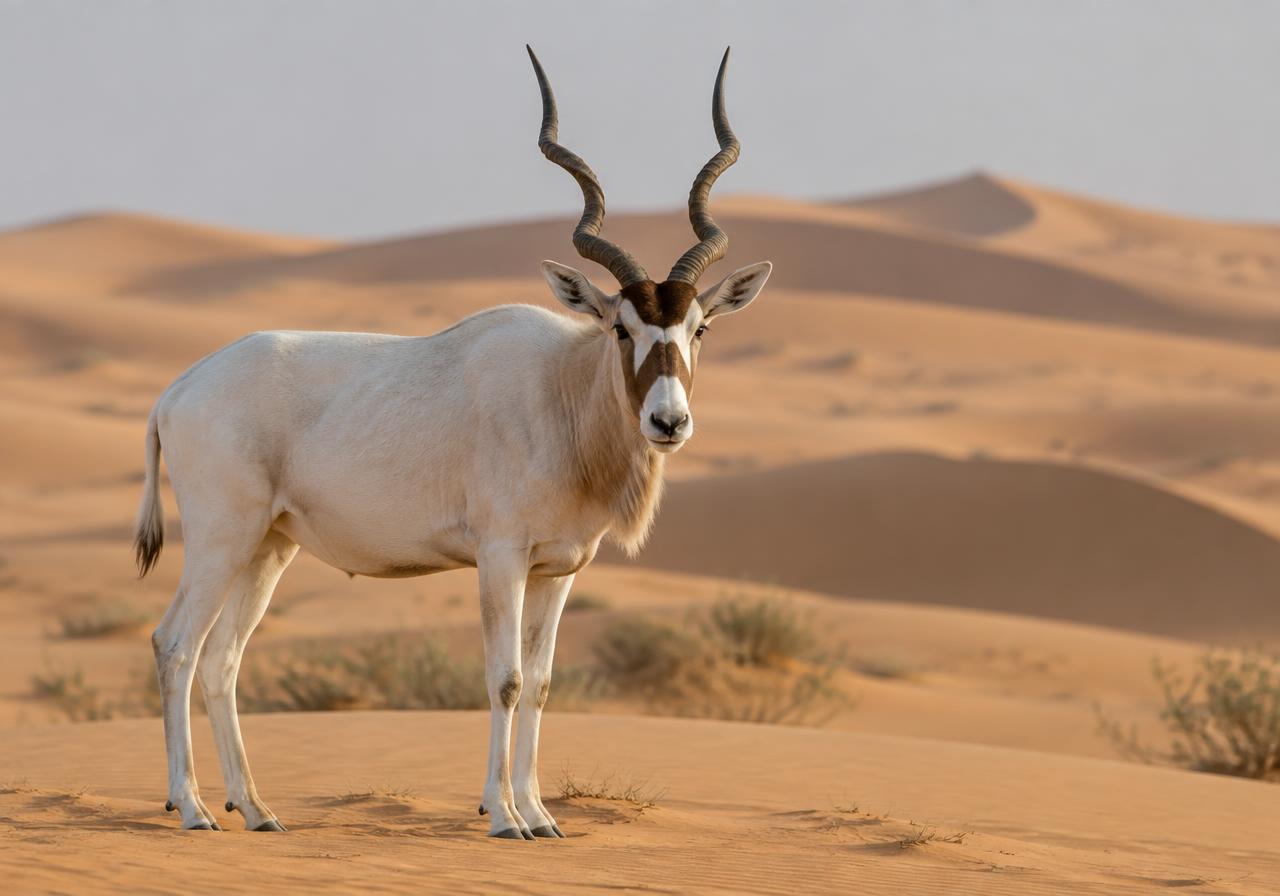 Illustrative depiction
Overview
Built for the dunes
Also called the white antelope or screw-horned antelope, the addax stands up to 130 cm at the shoulder. Its coat is white or blonde in summer to reflect the sun, turning greyish-brown in winter. It has a dark X-shaped patch across its nose, and males and females both carry long spiral horns with ringed ridges, up to 80 cm long.
It lives in sand dunes, gravel plains and dry scrub where the Sahel meets the Sahara. Wide hooves work like snowshoes on loose sand, and it rarely drinks, getting almost all its water from dew and the plants it eats. Small herds of 5 to 20 travel long distances to follow the rain.
Females have a single calf of about 5 kg after a nine-month pregnancy. Addax live up to 19 years in the wild and 25 in zoos. The only confirmed wild breeding group is in Niger's Termit and Tin Toumma reserve, with unconfirmed reports of a few near the Mali–Mauritania border.
Why it is nearly gone
A disaster made by people
Fewer than 300 were left in 2010. Six years later, surveys found a handful.
Hunting with guns and vehicles
Addax escape by running until exhausted, which makes them easy to chase down with 4x4s and rifles.
Oil and mining
Exploration crews hunted unmonitored, and Niger shrank the addax's last reserve to make way for oil drilling.
Farming and livestock
Cattle and goats compete for scarce grazing, and new waterholes push shy addax off feeding grounds.
Conflict
Years of unrest across the Sahara-Sahel border lands leave the last herds unprotected from armed poachers.
Conservation history
From Egyptian tombs to a handful
| Year | Event |
|---|---|
| ~2500 BC | Painted in ancient Egyptian tombs |
| 1816 | Described by French zoologist Henri de Blainville |
| 1800s | Found across the Sahelo-Saharan belt; since then it has lost about 99% of its range |
| After 1945 | Automatic rifles and 4x4 vehicles turn hunting into slaughter |
| 1985 | 8 addax reintroduced to Bou Hedma National Park, Tunisia |
| 1988 | 6 females from the US join the Tunisian herd |
| 2007 | Herds moved to Jbil and Senghar-Jabbes parks in Tunisia, plus 13 zoo-bred animals |
| 2010 | No more than 300 left in the wild |
| 2016–17 | Surveys in Niger's Termit and Tin Toumma reserve find only 3–6 |
| Dec 2024 | IUCN assessment estimates 30–90 left in the wild |
| Today | Close to extinction in the wild; ~760 in zoos and over 5,000 on private ranches |
Take action
Who's fighting for the addax
The addax survives in captivity, so the hope is to protect the last wild animals and release zoo-bred herds into safe reserves.
Sahara Conservation
Field surveys, protection and reintroduction of Sahara antelopes, including the addax
Everyday actions
What you can do from home
- 01
Back clean energy
Less demand for oil means less pressure to drill in wild places like Termit and Tin Toumma.
- 02
Buy traceable goods
Choose leather and animal products from certified sources to starve the illegal wildlife trade.
- 03
Share overlooked species
Telling people about the addax helps raise it up the conservation agenda.
- 04
Support reintroductions
Releases in Tunisia and Morocco show it works; they need steady funding.
Selected references